



Question: Mr. Donaldson knew he needed a plan, yet midwinter was the busiest time of the year at the shelter, and the laundry was piling up
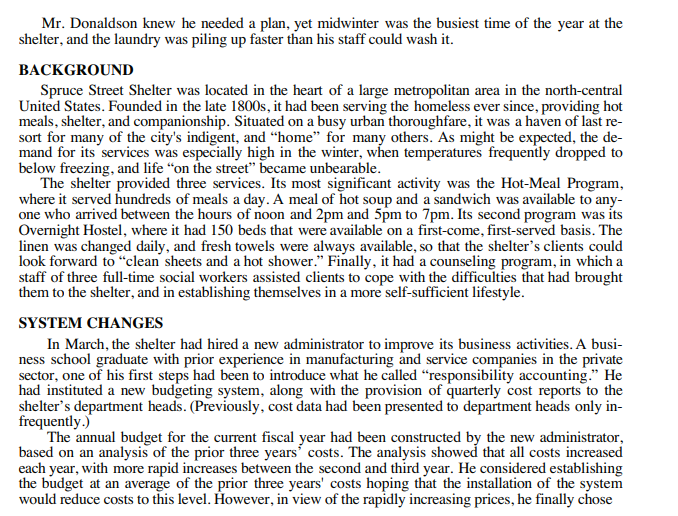
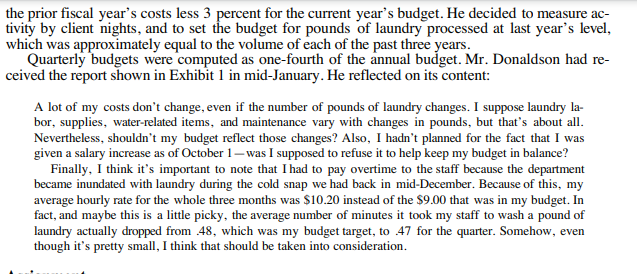
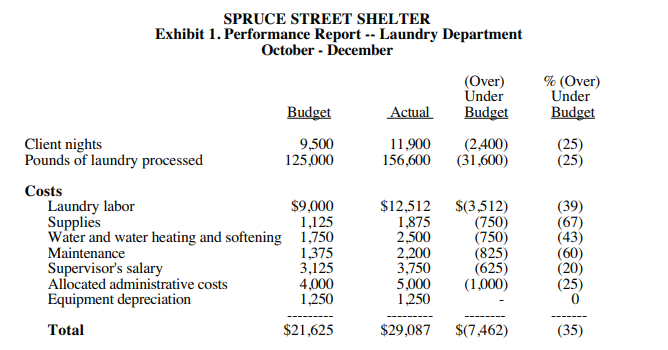


Mr. Donaldson knew he needed a plan, yet midwinter was the busiest time of the year at the shelter, and the laundry was piling up faster than his staff could wash it. BACKGROUND Spruce Street Shelter was located in the heart of a large metropolitan area in the north-central United States. Founded in the late 1800s, it had been serving the homeless ever since, providing hot meals, shelter, and companionship. Situated on a busy urban thoroughfare, it was a haven of last re- sort for many of the city's indigent, and home for many others. As might be expected, the de- mand for its services was especially high in the winter, when temperatures frequently dropped to below freezing, and life "on the street" became unbearable. The shelter provided three services. Its most significant activity was the Hot-Meal Program, where it served hundreds of meals a day. A meal of hot soup and a sandwich was available to any- one who arrived between the hours of noon and 2pm and 5pm to 7pm. Its second program was its Overnight Hostel, where it had 150 beds that were available on a first-come, first-served basis. The linen was changed daily, and fresh towels were always available, so that the shelter's clients could look forward to clean sheets and a hot shower. Finally, it had a counseling program, in which a staff of three full-time social workers assisted clients to cope with the difficulties that had brought them to the shelter, and in establishing themselves in a more self-sufficient lifestyle. SYSTEM CHANGES In March, the shelter had hired a new administrator to improve its business activities. A busi- ness school graduate with prior experience in manufacturing and service companies in the private sector, one of his first steps had been to introduce what he called responsibility accounting." He had instituted a new budgeting system, along with the provision of quarterly cost reports to the shelter's department heads. (Previously, cost data had been presented to department heads only in- frequently.) The annual budget for the current fiscal year had been constructed by the new administrator, based on an analysis of the prior three years' costs. The analysis showed that all costs increased each year, with more rapid increases between the second and third year. He considered establishing the budget at an average of the prior three years' costs hoping that the installation of the system would reduce costs to this level. However, in view of the rapidly increasing prices, he finally chose the prior fiscal year's costs less 3 percent for the current year's budget. He decided to measure ac- tivity by client nights, and to set the budget for pounds of laundry processed at last year's level, which was approximately equal to the volume of each of the past three years. Quarterly budgets were computed as one-fourth of the annual budget. Mr. Donaldson had re- ceived the report shown in Exhibit 1 in mid-January. He reflected on its content: A lot of my costs don't change, even if the number of pounds of laundry changes. I suppose laundry la- bor, supplies, water-related items, and maintenance vary with changes in pounds, but that's about all. Nevertheless, shouldn't my budget reflect those changes? Also, I hadn't planned for the fact that I was given a salary increase as of October 1 was I supposed to refuse it to help keep my budget in balance? Finally, I think it's important to note that I had to pay overtime to the staff because the department became inundated with laundry during the cold snap we had back in mid-December. Because of this, my average hourly rate for the whole three months was $10.20 instead of the $9.00 that was in my budget. In fact, and maybe this is a little picky, the average number of minutes it took my staff to wash a pound of laundry actually dropped from 48, which was my budget target, to .47 for quarter. Somehow, even though it's pretty small, I think that should be taken into consideration. % (Over) Under Budget (25) (25) SPRUCE STREET SHELTER Exhibit 1. Performance Report -- Laundry Department October - December (Over) Under Budget Actual Budget Client nights 9,500 11,900 (2,400) Pounds of laundry processed 125,000 156,600 (31,600) Costs Laundry labor $9,000 $12,512 $(3,512) Supplies 1.125 1,875 (750) Water and water heating and softening 1,750 2,500 (750) Maintenance 1,375 2,200 (825) Supervisor's salary 3,125 3,750 (625) Allocated administrative costs 4,000 5,000 (1,000) Equipment depreciation 1,250 1,250 Total $21,625 $29,087 $(7,462) (39) (67) (43) (35) Assignment 3. Compute the appropriate labor variances. What do they tell you? What should Mr. Donaldson tell the administrator about his budget variances? 4
Step by Step Solution
There are 3 Steps involved in it

Get step-by-step solutions from verified subject matter experts