Question: Mr. Fields was a keynote speaker at the Consumer Electronics Show in Las Vegas Tuesday. In his speech, he covered how Ford was trying to
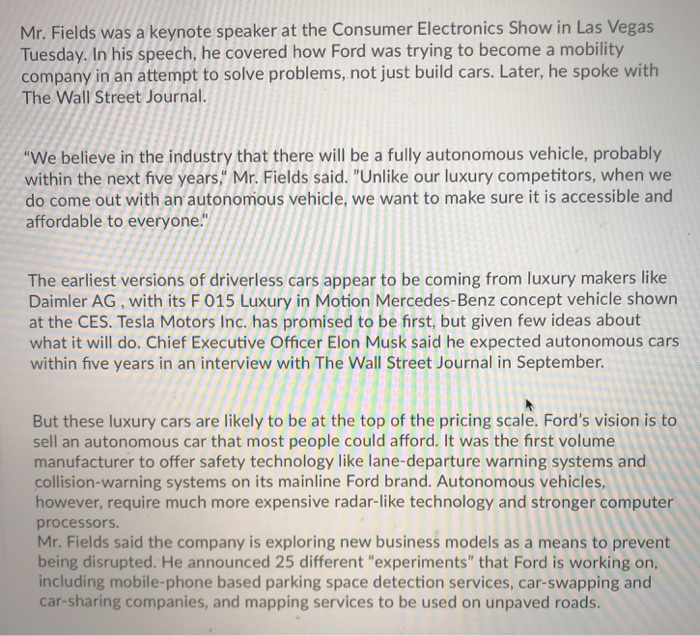
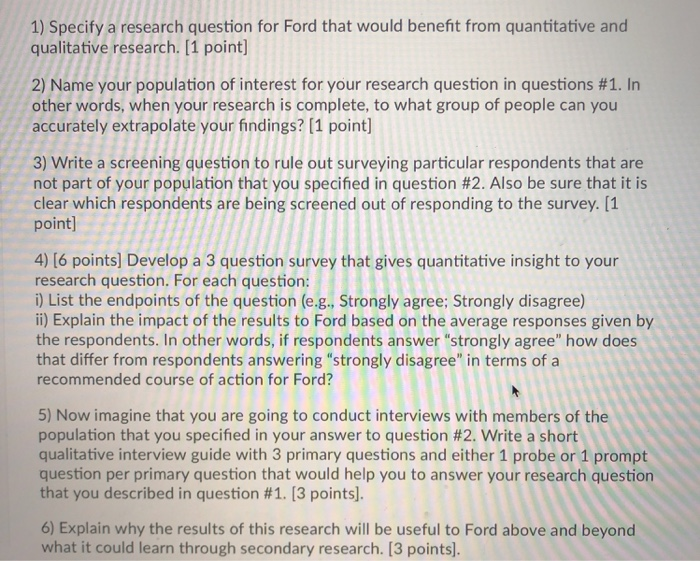
Mr. Fields was a keynote speaker at the Consumer Electronics Show in Las Vegas Tuesday. In his speech, he covered how Ford was trying to become a mobility company in an attempt to solve problems, not just build cars. Later, he spoke with The Wall Street Journal. "We believe in the industry that there will be a fully autonomous vehicle, probably within the next five years," Mr. Fields said. "Unlike our luxury competitors, when we do come out with an autonomous vehicle, we want to make sure it is accessible and affordable to everyone." The earliest versions of driverless cars appear to be coming from luxury makers like Daimler AG , with its F015 Luxury in Motion Mercedes-Benz concept vehicle shown at the CES. Tesla Motors Inc. has promised to be first, but given few ideas about what it will do. Chief Executive Officer Elon Musk said he expected autonomous cars within five years in an interview with The Wall Street Journal in September. But these luxury cars are likely to be at the top of the pricing scale. Ford's vision is to sell an autonomous car that most people could afford. It was the first volume manufacturer to offer safety technology like lane-departure warning systems and collision-warning systems on its mainline Ford brand. Autonomous vehicles, however, require much more expensive radar-like technology and stronger computer processors. Mr. Fields said the company is exploring new business models as a means to prevent being disrupted. He announced 25 different "experiments" that Ford is working on, including mobile phone based parking space detection services, car-swapping and car-sharing companies, and mapping services to be used on unpaved roads. 1) Specify a research question for Ford that would benefit from quantitative and qualitative research. [1 point] 2) Name your population of interest for your research question in questions #1. In other words, when your research is complete, to what group of people can you accurately extrapolate your findings? [1 point] 3) Write a screening question to rule out surveying particular respondents that are not part of your population that you specified in question #2. Also be sure that it is clear which respondents are being screened out of responding to the survey. [1 point] 4) [6 points] Develop a 3 question survey that gives quantitative insight to your research question. For each question: i) List the endpoints of the question (e.g., Strongly agree; Strongly disagree) ii) Explain the impact of the results to Ford based on the average responses given by the respondents. In other words, if respondents answer "strongly agree" how does that differ from respondents answering "strongly disagree" in terms of a recommended course of action for Ford? 5) Now imagine that you are going to conduct interviews with members of the population that you specified in your answer to question #2. Write a short qualitative interview guide with 3 primary questions and either 1 probe or 1 prompt question per primary question that would help you to answer your research question that you described in question #1. [3 points) 6) Explain why the results of this research will be useful to Ford above and beyond what it could learn through secondary research. [3 points)









 Study Help