



Question: multiple chioce, no explanation necessary. Please answer all parts, thanks! 1. Which of the following statements about hardhats is not true? a. Class E hardhats
multiple chioce, no explanation necessary. Please answer all parts, thanks!
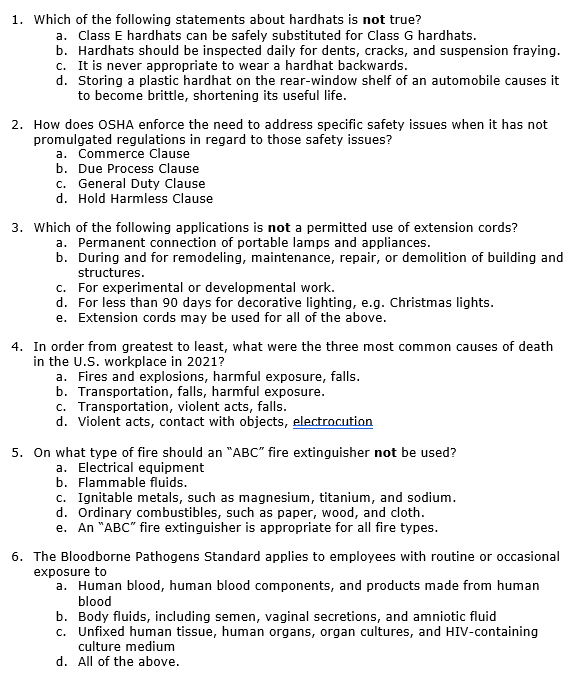
1. Which of the following statements about hardhats is not true? a. Class E hardhats can be safely substituted for Class G hardhats. b. Hardhats should be inspected daily for dents, cracks, and suspension fraying. c. It is never appropriate to wear a hardhat backwards. d. Storing a plastic hardhat on the rear-window shelf of an automobile causes it to become brittle, shortening its useful life. 2. How does OSHA enforce the need to address specific safety issues when it has not promulgated regulations in regard to those safety issues? a. Commerce Clause b. Due Process Clause c. General Duty Clause d. Hold Harmless Clause 3. Which of the following applications is not a permitted use of extension cords? a. Permanent connection of portable lamps and appliances. b. During and for remodeling, maintenance, repair, or demolition of building and structures. c. For experimental or developmental work. d. For less than 90 days for decorative lighting, e.g. Christmas lights. e. Extension cords may be used for all of the above. 4. In order from greatest to least, what were the three most common causes of death in the U.S. workplace in 2021? a. Fires and explosions, harmful exposure, falls. b. Transportation, falls, harmful exposure. c. Transportation, violent acts, falls. d. Violent acts, contact with objects, electrocution 5. On what type of fire should an "ABC" fire extinguisher not be used? a. Electrical equipment b. Flammable fluids. c. Ignitable metals, such as magnesium, titanium, and sodium. d. Ordinary combustibles, such as paper, wood, and cloth. e. An"ABC"fireextinguisherisappropriateforallfiretypes. 6. The Bloodborne Pathogens Standard applies to employees with routine or occasional exposure to a. Human blood, human blood components, and products made from human blood b. Body fluids, including semen, vaginal secretions, and amniotic fluid c. Unfixed human tissue, human organs, organ cultures, and HIV-containing culture medium d. All of the above
Step by Step Solution
There are 3 Steps involved in it

Get step-by-step solutions from verified subject matter experts