





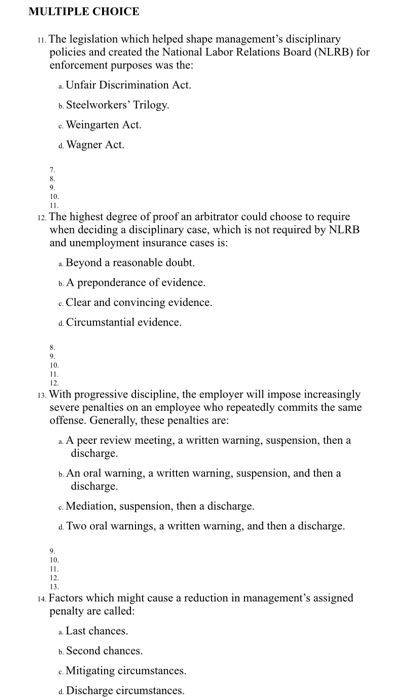
Question: MULTIPLE CHOICE 11. The legislation which helped shape management's disciplinary policies and created the National Labor Relations Board (NLRB) for enforcement purposes was the: Unfair
MULTIPLE CHOICE 11. The legislation which helped
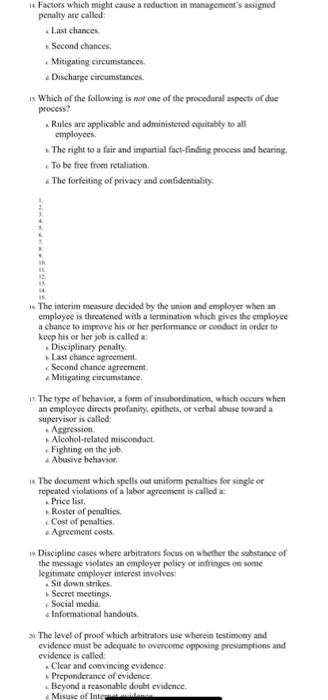
MULTIPLE CHOICE 11. The legislation which helped shape management's disciplinary policies and created the National Labor Relations Board (NLRB) for enforcement purposes was the: Unfair Discrimination Act. b. Steelworkers' Trilogy 6. Weingarten Act 4. Wagner Act. 7. 8 9. 10 11 12. The highest degree of proof an arbitrator could choose to require when deciding a disciplinary case, which is not required by NLRB and unemployment insurance cases is: Beyond a reasonable doubt. b. A preponderance of evidence. Clear and convincing evidence. 1. Circumstantial evidence. 8. 10. 11. 13. With progressive discipline, the employer will impose increasingly severe penalties on an employee who repeatedly commits the same offense. Generally, these penalties are: A peer review meeting, a written warning, suspension, then a discharge. b. An oral warning, a written warning, suspension, and then a discharge. c. Mediation, suspension, then a discharge. d. Two oral warnings, a written warning, and then a discharge. 9. 10 12 14. Factors which might cause a reduction in management's assigned penalty are called Last chances. 1. Second chances c. Mitigating circumstances. 4. Discharge circumstances. 14. Factors which might cause a reduction in management's assigned penalty are called Last chances Second chances Mitigating circumstances, 4 Discharge circumstances. 1s Which of the following is not one of the procedural aspects of due process? Rules are applicable and administered equitably to all employees The right to a fair and impartial fact-finding process and hearing. To be free from retaliation The forfeiting of privacy and confidentiality. 13 15 The interim measure decided by the union and employer when an employee is threatened with a termination which gives the employee a chance to improve his or her performance or conduct in order to keep his or her job is called a: Disciplinary penalty Last chance agreement. Second chance agreement Mitigating circumstance. 11. The type of behavior, a form of insubordination, which occurs when an employee directs profanity, epithets, or verbal abuse toward a supervisor is called Aggression Alcohol-related misconduct Fighting on the job Abusive behavior IR The document which spells out uniform penalties for single or repeated violations of a labor agreement is called a Price list Roster of penalties. Cost of penalties Agreement costs 19 Discipline cases where arbitrators focus on whether the substance of the message violates an employer policy or infringes on some legitimate employer interest involves: Sit down strikes Secret meetings Social media. Informational handouts. The level of proof which arbitrators use wherein testimony and evidence must be adequate to overcome opposing presumptions and evidence is called Clear and convincing evidence. Preponderance of evidence Beyond a reasonable doubt evidence. Misuse of Intl

Step by Step Solution

There are 3 Steps involved in it

1 Expert Approved Answer
Step: 1 Unlock blur-text-image

Question Has Been Solved by an Expert!

Get step-by-step solutions from verified subject matter experts

Step: 2 Unlock
Step: 3 Unlock

Students Have Also Explored These Related General Management Questions!