







Question: multiple choice 17. What is the difference between an isoquant and an indifference curve? (a) Multiple isoquants can be ranked and multiple indifference curves are
multiple choice
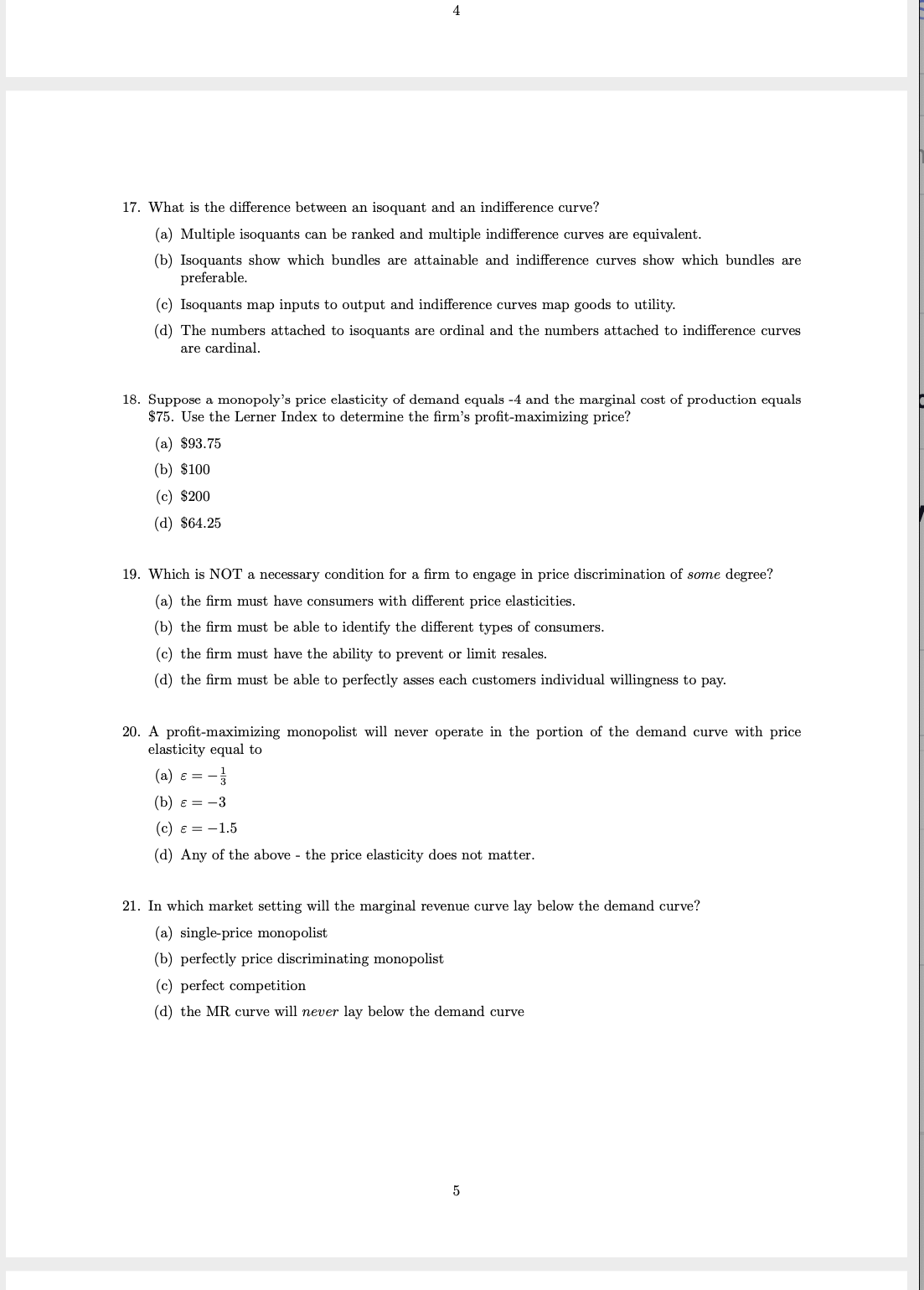
17. What is the difference between an isoquant and an indifference curve? (a) Multiple isoquants can be ranked and multiple indifference curves are equivalent. (b) Isoquants show which bundles are attainable and indifference curves show which bundles are preferable. (c) Isoquants map inputs to output and indifference curves map goods to utility. (d) The numbers attached to isoquants are ordinal and the numbers attached to indifference curves are cardinal. 18. Suppose a monopoly's price elasticity of demand equals -4 and the marginal cost of production equals $75. Use the Lerner Index to determine the rm's prot-mandinizing price? (a) $93.75 (b) $100 (a) $200 (cl) $64.25 19. \"rhich is NOT a necessary condition for a rm to engage in price discrimination of some degree? (a) the rm must have consumers with different price elasticities. (b) the rm must be able to identify the different types of consumers. (c) the rm must have the ability to prevent or limit resales. (d) the rm must be able to perfectly asses each customers individual willingness to pay. 20. A prot-maximizing monopolist will never operate in the portion of the demand curve with price elasticity equal to (a) s=% (b) 3 (c) 1.5 (d) E 6 Any of the above - the price elasticity does not matter. 21. In which market setting will the marginal revenue curve lay below the demand curve? (a) single-price monopolist (b) perfectly price discriminating monopolist (c) perfect competition (d) the MR curve will never lay below the demand curve
Step by Step Solution
There are 3 Steps involved in it

Get step-by-step solutions from verified subject matter experts
 Study Help