





Question: Multiple Choice Answer with short explanation 1. It is any contract that evidences a residual interest in the assets of an entity after deducting all

Multiple Choice

Answer with short explanation
Multiple Choice Answer with short explanation 1.Multiple Choice Answer with short explanation 1.
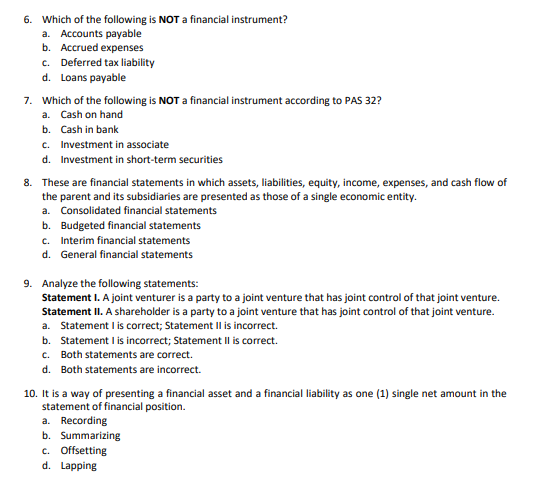
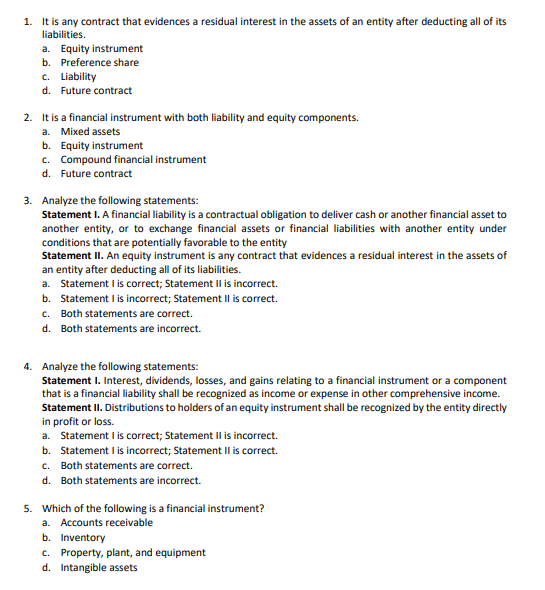
1. It is any contract that evidences a residual interest in the assets of an entity after deducting all of its liabilities. a. Equity instrument b. Preference share C. Liability d. Future contract 2. It is a financial instrument with both liability and equity components. Mixed assets b. Equity instrument . Compound financial instrument d. Future contract 3. Analyze the following statements: Statement I. A financial liability is a contractual obligation to deliver cash or another financial asset to another entity, or to exchange financial assets or financial liabilities with another entity under conditions that are potentially favorable to the entity Statement II. An equity instrument is any contract that evidences a residual interest in the assets of an entity after deducting all of its liabilities. Statement I is correct; Statement II is incorrect. b. Statement I is incorrect; Statement II is correct. c. Both statements are correct. d. Both statements are incorrect. 4. Analyze the following statements: Statement I. Interest, dividends, losses, and gains relating to a financial instrument or a component that is a financial liability shall be recognized as income or expense in other comprehensive income. Statement II. Distributions to holders of an equity instrument shall be recognized by the entity directly in profit or loss. a. Statement I is correct; Statement II is incorrect. b. Statement I is incorrect; Statement II is correct. C. Both statements are correct. d. Both statements are incorrect. 5. Which of the following is a financial instrument? a. Accounts receivable b. Inventory c. Property, plant, and equipment d. Intangible assets6. Which of the following is NOT a financial instrument? a. Accounts payable b. Accrued expenses C. Deferred tax liability d. Loans payable 7. Which of the following is NOT a financial instrument according to PAS 32? a. Cash on hand b. Cash in bank C. Investment in associate d. Investment in short-term securities 8. These are financial statements in which assets, liabilities, equity, income, expenses, and cash flow of the parent and its subsidiaries are presented as those of a single economic entity. a. Consolidated financial statements b. Budgeted financial statements c. Interim financial statements d. General financial statements 9. Analyze the following statements: Statement I. A joint venturer is a party to a joint venture that has joint control of that joint venture. Statement II. A shareholder is a party to a joint venture that has joint control of that joint venture. a. Statement I is correct; Statement Il is incorrect. b. Statement I is incorrect; Statement II is correct. c. Both statements are correct d. Both statements are incorrect. 10. It is a way of presenting a financial asset and a financial liability as one (1) single net amount in the statement of financial position. a. Recording b. Summarizing c. Offsetting d. Lapping

Step by Step Solution

There are 3 Steps involved in it

1 Expert Approved Answer
Step: 1 Unlock blur-text-image

Question Has Been Solved by an Expert!

Get step-by-step solutions from verified subject matter experts

Step: 2 Unlock
Step: 3 Unlock

Students Have Also Explored These Related Accounting Questions!