





Question: MULTIPLE CHOICE. Choose the one alternative that best completes the statement or answers the question. 1) Operations is: 1) A) both a basic function and
MULTIPLE CHOICE. Choose the one alternative thatMULTIPLE CHOICE. Choose the one alternative that

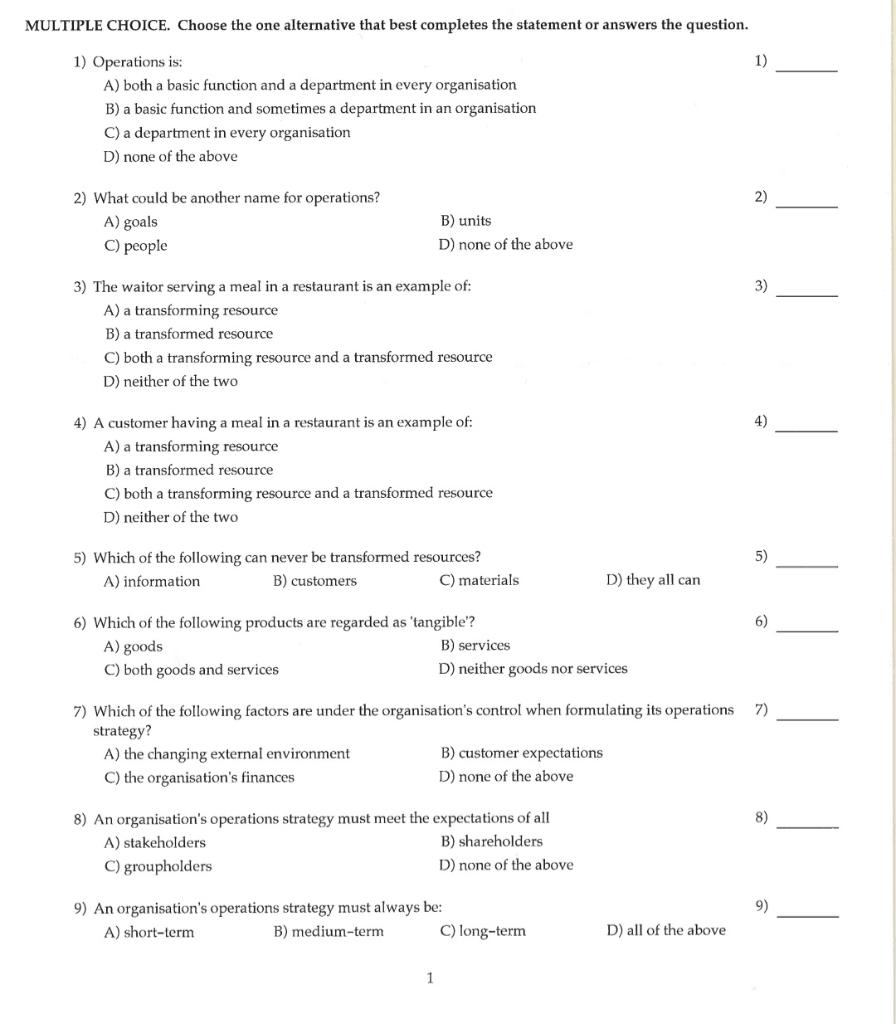
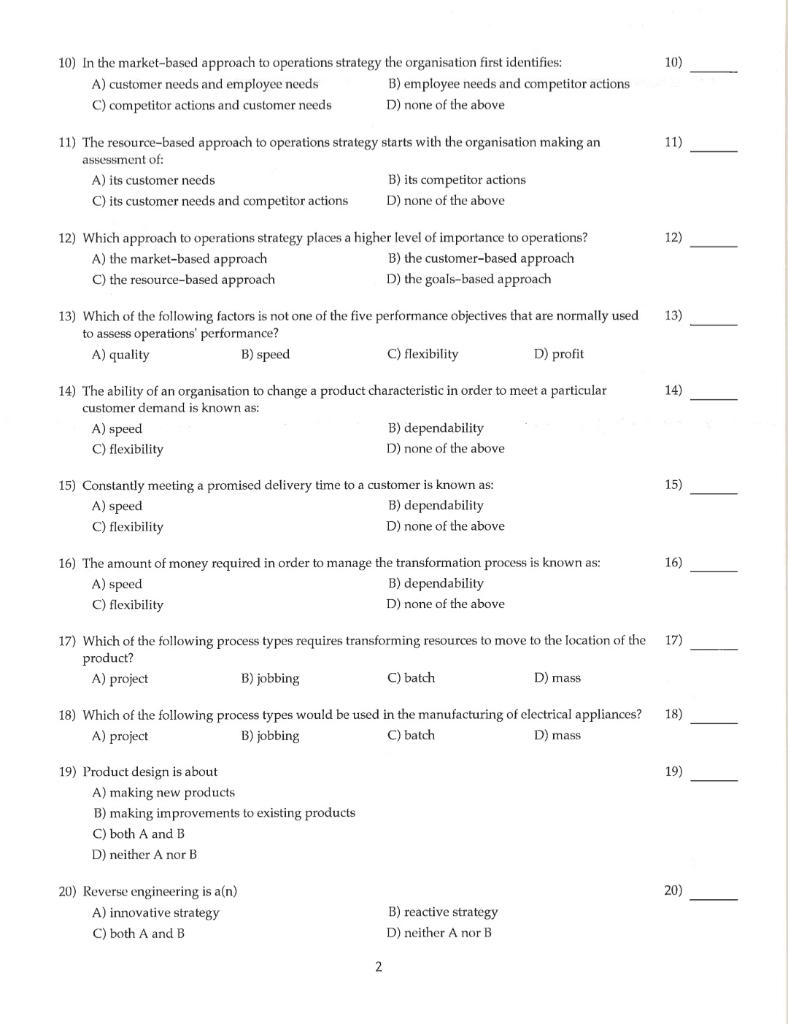
MULTIPLE CHOICE. Choose the one alternative that best completes the statement or answers the question. 1) Operations is: 1) A) both a basic function and a department in every organisation B) a basic function and sometimes a department in an organisation C) a department in every organisation D) none of the above 2) What could be another name for operations? A) goals B) units 2) C) people D) none of the above 3) The waitor serving a meal in a restaurant is an example of: A) a transforming resource B) a transformed resource C) both a transforming resource and a transformed resource D) neither of the two 4) A customer having a meal in a restaurant is an example of: 3) A) a transforming resource B) a transformed resource C) both a transforming resource and a transformed resource D) neither of the two 5) Which of the following can never be transformed resources? 4) A) information B) customers C) materials D) they all can 5) 6) Which of the following products are regarded as 'tangible'? A) goods B) services C) both goods and services D) neither goods nor services 7) Which of the following factors are under the organisation's control when formulating its operations 6) strategy? A) the changing external environment B) customer expectations C) the organisation's finances D) none of the above 8) An organisation's operations strategy must meet the expectations of all 7) A) stakeholders B) shareholders C) groupholders D) none of the above 9) An organisation's operations strategy must always be: 8) A) short-term B) medium-term C) long-term D) all of the above 9) 10) In the market-based approach to operations strategy the organisation first identifies: 10) A) customer needs and employee needs B) employee needs and competitor actions C) competitor actions and customer needs D) none of the above 11) The resource-based approach to operations strategy starts with the organisation making an 11) assessment of: A) its customer needs B) its competitor actions C) its customer needs and competitor actions D) none of the above 12) Which approach to operations strategy places a higher level of importance to operations? 12) A) the market-based approach B) the customer-based approach C) the resource-based approach D) the goals-based approach 13) Which of the following factors is not one of the five performance objectives that are normally used 13) to assess operations' performance? A) quality B) speed C) flexibility D) profit 14) The ability of an organisation to change a product characteristic in order to meet a particular 14) customer demand is known as: A) speed B) dependability C) flexibility D) none of the above 15) Constantly meeting a promised delivery time to a customer is known as: 15) A) speed B) dependability C) flexibility D) none of the above 16) The amount of money required in order to manage the transformation process is known as: 16) A) speed B) dependability C) flexibility D) none of the above 17) Which of the following process types requires transforming resources to move to the location of the 17) product? A) project B) jobbing C) batch D) mass 18) Which of the following process types would be used in the manufacturing of electrical appliances? 18) A) project B) jobbing C) batch D) mass 19) Product design is about A) making new products B) making improvements to existing products C) both A and B D) neither A nor B 19) 20) Reverse engineering is a(n) 20) A) innovative strategy B) reactive strategy C) both A and B D) neither A nor B

Step by Step Solution

There are 3 Steps involved in it

1 Expert Approved Answer
Step: 1 Unlock blur-text-image

Question Has Been Solved by an Expert!

Get step-by-step solutions from verified subject matter experts

Step: 2 Unlock
Step: 3 Unlock

Students Have Also Explored These Related General Management Questions!