







Question: Multiple Choice Ide the choice the best completes the statement or answer the question 1. The cost system best suited to industries that manufacture a
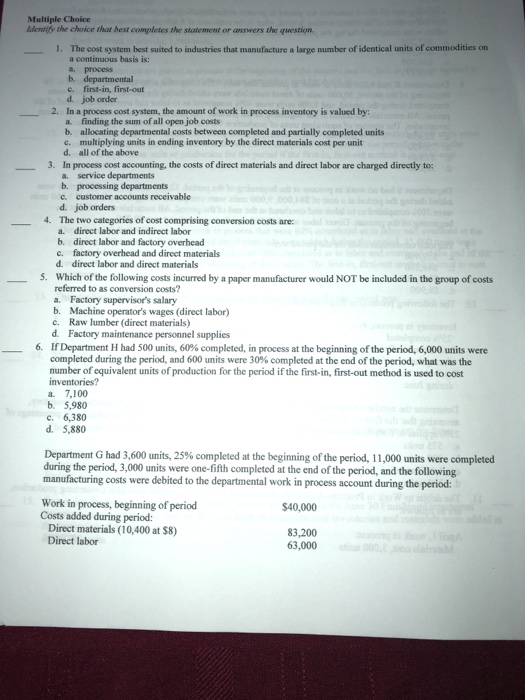
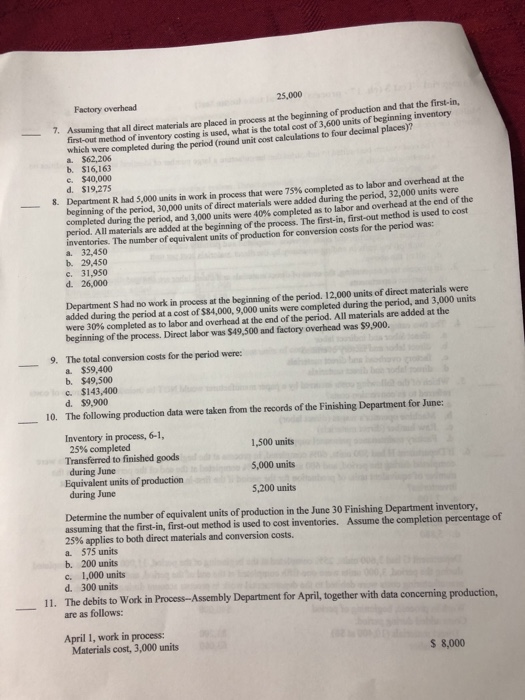
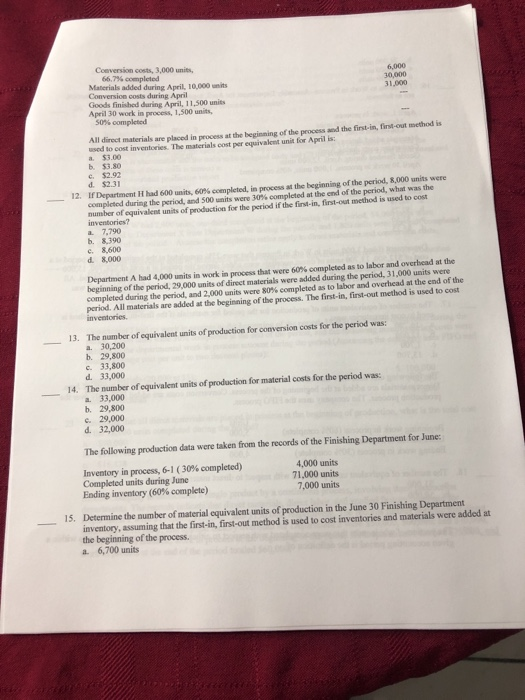
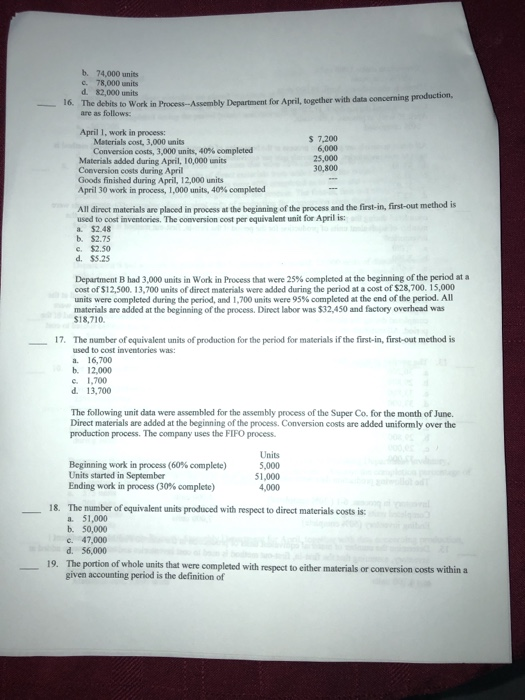
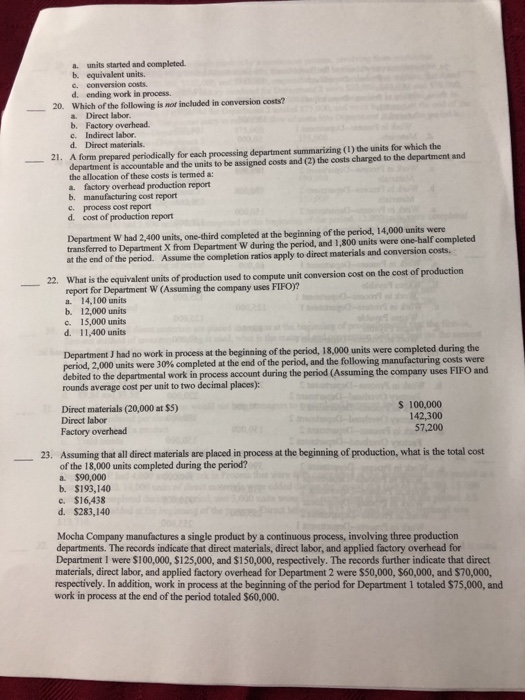
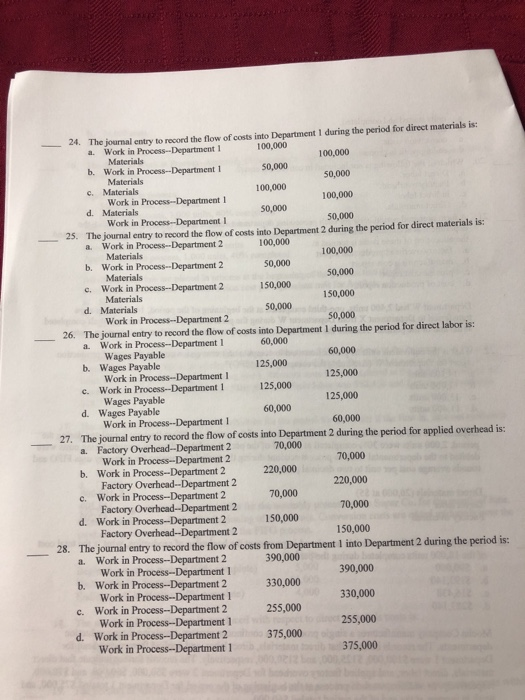
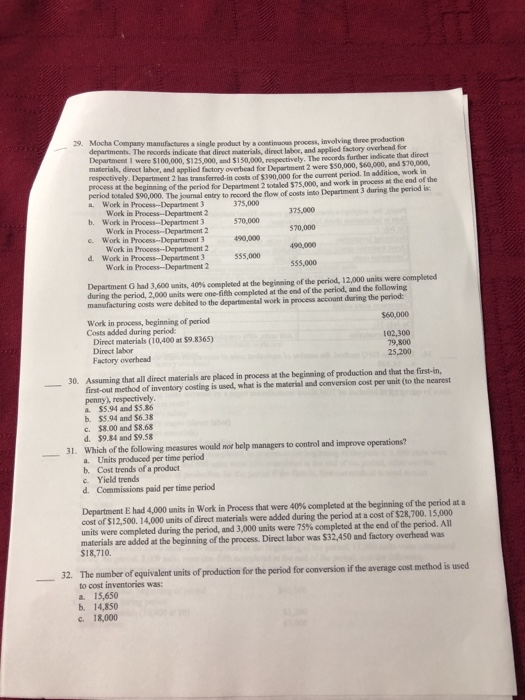
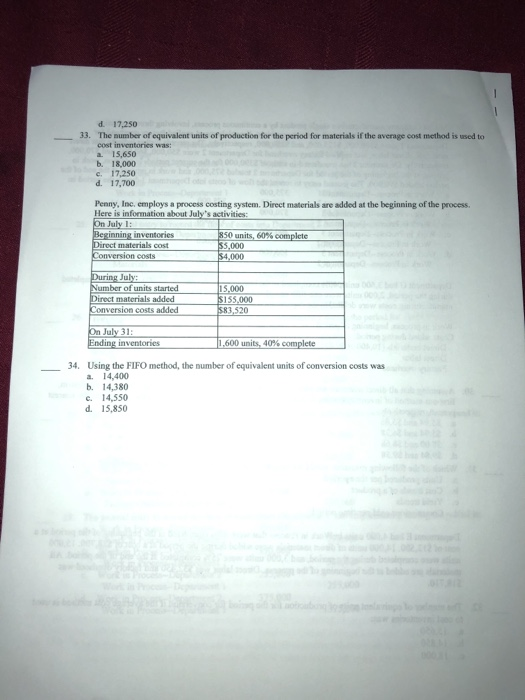
Multiple Choice Ide the choice the best completes the statement or answer the question 1. The cost system best suited to industries that manufacture a large number of identical units of commodities on a continuous basis is: a process b. departmental e. first-in, first-out d. job order 2. In a process cost system, the amount of work in process inventory is valued by: a. finding the sum of all open job costs b. allocating departmental costs between completed and partially completed units c. multiplying units in ending inventory by the direct materials cost per unit d. all of the above 3. In process cost accounting, the costs of direct materials and direct labor are charged directly to: a. service departments b. processing departments c. customer accounts receivable d. job orders 4. The two categories of cost comprising conversion costs are: a. direct labor and indirect labor b. direct labor and factory overhead c. factory overhead and direct materials d. direct labor and direct materials 5. Which of the following costs incurred by a paper manufacturer would NOT be included in the group of costs referred to as conversion costs? a. Factory supervisor's salary b. Machine operator's wages (direct labor) c. Raw lumber (direct materials) d. Factory maintenance personnel supplies 6. If Department H had 500 units, 60% completed, in process at the beginning of the period, 6,000 units were completed during the period, and 600 units were 30% completed at the end of the period, what was the number of equivalent units of production for the period if the first in, first-out method is used to cost inventories? a. 7,100 b. 5,980 c. 6,380 d. 5.880 Department G had 3.600 units, 25% completed at the beginning of the period, 11,000 units were completed during the period, 3,000 units were one-fifth completed at the end of the period, and the following manufacturing costs were debited to the departmental work in process account during the period: $40,000 Work in process, beginning of period Costs added during period: Direct materials (10,400 at 58) Direct labor 83,200 63,000 Factory overhead 25,000 Assuming that all direct materials are placed in process at the beginning of production and that the first-in, first-out method of inventory costing is used, what is the total cost of 3,600 units of beginning inventory which were completed during the period (round unit cost calculations to four decimal places)? a $62206 b. $16,163 e $40,000 d. $19,275 Department R had 5,000 units in work in process that were 75% completed as to labor and overhead at the beginning of the period. 30,000 units of direct materials were added during the period, 32,000 units were completed during the period, and 3,000 units were 40% completed as to labor and overhead at the end of the period. All materials are added at the beginning of the process. The first in, first-out method is used to cost inventories. The number of equivalent units of production for conversion costs for the period was a. 32.450 b. 29,450 c. 31.950 d. 26,000 Department Shad no work in process at the beginning of the period. 12,000 units of direct materials were added during the period at a cost of $84,000,9,000 units were completed during the period, and 3,000 units were 30% completed as to labor and overhead at the end of the period. All materials are added at the beginning of the process. Direct labor was $49,500 and factory overhead was $9.900. 9. The total conversion costs for the period were: a $59.400 b. $49,500 c. $143,400 d. $9.900 10. The following production data were taken from the records of the Finishing Department for June: Inventory in process, 6-1, 25% completed 1,500 units Transferred to finished goods during June 5,000 units Equivalent units of production during June 5,200 units Determine the number of equivalent units of production in the June 30 Finishing Department inventory, assuming that the first-in, first-out method is used to cost inventories. Assume the completion percentage of 25% applies to both direct materials and conversion costs. a. 575 units b. 200 units c. 1,000 units d. 300 units The debits to Work in Process --Assembly Department for April, together with data concerning production, are as follows: April 1, work in process: Materials cost, 3,000 units $ 8,000 Ceaven 3.000 667 Materials added during April 10,000 Conversions during April Goods finished during April 11,500 units April 30 works , 1.500 506 completed 30.000 31.000 All direct materials are placed in the being of the process and the first first-cut method is used to cost inventories. The materials cost requivalent unit for Aprilis SO b. $380 c5292 5231 12. Department had 600 completed in the beginning of the period, 8,000 units were completed during the period, and 500 units were 30% completed at the end of the period, what was the number of equivalent units of production for the period of the first in, first-out method is used to cost inventories? 7,790 b. 3390 c. 8.600 d 2000 Department Ahad 400 m in work in press that were 60% completed as to labor and overhead at the beginning of the period, 29,000 units of direct materials were added during the period. 31.000 units were completed during the period, and 2.000 units were 80% completed as to labor and overhead at the end of the period. All materials are added at the beginning of the process. The first in, first-out method is used to cost inventories 13. The number of equivalent units of production for conversion costs for the period was: 30,200 b. 29,800 31,800 d. 33,000 14. The number of equivalent units of production for material costs for the period was: 31.000 29,800 c. 29.000 d. 32,000 The following production data were taken from the records of the Finishing Department for June: Inventory in process, 6-1 (30% completed) Completed units during June Ending inventory (60% complete) 4,000 units 71,000 units 7,000 units 15. Determine the number of material equivalent units of production in the June 30 Finishing Department inventory, assuming that the first in, first-out method is used to cost inventories and materials were added at the beginning of the process 6,700 units b 74,000 units C. 78,000 units d. 82,000 units 16. The debits to Work in Process Assembly Department for April, together with data concerning production, are as follows: $ 7.200 April 1, work in process: Materials cost, 3,000 units Conversion costs, 3,000 units, 40% completed Materials added during April 10,000 units Conversion costs during April Goods finished during April, 12,000 units April 30 work in process, 1,000 units, 40% completed 25,000 30,800 All direct materials are placed in process at the beginning of the process and the first-in, first-out method is used to cost inventories. The conversion cost per equivalent unit for April is: a $248 $2.75 c. $2.50 d. $5.25 Department Bhad 3.000 units in Work in Process that were 25% completed at the beginning of the period at a cost of $12,500. 13,700 units of direct materials were added during the period at a cost of $28,700. 15,000 units were completed during the period, and 1.700 units were 95% completed at the end of the period. All materials are added at the beginning of the process. Direct labor was $32.450 and factory overhead was $18,710. 17. The number of equivalent units of production for the period for materials if the first-in, first-out method is used to cost inventories was: a. 16.700 b. 12.000 c. 1,700 d. 13.700 The following unit data were assembled for the assembly process of the Super Co. for the month of June. Direct materials are added at the beginning of the process. Conversion costs are added uniformly over the production process. The company uses the FIFO process. Beginning work in process (60% complete) Units started in September Ending work in process (30% complete) Units 5.000 51,000 4,000 18 The number of equivalent units produced with respect to direct materials costs is . 51.000 b. 50,000 c. 47,000 d. 56,000 19. The portion of whole units that were completed with respect to either materials or conversion costs within a given accounting period is the definition of 1. units started and completed. b. equivalent units c. conversion costs. d. ending work in process. 20. Which of the following is not included in conversion costs? a. Direct labor. b. Factory overhead. C. Indirect labor d. Direct materials 21. A form prepared periodically for each processing department summarizing (1) the units for which the department is accountable and the units to be assigned costs and (2) the costs charged to the department and the allocation of these costs is termed a: a. factory overhead production report b. manufacturing cost report c. process cost report d. cost of production report Department W had 2,400 units, one-third completed at the beginning of the period, 14,000 units were transferred to Department X from Department w during the period, and 1,800 units were one-half completed at the end of the period. Assume the completion ratios apply to direct materials and conversion costs. 22. What is the equivalent units of production used to compute unit conversion cost on the cost of production report for Department W (Assuming the company uses FIFO)? a. 14,100 units b. 12,000 units c. 15,000 units d. 11,400 units Department had no work in process at the beginning of the period, 18,000 units were completed during the period, 2,000 units were 30% completed at the end of the period, and the following manufacturing costs were debited to the departmental work in process account during the period (Assuming the company uses FIFO and rounds average cost per unit to two decimal places): Direct materials (20,000 at $5) Direct labor Factory overhead $ 100,000 142,300 57,200 23. Assuming that all direct materials are placed in process at the beginning of production, what is the total cost of the 18,000 units completed during the period? a. $90,000 b. $193,140 c. $16,438 d. $283,140 Mocha Company manufactures a single product by a continuous process, involving three production departments. The records indicate that direct materials, direct labor, and applied factory overhead for Department I were $100,000, $125,000, and $150,000, respectively. The records further indicate that direct materials, direct labor, and applied factory overhead for Department 2 were $50,000, S60,000, and $70,000, respectively. In addition, work in process at the beginning of the period for Department 1 totaled $75,000, and work in process at the end of the period totaled $60,000. 24. The journal entry to record the flow of costs into Department 1 during the period for direct materials is: a. Work in Process --Department 1 100,000 Materials 100,000 b. Work in Process --Department 1 50,000 50,000 Materials C. Materials 100,000 Work in Process --Department 1 100,000 d. Materials 50,000 Work in Process Department 1 50,000 25. The journal entry to record the flow of costs into Department 2 during the period for direct materials is a Work in Process Department 2 100,000 Materials 100,000 b. Work in Process --Department 2 50,000 Materials 50,000 c. Work in Process--Department 2 150,000 Materials 150,000 d. Materials 50,000 Work in Process--Department 2 50,000 26. The journal entry to record the flow of costs into Department during the period for direct laboris: a. Work in Process --Department 1 60,000 Wages Payable 60,000 b. Wages Payable 125,000 Work in Process-Department 1 125,000 c. Work in Process --Department 1 125,000 Wages Payable 125,000 d. Wages Payable 60,000 Work in Process--Department 1 60,000 27. The journal entry to record the flow of costs into Department 2 during the period for applied overhead is: a. Factory Overhead-Department 2 70,000 Work in Process-Department 2 70,000 b. Work in Process --Department 2 220,000 Factory Overhead-Department 2 220,000 c. Work in Process-Department 2 70,000 Factory Overhead-Department 2 70,000 d. Work in Process-Department 2 150,000 Factory Overhead--Department 2 150,000 28. The journal entry to record the flow of costs from Department into Department 2 during the period is: a. Work in Process--Department 2 390,000 Work in Process --Department 1 390,000 b. Work in Process--Department 2 330,000 Work in Process-Department 1 330,000 c. Work in Process --Department 2 255,000 Work in Process-Department 1 255,000 d. Work in Process-Department 2 375,000 Work in Process--Department 1 375,000 29. Mocha Company manufactures a single product by a coins process, involving the production departments. The records indicate that direct material direct laber, and led factory overhead for Department were $100.000 125.000 ISO spety Therds further indicate that direct materials, direct law, and applied faster overhed e n 2 were $50,000, 000 and 70.000 respectively. Department 2 has transferred-in costs of $390,000 for the current period. In addition, work in process at the beginning of the period for Department 2 vid 575.000, and work in process at the end of the period totaled $90,000. The journal entry to read the flow of costs Department during the period is: Works Process-De 375.000 Work in Process Department 2 375.000 b. Work in Process Department 570,000 Work in Process --Department 2 570,000 Work in Process Department 190.000 Werk in Process Department 2 190.000 d. Work in Process Department 555,000 Work in Process Department 2 555,000 Department had o p ted the being of the period, 12.000 units were completed during the period, 2.000 units were one-fifth completed at the end of the period, and the following manufacturing costs were debited to the departmental work in process account during the period $60,000 Work in process, beginning of period Costs added during period Direct materials (10,400 a $9.8365) Direct labor Factory overhead 102 100 79,800 25,200 30. Assuming that all direct materials are placed in process at the beginning of production and that the first-in, first-out method of inventory costing is used, what is the material and conversion cost per unit to the nearest penny respectively S$ 94 and 55 56 b. 55 94 and 5638 C. $8.00 and $8.68 d. 59.84 and $9.58 Which of the following measures would help managers to control and improve operations? Units produced per time period b. Cost trends of a product Yield trends d. Commissions paid per time period Department had 4,000 units in Work in Process that were 40% completed at the beginning of the period at a cost of $12.500. 14,000 units of direct materials were added during the period at a cost of $28,700. 15,000 units were completed during the period, and 3,000 units were 75% completed at the end of the period. All materials are added at the beginning of the process. Direct labor was $32,450 and factory overhead was S18710 32. The number of equivalent units of production for the period for conversion if the average cost method is used to cost inventories was a 15,650 b. 14,850 c. 18,000 d. 17.250 33. The number of equivalent units of production for the period for materials if the average cost method is used to cest inventories was: a 15,650 b 18.000 c. 17.250 d. 17,700 Penny, Inc. employs a process costing system. Direct materials are added at the beginning of the process. Here is information about July's activities: On July 1: Beginning inventories 850 units, 60% complete Direct materials cost 35,000 Conversion costs $4,000 During July: Number of units started Direct materials added Conversion costs added li5.000 SI55.000 $83,520 On July 31: Ending inventories 1.600 units, 40% complete 1.600 units, 40% complete 34. Using the FIFO method, the number of equivalent units of conversion costs was a. 14,400 b. 14.380 c. 14.550 d. 15.850 Multiple Choice Ide the choice the best completes the statement or answer the question 1. The cost system best suited to industries that manufacture a large number of identical units of commodities on a continuous basis is: a process b. departmental e. first-in, first-out d. job order 2. In a process cost system, the amount of work in process inventory is valued by: a. finding the sum of all open job costs b. allocating departmental costs between completed and partially completed units c. multiplying units in ending inventory by the direct materials cost per unit d. all of the above 3. In process cost accounting, the costs of direct materials and direct labor are charged directly to: a. service departments b. processing departments c. customer accounts receivable d. job orders 4. The two categories of cost comprising conversion costs are: a. direct labor and indirect labor b. direct labor and factory overhead c. factory overhead and direct materials d. direct labor and direct materials 5. Which of the following costs incurred by a paper manufacturer would NOT be included in the group of costs referred to as conversion costs? a. Factory supervisor's salary b. Machine operator's wages (direct labor) c. Raw lumber (direct materials) d. Factory maintenance personnel supplies 6. If Department H had 500 units, 60% completed, in process at the beginning of the period, 6,000 units were completed during the period, and 600 units were 30% completed at the end of the period, what was the number of equivalent units of production for the period if the first in, first-out method is used to cost inventories? a. 7,100 b. 5,980 c. 6,380 d. 5.880 Department G had 3.600 units, 25% completed at the beginning of the period, 11,000 units were completed during the period, 3,000 units were one-fifth completed at the end of the period, and the following manufacturing costs were debited to the departmental work in process account during the period: $40,000 Work in process, beginning of period Costs added during period: Direct materials (10,400 at 58) Direct labor 83,200 63,000 Factory overhead 25,000 Assuming that all direct materials are placed in process at the beginning of production and that the first-in, first-out method of inventory costing is used, what is the total cost of 3,600 units of beginning inventory which were completed during the period (round unit cost calculations to four decimal places)? a $62206 b. $16,163 e $40,000 d. $19,275 Department R had 5,000 units in work in process that were 75% completed as to labor and overhead at the beginning of the period. 30,000 units of direct materials were added during the period, 32,000 units were completed during the period, and 3,000 units were 40% completed as to labor and overhead at the end of the period. All materials are added at the beginning of the process. The first in, first-out method is used to cost inventories. The number of equivalent units of production for conversion costs for the period was a. 32.450 b. 29,450 c. 31.950 d. 26,000 Department Shad no work in process at the beginning of the period. 12,000 units of direct materials were added during the period at a cost of $84,000,9,000 units were completed during the period, and 3,000 units were 30% completed as to labor and overhead at the end of the period. All materials are added at the beginning of the process. Direct labor was $49,500 and factory overhead was $9.900. 9. The total conversion costs for the period were: a $59.400 b. $49,500 c. $143,400 d. $9.900 10. The following production data were taken from the records of the Finishing Department for June: Inventory in process, 6-1, 25% completed 1,500 units Transferred to finished goods during June 5,000 units Equivalent units of production during June 5,200 units Determine the number of equivalent units of production in the June 30 Finishing Department inventory, assuming that the first-in, first-out method is used to cost inventories. Assume the completion percentage of 25% applies to both direct materials and conversion costs. a. 575 units b. 200 units c. 1,000 units d. 300 units The debits to Work in Process --Assembly Department for April, together with data concerning production, are as follows: April 1, work in process: Materials cost, 3,000 units $ 8,000 Ceaven 3.000 667 Materials added during April 10,000 Conversions during April Goods finished during April 11,500 units April 30 works , 1.500 506 completed 30.000 31.000 All direct materials are placed in the being of the process and the first first-cut method is used to cost inventories. The materials cost requivalent unit for Aprilis SO b. $380 c5292 5231 12. Department had 600 completed in the beginning of the period, 8,000 units were completed during the period, and 500 units were 30% completed at the end of the period, what was the number of equivalent units of production for the period of the first in, first-out method is used to cost inventories? 7,790 b. 3390 c. 8.600 d 2000 Department Ahad 400 m in work in press that were 60% completed as to labor and overhead at the beginning of the period, 29,000 units of direct materials were added during the period. 31.000 units were completed during the period, and 2.000 units were 80% completed as to labor and overhead at the end of the period. All materials are added at the beginning of the process. The first in, first-out method is used to cost inventories 13. The number of equivalent units of production for conversion costs for the period was: 30,200 b. 29,800 31,800 d. 33,000 14. The number of equivalent units of production for material costs for the period was: 31.000 29,800 c. 29.000 d. 32,000 The following production data were taken from the records of the Finishing Department for June: Inventory in process, 6-1 (30% completed) Completed units during June Ending inventory (60% complete) 4,000 units 71,000 units 7,000 units 15. Determine the number of material equivalent units of production in the June 30 Finishing Department inventory, assuming that the first in, first-out method is used to cost inventories and materials were added at the beginning of the process 6,700 units b 74,000 units C. 78,000 units d. 82,000 units 16. The debits to Work in Process Assembly Department for April, together with data concerning production, are as follows: $ 7.200 April 1, work in process: Materials cost, 3,000 units Conversion costs, 3,000 units, 40% completed Materials added during April 10,000 units Conversion costs during April Goods finished during April, 12,000 units April 30 work in process, 1,000 units, 40% completed 25,000 30,800 All direct materials are placed in process at the beginning of the process and the first-in, first-out method is used to cost inventories. The conversion cost per equivalent unit for April is: a $248 $2.75 c. $2.50 d. $5.25 Department Bhad 3.000 units in Work in Process that were 25% completed at the beginning of the period at a cost of $12,500. 13,700 units of direct materials were added during the period at a cost of $28,700. 15,000 units were completed during the period, and 1.700 units were 95% completed at the end of the period. All materials are added at the beginning of the process. Direct labor was $32.450 and factory overhead was $18,710. 17. The number of equivalent units of production for the period for materials if the first-in, first-out method is used to cost inventories was: a. 16.700 b. 12.000 c. 1,700 d. 13.700 The following unit data were assembled for the assembly process of the Super Co. for the month of June. Direct materials are added at the beginning of the process. Conversion costs are added uniformly over the production process. The company uses the FIFO process. Beginning work in process (60% complete) Units started in September Ending work in process (30% complete) Units 5.000 51,000 4,000 18 The number of equivalent units produced with respect to direct materials costs is . 51.000 b. 50,000 c. 47,000 d. 56,000 19. The portion of whole units that were completed with respect to either materials or conversion costs within a given accounting period is the definition of 1. units started and completed. b. equivalent units c. conversion costs. d. ending work in process. 20. Which of the following is not included in conversion costs? a. Direct labor. b. Factory overhead. C. Indirect labor d. Direct materials 21. A form prepared periodically for each processing department summarizing (1) the units for which the department is accountable and the units to be assigned costs and (2) the costs charged to the department and the allocation of these costs is termed a: a. factory overhead production report b. manufacturing cost report c. process cost report d. cost of production report Department W had 2,400 units, one-third completed at the beginning of the period, 14,000 units were transferred to Department X from Department w during the period, and 1,800 units were one-half completed at the end of the period. Assume the completion ratios apply to direct materials and conversion costs. 22. What is the equivalent units of production used to compute unit conversion cost on the cost of production report for Department W (Assuming the company uses FIFO)? a. 14,100 units b. 12,000 units c. 15,000 units d. 11,400 units Department had no work in process at the beginning of the period, 18,000 units were completed during the period, 2,000 units were 30% completed at the end of the period, and the following manufacturing costs were debited to the departmental work in process account during the period (Assuming the company uses FIFO and rounds average cost per unit to two decimal places): Direct materials (20,000 at $5) Direct labor Factory overhead $ 100,000 142,300 57,200 23. Assuming that all direct materials are placed in process at the beginning of production, what is the total cost of the 18,000 units completed during the period? a. $90,000 b. $193,140 c. $16,438 d. $283,140 Mocha Company manufactures a single product by a continuous process, involving three production departments. The records indicate that direct materials, direct labor, and applied factory overhead for Department I were $100,000, $125,000, and $150,000, respectively. The records further indicate that direct materials, direct labor, and applied factory overhead for Department 2 were $50,000, S60,000, and $70,000, respectively. In addition, work in process at the beginning of the period for Department 1 totaled $75,000, and work in process at the end of the period totaled $60,000. 24. The journal entry to record the flow of costs into Department 1 during the period for direct materials is: a. Work in Process --Department 1 100,000 Materials 100,000 b. Work in Process --Department 1 50,000 50,000 Materials C. Materials 100,000 Work in Process --Department 1 100,000 d. Materials 50,000 Work in Process Department 1 50,000 25. The journal entry to record the flow of costs into Department 2 during the period for direct materials is a Work in Process Department 2 100,000 Materials 100,000 b. Work in Process --Department 2 50,000 Materials 50,000 c. Work in Process--Department 2 150,000 Materials 150,000 d. Materials 50,000 Work in Process--Department 2 50,000 26. The journal entry to record the flow of costs into Department during the period for direct laboris: a. Work in Process --Department 1 60,000 Wages Payable 60,000 b. Wages Payable 125,000 Work in Process-Department 1 125,000 c. Work in Process --Department 1 125,000 Wages Payable 125,000 d. Wages Payable 60,000 Work in Process--Department 1 60,000 27. The journal entry to record the flow of costs into Department 2 during the period for applied overhead is: a. Factory Overhead-Department 2 70,000 Work in Process-Department 2 70,000 b. Work in Process --Department 2 220,000 Factory Overhead-Department 2 220,000 c. Work in Process-Department 2 70,000 Factory Overhead-Department 2 70,000 d. Work in Process-Department 2 150,000 Factory Overhead--Department 2 150,000 28. The journal entry to record the flow of costs from Department into Department 2 during the period is: a. Work in Process--Department 2 390,000 Work in Process --Department 1 390,000 b. Work in Process--Department 2 330,000 Work in Process-Department 1 330,000 c. Work in Process --Department 2 255,000 Work in Process-Department 1 255,000 d. Work in Process-Department 2 375,000 Work in Process--Department 1 375,000 29. Mocha Company manufactures a single product by a coins process, involving the production departments. The records indicate that direct material direct laber, and led factory overhead for Department were $100.000 125.000 ISO spety Therds further indicate that direct materials, direct law, and applied faster overhed e n 2 were $50,000, 000 and 70.000 respectively. Department 2 has transferred-in costs of $390,000 for the current period. In addition, work in process at the beginning of the period for Department 2 vid 575.000, and work in process at the end of the period totaled $90,000. The journal entry to read the flow of costs Department during the period is: Works Process-De 375.000 Work in Process Department 2 375.000 b. Work in Process Department 570,000 Work in Process --Department 2 570,000 Work in Process Department 190.000 Werk in Process Department 2 190.000 d. Work in Process Department 555,000 Work in Process Department 2 555,000 Department had o p ted the being of the period, 12.000 units were completed during the period, 2.000 units were one-fifth completed at the end of the period, and the following manufacturing costs were debited to the departmental work in process account during the period $60,000 Work in process, beginning of period Costs added during period Direct materials (10,400 a $9.8365) Direct labor Factory overhead 102 100 79,800 25,200 30. Assuming that all direct materials are placed in process at the beginning of production and that the first-in, first-out method of inventory costing is used, what is the material and conversion cost per unit to the nearest penny respectively S$ 94 and 55 56 b. 55 94 and 5638 C. $8.00 and $8.68 d. 59.84 and $9.58 Which of the following measures would help managers to control and improve operations? Units produced per time period b. Cost trends of a product Yield trends d. Commissions paid per time period Department had 4,000 units in Work in Process that were 40% completed at the beginning of the period at a cost of $12.500. 14,000 units of direct materials were added during the period at a cost of $28,700. 15,000 units were completed during the period, and 3,000 units were 75% completed at the end of the period. All materials are added at the beginning of the process. Direct labor was $32,450 and factory overhead was S18710 32. The number of equivalent units of production for the period for conversion if the average cost method is used to cost inventories was a 15,650 b. 14,850 c. 18,000 d. 17.250 33. The number of equivalent units of production for the period for materials if the average cost method is used to cest inventories was: a 15,650 b 18.000 c. 17.250 d. 17,700 Penny, Inc. employs a process costing system. Direct materials are added at the beginning of the process. Here is information about July's activities: On July 1: Beginning inventories 850 units, 60% complete Direct materials cost 35,000 Conversion costs $4,000 During July: Number of units started Direct materials added Conversion costs added li5.000 SI55.000 $83,520 On July 31: Ending inventories 1.600 units, 40% complete 1.600 units, 40% complete 34. Using the FIFO method, the number of equivalent units of conversion costs was a. 14,400 b. 14.380 c. 14.550 d. 15.850
Step by Step Solution
There are 3 Steps involved in it

Get step-by-step solutions from verified subject matter experts
 Study Help