







Question: multiple choice question 18 d and e are in the third picture 11. The Supreme Court's Gardner-Denver decision: a. resulted in trial courts overturning discrimination
multiple choice
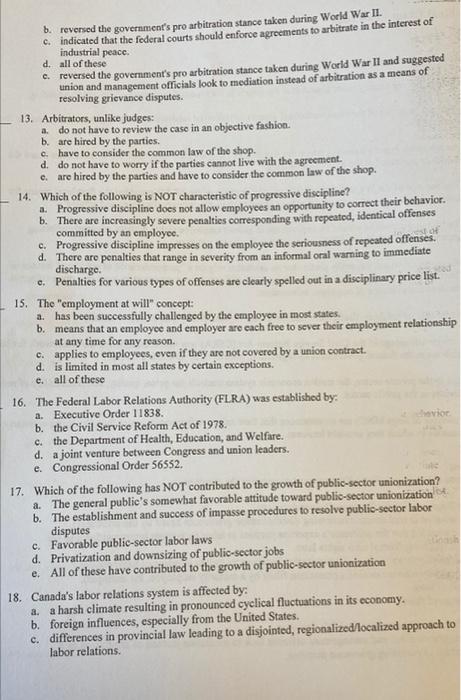
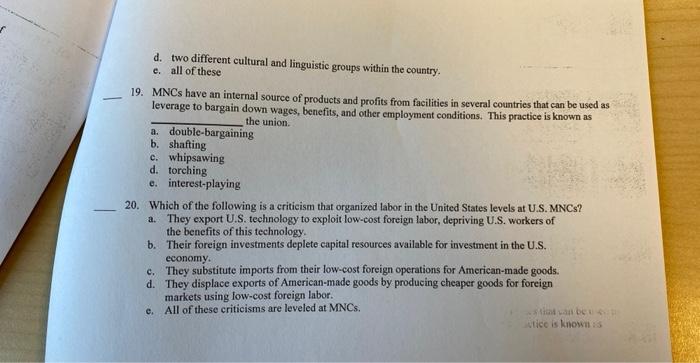
11. The Supreme Court's Gardner-Denver decision: a. resulted in trial courts overturning discrimination grievances heard by the arbitrators. b. contended that the arbitrator's expertise pertains to labor agreement interpretation and not to resolving federal civil rights laws. c. applies only to "reverse-discrimination" grievances (white employees having more frawewo seniority who are denied a promotion filled by a minority employee, for example). d. all of these e. none of these 12. The Supreme Court's Lincoln Mills decision: a. suggested union and management officials look to mediation instead of arbitration as a means of resolving grievance disputes. b. reversed the government's pro arbitration stance taken during World War II. c. indicated that the federal courts should enforve agrecments to arbitrate in the interest of industrial peace. d. all of these c. reversed the government's pro arbitration stance taken during World War II and suggested union and management officials look to mediation instead of arbitration as a means of resolving grievance disputes. 13. Arbitrators, unlike judges: a. do not have to review the case in an objective fachion. b. are hired by the parties. c. have to consider the common law of the shop. d. do not have to worry if the parties cannot live with the agreement. e. are hired by the parties and have to consider the common law of the shop. 14. Which of the following is NOT characteristic of progressive discipline? a. Progressive discipline does not allow employees an opportunity to correct their behavior. b. There are increasingly severe penalties corresponding with repeated, identical offenses committed by an employee. c. Progressive discipline impresses on the employee the seriousness of repeated offenses. d. There are penalties that range in severity from an informal oral waming to immediate discharge. e. Penalties for various types of offenses are clearly spelled out in a disciplinary price list. 15. The "employment at will" concept: a. has been successfully challenged by the employee in most states. b. means that an employee and employer are cach free to sever their employment relationship at any time for any reason. c. applies to employees, even if they are not covered by a union contract. d. is limited in most all states by certain exceptions. e. all of these 16. The Federal Labor Relations Authority (FLRA) was established by: a. Executive Order 11838 . b. the Civil Service Reform Act of 1978 . c. the Department of Health, Education, and Welfare. d. a joint venture between Congress and union leaders. e. Congressional Order 56552 , 17. Which of the following has NOT contributed to the growth of public-sector unionization? a. The general public's somewhat favorable attitude toward public-sector unionization b. The establishment and success of impasse procedures to resolve publie-sector labor disputes c. Favorable public-sector labor laws d. Privatization and downsizing of public-sector jobs e. All of these have contributed to the growth of public-sector unionization 18. Canada's labor relations system is affected by: a. a harsh climate resulting in pronounced cyelical fluctuations in its economy. b. foreign influences, especially from the United States. c. differences in provincial law leading to a disjointed, regionalized/localized approach to labor relations. d. two different cultural and linguistic groups within the country. c. all of these 19. MNCs have an internal source of products and profits from facilities in several countries that can be used as leverage to bargain down wages, benefits, and other employment conditions. This practice is known as the union. a. double-bargaining b. shafting c. whipsawing d. torching e. interest-playing 20. Which of the following is a criticism that organized labor in the United States levels at U.S. MNCs? a. They export U.S. technology to exploit low-cost foreign labor, depriving U.S. workers of the benefits of this technology. b. Their foreign investments deplete capital resources available for investment in the U.S. economy. c. They substitute imports from their low-cost foreign operations for American-made goods. d. They displace exports of American-made goods by producing cheaper goods for foreign markets using low-cost foreign labor. e. All of these criticisms are leveled at MNCs question 18
d and e are in the third picture 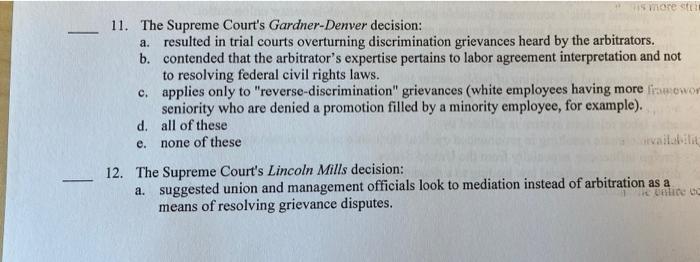
Step by Step Solution
There are 3 Steps involved in it
1 Expert Approved Answer
Step: 1 Unlock

Question Has Been Solved by an Expert!
Get step-by-step solutions from verified subject matter experts
Step: 2 Unlock
Step: 3 Unlock
 Study Help