



Question: .Multiple choice questions The larger, wider forces that have influence over companies and economies are known as the: a. Marketing environment b. Micro-environment c. Threats
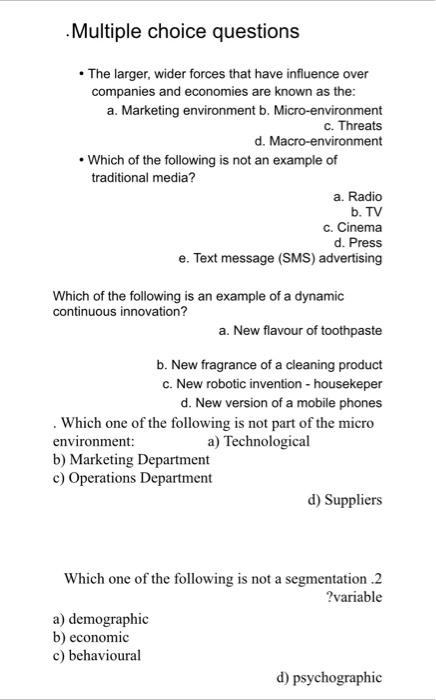
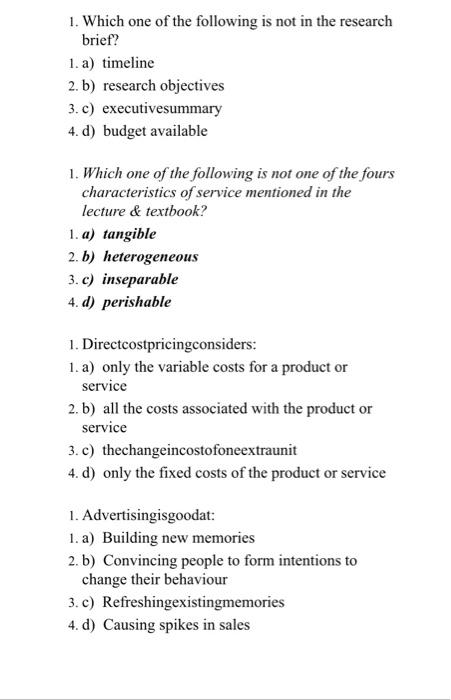
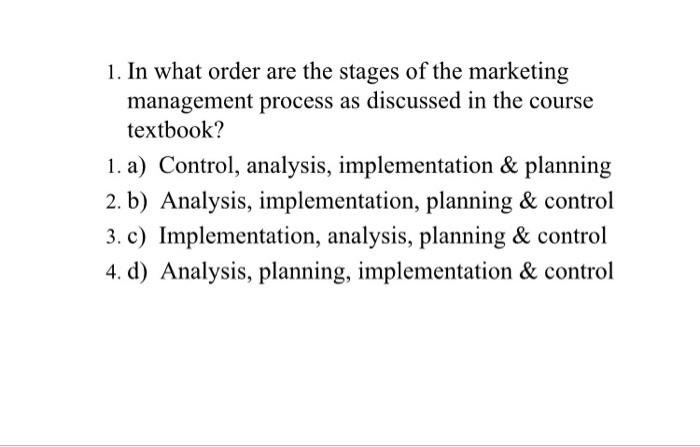
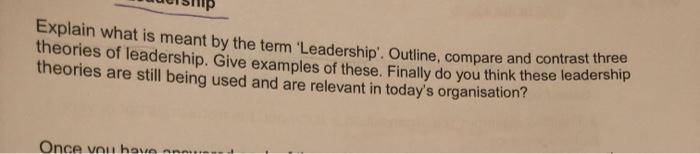
. Multiple choice questions The larger, wider forces that have influence over companies and economies are known as the a. Marketing environment b. Micro-environment c. Threats d. Macro-environment Which of the following is not an example of traditional media? a. Radio b. TV C. Cinema d. Press e. Text message (SMS) advertising Which of the following is an example of a dynamic continuous innovation? a. New flavour of toothpaste b. New fragrance of a cleaning product c. New robotic invention - housekeper d. New version of a mobile phones Which one of the following is not part of the micro environment: a) Technological b) Marketing Department c) Operations Department d) Suppliers Which one of the following is not a segmentation 2 ?variable a) demographic b) economic c) behavioural d) psychographic 1. Which one of the following is not in the research brief? 1. a) timeline 2. b) research objectives 3.c) executivesummary 4.d) budget available 1. Which one of the following is not one of the fours characteristics of service mentioned in the lecture & textbook? 1. a) tangible 2.b) heterogeneous 3.c) inseparable 4.d) perishable 1. Directcostpricingconsiders: 1. a) only the variable costs for a product or service 2. b) all the costs associated with the product or service 3.c) thechangeincostofoneextraunit 4. d) only the fixed costs of the product or service 1. Advertisingisgoodat: 1. a) Building new memories 2. b) Convincing people to form intentions to change their behaviour 3.c) Refreshingexistingmemories 4. d) Causing spikes in sales 1. In what order are the stages of the marketing management process as discussed in the course textbook? 1. a) Control, analysis, implementation & planning 2. b) Analysis, implementation, planning & control 3. c) Implementation, analysis, planning & control 4. d) Analysis, planning, implementation & control Explain what is meant by the term 'Leadership'. Outline, compare and contrast their theories of leadership. Give examples of these. Finally do you think these leadership theories are still being used and are relevant in today's organisation? Once vau have annum
Step by Step Solution
There are 3 Steps involved in it

Get step-by-step solutions from verified subject matter experts