







Question: Question 4 Consider an investor with the following utility function; U (W) = 20 + W /5 a. Demonstrate that this investor always prefers
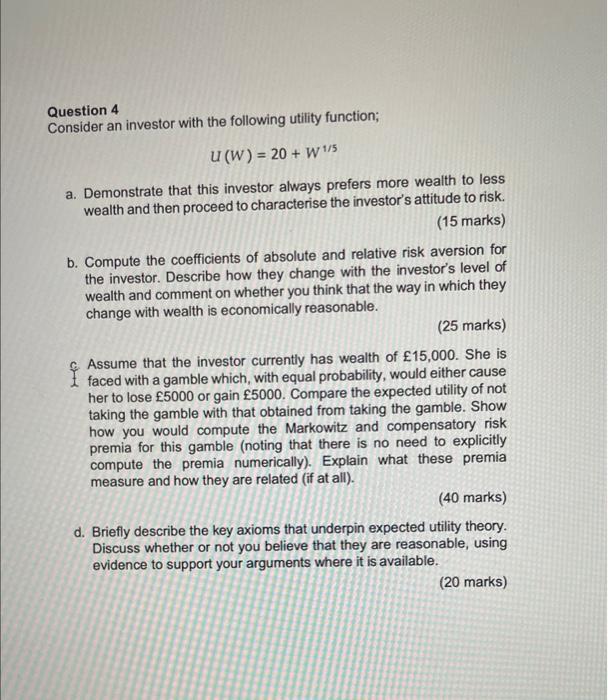
Question 4 Consider an investor with the following utility function; U (W) = 20 + W /5 a. Demonstrate that this investor always prefers more wealth to less wealth and then proceed to characterise the investor's attitude to risk. (15 marks) b. Compute the coefficients of absolute and relative risk aversion for the investor. Describe how they change with the investor's level of wealth and comment on whether you think that the way in which they change with wealth is economically reasonable. CH (25 marks) Assume that the investor currently has wealth of 15,000. She is faced with a gamble which, with equal probability, would either cause her to lose 5000 or gain 5000. Compare the expected utility of not taking the gamble with that obtained from taking the gamble. Show how you would compute the Markowitz and compensatory risk premia for this gamble (noting that there is no need to explicitly compute the premia numerically). Explain what these premia measure and how they are related (if at all). (40 marks) d. Briefly describe the key axioms that underpin expected utility theory. Discuss whether or not you believe that they are reasonable, using evidence to support your arguments where it is available. (20 marks)
Step by Step Solution
3.37 Rating (153 Votes )
There are 3 Steps involved in it
Answer a This investor always prefers more wealth to less wealth because her utility function is increasing with wealth This indicates that her attitude towards risk is riskaverse as she is more inter... View full answer

Get step-by-step solutions from verified subject matter experts
 Study Help