







Question: MULTIPLE CHOICE: (Total Point Value 70) Circle the answer of the best response. 1) Auditing is the process of verifying the accuracy of financial statements.
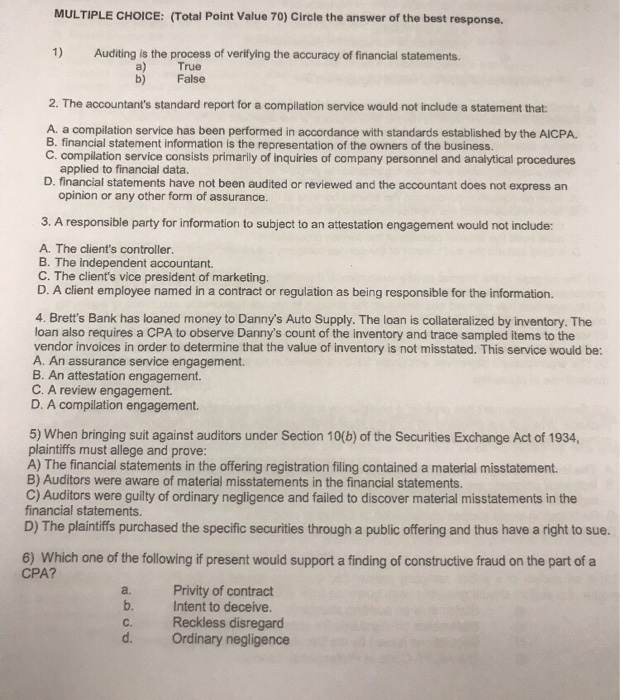
MULTIPLE CHOICE: (Total Point Value 70) Circle the answer of the best response. 1) Auditing is the process of verifying the accuracy of financial statements. a) b) True False 2. The accountant's standard report for a complation service would not include a statement that A. a compilation service has been performed in accordance with standards established by the AICPA B. financial statement information is the representation of the owners of the business. C. compilation service consists primarily of inquiries of company personnel and analytical procedures applied to financial data. D. financial statements have not been audited or reviewed and the accountant does not express an opinion or any other form of assurance. 3. A responsible party for information to subject to an attestation engagement would not include: A. The client's controller. B. The independent accountant C. The client's vice president of marketing. D. A client employee named in a contract or regulation as being responsible for the information. 4. Brett's Bank has loaned money to Danny's Auto Supply. The loan is collateralized by inventory. The loan also requires a CPA to observe Danny's count of the inventory and trace sampled items to the vendor invoices in order to determine that the value of inventory is not misstated. This service would be A. An assurance service engagement. B. An attestation engagement C. A review engagement. D. A compilation engagement 5) When bringing suit against auditors under Section 10(b) of the Securities Exchange Act of 1934, plaintiffs must allege and prove: A) The financial statements in the offering registration filing contained a material misstatement. B) Auditors were aware of material misstatements in the financial statements. C) Auditors were guilty of ordinary negligence and failed to discover material misstatements in the financial statements D) The plaintiffs purchased the specific securities through a public offering and thus have a right to sue. 6) Which one of the following if present would support a finding of constructive fraud on the part of a CPA? Privity of contract Intent to deceive. Reckless disregard d. Ordinary negligence
Step by Step Solution
There are 3 Steps involved in it

Get step-by-step solutions from verified subject matter experts
 Study Help