



Question: MULTIPLE CHOICE With standard Ethernet Networks, we can use at most a. 2 repeaters c. 4 repeaters (15 POINTS) b.3 repeaters d.5 repeaters The OSI
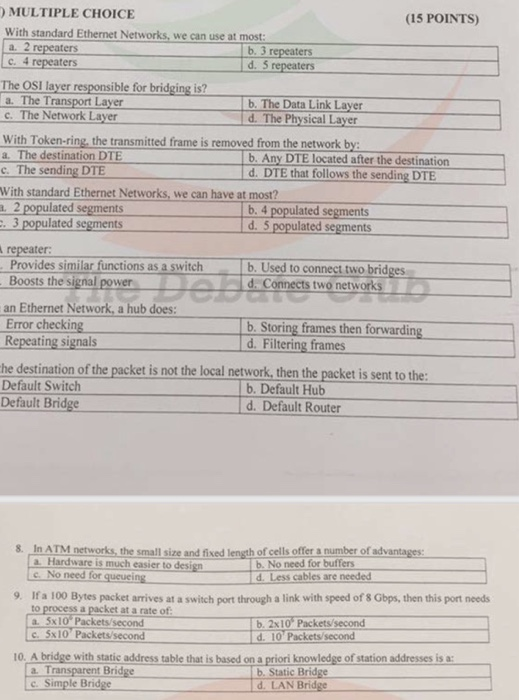
MULTIPLE CHOICE With standard Ethernet Networks, we can use at most a. 2 repeaters c. 4 repeaters (15 POINTS) b.3 repeaters d.5 repeaters The OSI layer responsible for bridging is? a. The Transport Layer c. The Network Layer b. The Data Link Layer d. The Physical Layer With Token-ring, the transmitted frame is removed from the network by a. The destination DTE c. The sending DTE With standard Ethernet Networks, we can have at most? b. Any DTE located after the destination d. DTE that follows the sending DTE b.4 populated segments d. 5 populated segments ted . 3 populated segments repeater: Provides similar functions as a switch Boosts the signal power an Ethernet Network, a hub does Error checking Repeating signals b. Used to connect two bridges d. Connects two networksA b. Storing frames then forwarding d. Filtering frames he destination of the packet is not the local network, then the packet is sent to the Default Switeh Default Bridge b. Default Hub d. Default Router 8. In ATM networks, the small size and fixed length of cells offer a number of advantages Hardware is much easier to design No need for queueing b. No need for buffers d. Less cables are needed c. 9. Ifa 100 Bytes packet arrives at a switch port through a link with speed of 8 Gbps, then this port needs to process a packet at a rate of a. 5x10 Packets/second c. 5x10 Packets/second b. 2x10 Packets/second d. 10 Packets/second 0. A bridge with static address table that is based on a priori knowledge of station addresses is a a Transparent Bridge c. Simple Bridge d. LAN Bridge
Step by Step Solution
There are 3 Steps involved in it

Get step-by-step solutions from verified subject matter experts