





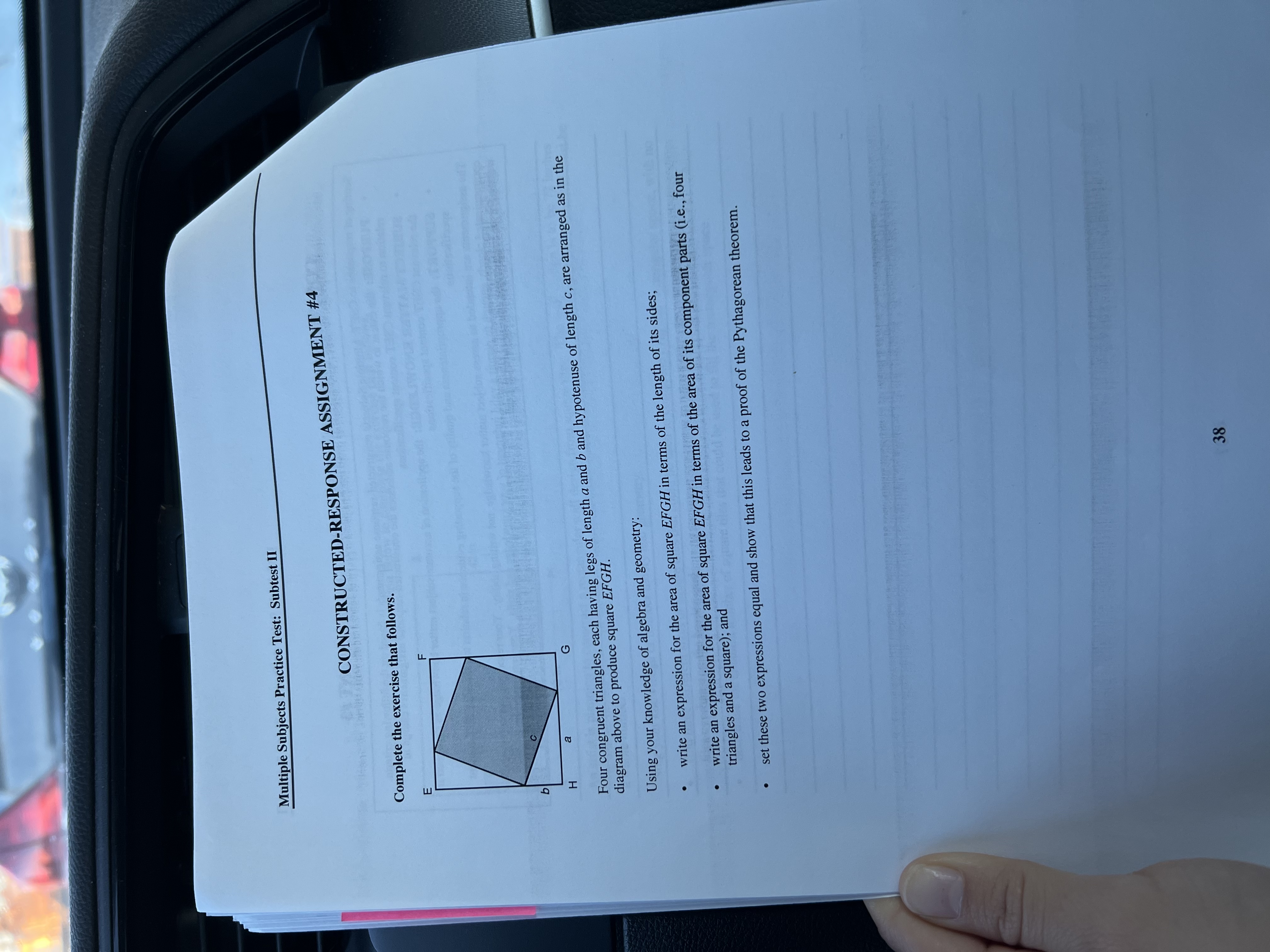
Question: Multiple Subjects Practice Test: Subtest II CONSTRUCTED-RESPONSE ASSIGNMENT #4 Complete the exercise that follows. H a Four congruent triangles, each having legs of length a
Multiple Subjects Practice Test: Subtest IIMultiple Subjects Practice Test: Subtest II
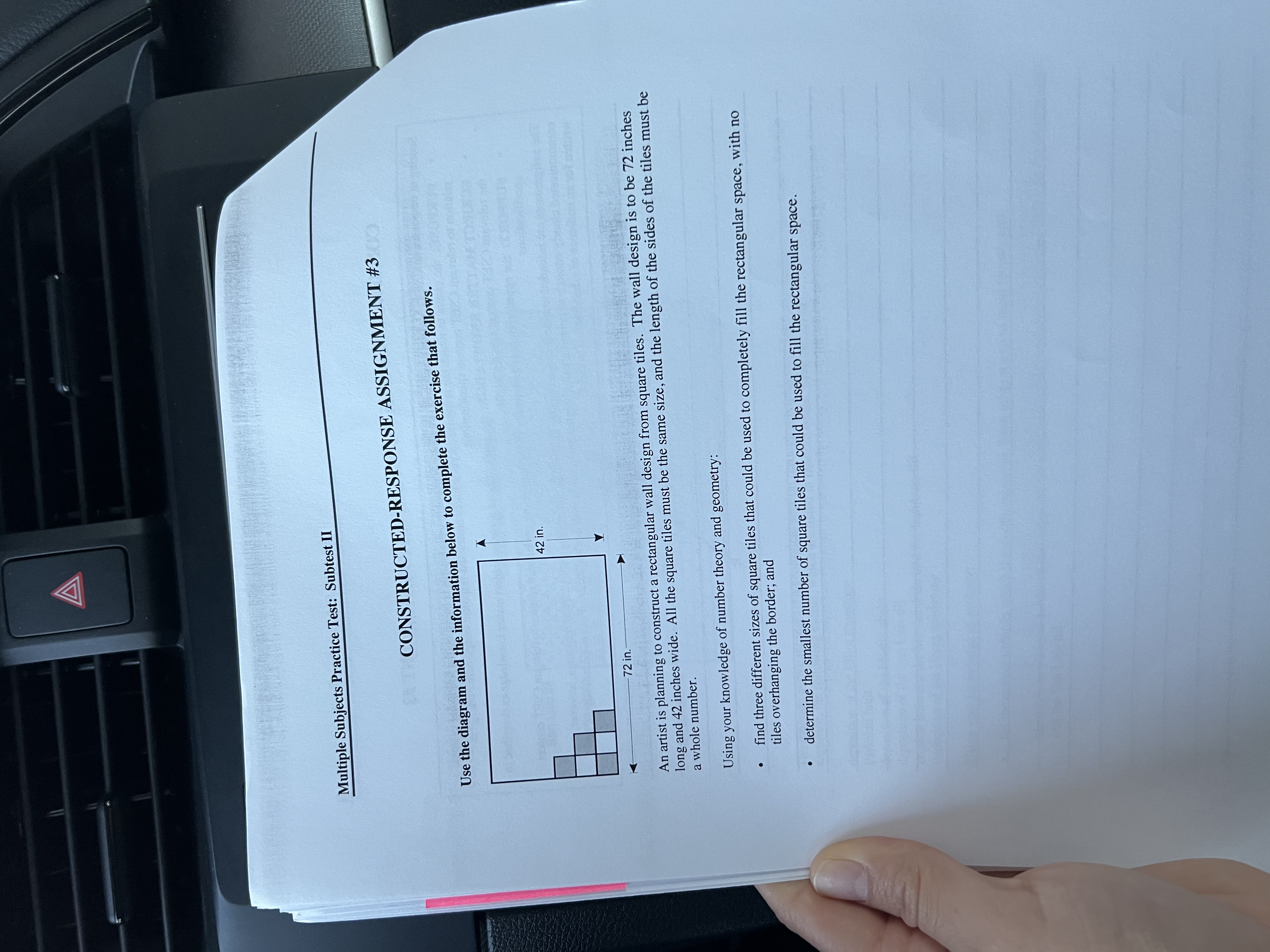
Multiple Subjects Practice Test: Subtest II CONSTRUCTED-RESPONSE ASSIGNMENT #4 Complete the exercise that follows. H a Four congruent triangles, each having legs of length a and b and hypotenuse of length c, are arranged as in the diagram above to produce square EFGH. Using your knowledge of algebra and geometry: write an expression for the area of square EFGH in terms of the length of its sides; write an expression for the area of square EFGH in terms of the area of its component parts (i.e., four triangles and a square); and set these two expressions equal and show that this leads to a proof of the Pythagorean theorem. 38A Multiple Subjects Practice Test: Subtest II CONSTRUCTED-RESPONSE ASSIGNMENT #3 Use the diagram and the information below to complete the exercise that follows. 42 in . 72 in. An artist is planning to construct a rectangular wall design from square tiles. The wall design is to be 72 inches long and 42 inches wide. All the square tiles must be the same size, and the length of the sides of the tiles must be a whole number. Using your knowledge of number theory and geometry: find three different sizes of square tiles that could be used to completely fill the rectangular space, with no tiles overhanging the border; and determine the smallest number of square tiles that could be used to fill the rectangular space

Step by Step Solution

There are 3 Steps involved in it

1 Expert Approved Answer
Step: 1 Unlock blur-text-image
Question Has Been Solved by an Expert!

Get step-by-step solutions from verified subject matter experts

Step: 2 Unlock
Step: 3 Unlock

Students Have Also Explored These Related Mathematics Questions!