







Question: Multiple-choice questions each have five possible answers (a, b, c, d, e), one of which is correct. Assume that you guess the answers to three
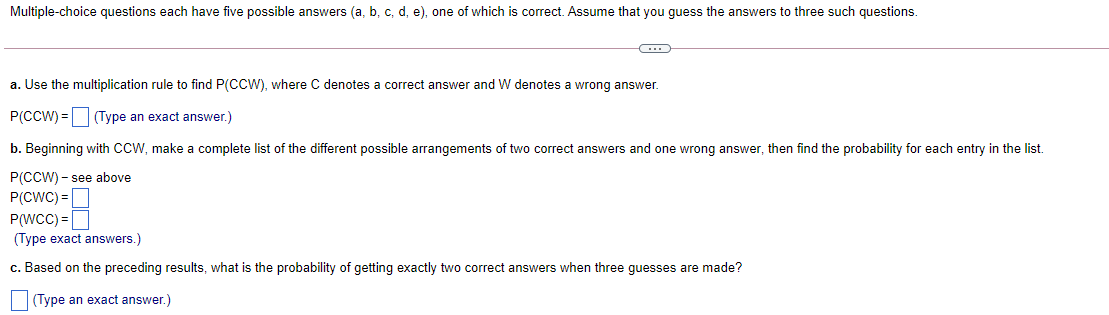
Multiple-choice questions each have five possible answers (a, b, c, d, e), one of which is correct. Assume that you guess the answers to three such questions. a. Use the multiplication rule to find P(CCW), where C denotes a correct answer and W denotes a wrong answer. P(CCW) = (Type an exact answer.) b. Beginning with CCW, make a complete list of the different possible arrangements of two correct answers and one wrong answer, then find the probability for each entry in the list. P(CCW) - see above P(CWC) = P(WCC) = (Type exact answers.) c. Based on the preceding results, what is the probability of getting exactly two correct answers when three guesses are made? (Type an exact answer.)
Step by Step Solution
There are 3 Steps involved in it

Get step-by-step solutions from verified subject matter experts
 Study Help