







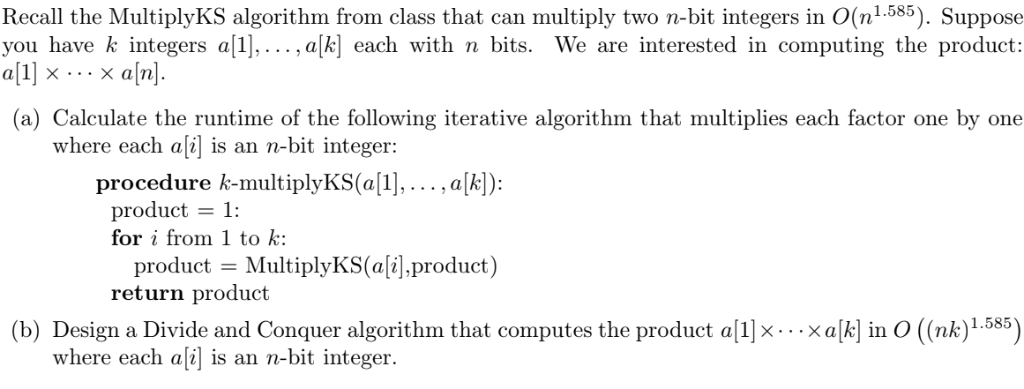
Question: MultiplyKS algorithm is following Recall the MultiplyKS algorithm from class that can multiply two n-bit integers in O(n1.585). Suppose you have k integers a[1ak each
MultiplyKS algorithm is following
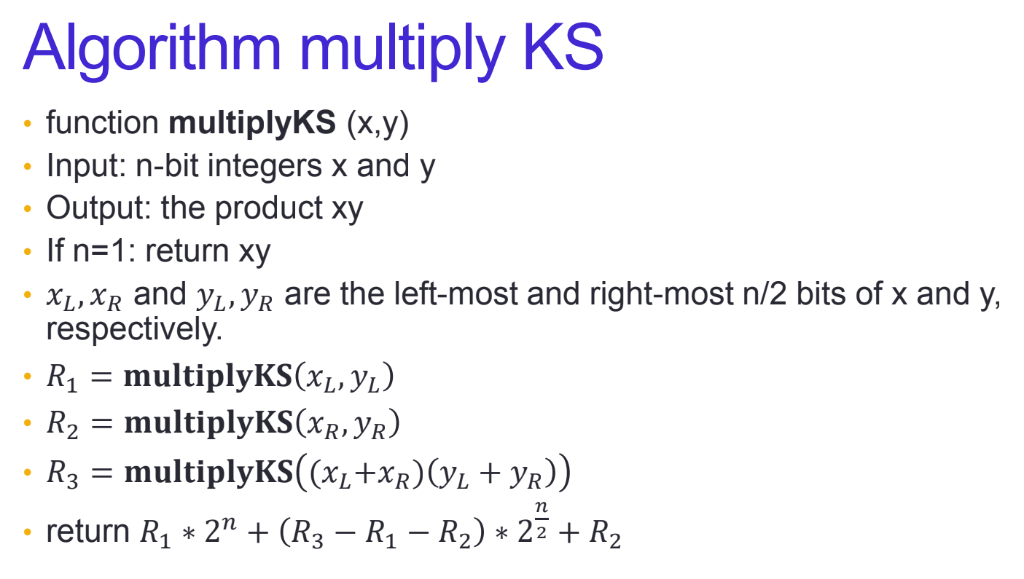
Recall the MultiplyKS algorithm from class that can multiply two n-bit integers in O(n1.585). Suppose you have k integers a[1ak each with n bits. We are interested in computing the product: a[1] aln] (a) Calculat e the runtime of the following iterative algorithm that multiplies each factor one by one where each ai is an n-bit integer: procedure k-multiplyKS(a[1],... , a[k]) product = 1: for i from 1 to k: product MultiplyKS(al product) return product (b) Design a Divide and Conquer algorithm that computes the product a[l]x...xalk] in O ((nk)1.585 where each ali is an n-bit integer Algorithm multiply KS function multiplyKS (x.y) Input: n-bit integers x and y Output: the product xy If n-1: return xy xL,R and yL,yR are the left-most and right-most n/2 bits of x and y, respectively. R1multiplyKS(Li) R2multiplyKS(xR.yR) Ka multiplyKS((XL+XR)0% + y) return R1 2n(R-R-R222 R2 respecinve. are the left-most and right-most n/2 Recall the MultiplyKS algorithm from class that can multiply two n-bit integers in O(n1.585). Suppose you have k integers a[1ak each with n bits. We are interested in computing the product: a[1] aln] (a) Calculat e the runtime of the following iterative algorithm that multiplies each factor one by one where each ai is an n-bit integer: procedure k-multiplyKS(a[1],... , a[k]) product = 1: for i from 1 to k: product MultiplyKS(al product) return product (b) Design a Divide and Conquer algorithm that computes the product a[l]x...xalk] in O ((nk)1.585 where each ali is an n-bit integer Algorithm multiply KS function multiplyKS (x.y) Input: n-bit integers x and y Output: the product xy If n-1: return xy xL,R and yL,yR are the left-most and right-most n/2 bits of x and y, respectively. R1multiplyKS(Li) R2multiplyKS(xR.yR) Ka multiplyKS((XL+XR)0% + y) return R1 2n(R-R-R222 R2 respecinve. are the left-most and right-most n/2
Step by Step Solution
There are 3 Steps involved in it

Get step-by-step solutions from verified subject matter experts
 Study Help