







Question: Multivariate Calculus 14 (a-d only) 16. Consider the function f defined by f(x, y) = 8 - al - 3y?. a. Determine f(x, y) and
Multivariate Calculus
14 (a-d only)
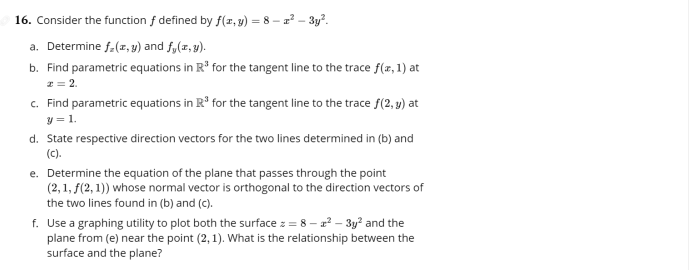
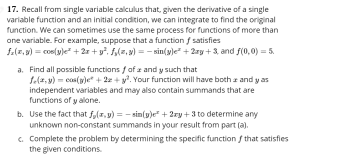
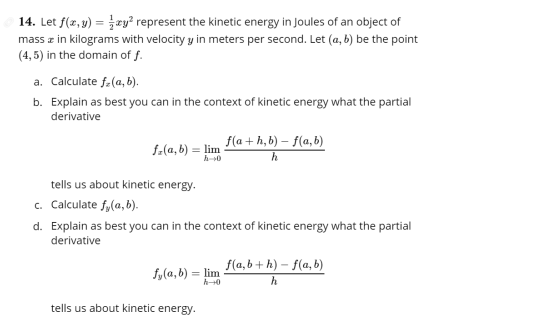
16. Consider the function f defined by f(x, y) = 8 - al - 3y?. a. Determine f(x, y) and fy(x, y). b. Find parametric equations in R for the tangent line to the trace f(x, 1) at = 2 c. Find parametric equations in R* for the tangent line to the trace f(2, y) at 7 = 1. d. State respective direction vectors for the two lines determined in (b) and (C). e. Determine the equation of the plane that passes through the point (2, 1, f(2, 1)) whose normal vector is orthogonal to the direction vectors of the two lines found in (b) and (c). f. Use a graphing utility to plot both the surface = = 8 - 23 - 3y' and the plane from (e) near the point (2, 1). What is the relationship between the surface and the plane?17. Recall from single variable calculus that, given the derivative of a single variable function and an initial condition, we can integrate to find the original function. We can sometimes use the same process for functions of more than one variable. For example. suppose that a function / satisfies flzy) = celyle + 2x + u, f(z, w) = - sindyled + Try + 3, and f(0,0) = 5. a, Find all possible functions / of s and y such that (x, y) = co(ple + le + y'. Your function will have both s and y as independent variables and may also contain summands that are functions of y clone. b. Use the fact that f (x.p) = - simtoje" + 2ry + 3 to determine any unknown non-constant summands in your result from part (a]. & Complete the problem by determining the specific function / that satisfies the given conditions14. Let x. y} = %:y3 represent the kinetic energy Injoules of an object of mass :e in kilograms with velocity 9 in meters per second. Let (a, b]- he 'le point [4, 5] in the domain of I. a. Calculate 3:35, in]. b. Explain as best you can in the context of kinetic energyI what the partial derivative mat.) =Hw tells us about kinetic energy. E. Calculate mm}. d. Explain as best you can in the context of kinetic energy what the partial derlvatlve at. e i. Inimbi= +1: .i'iwi' tells us about kinetic energy
Step by Step Solution
There are 3 Steps involved in it

Get step-by-step solutions from verified subject matter experts
 Study Help