







Question: Muscular Dystrophy. Duchenne Muscular Dystrophy (DMD) is a genetically transmitted disease, passed from a mother to her children. Boys with the disease usually die at
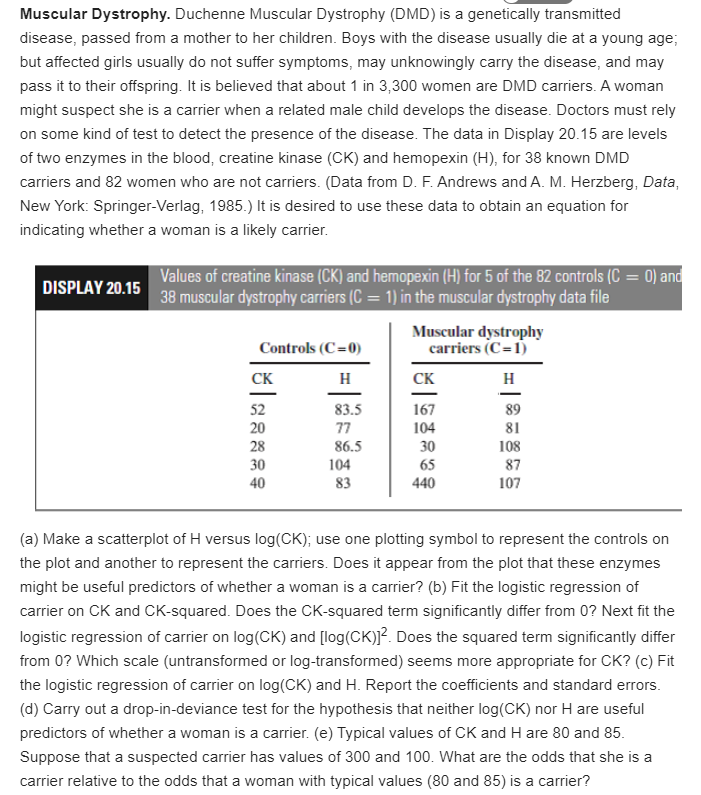
Muscular Dystrophy. Duchenne Muscular Dystrophy (DMD) is a genetically transmitted disease, passed from a mother to her children. Boys with the disease usually die at a young age; but affected girls usually do not suffer symptoms, may unknowingly carry the disease, and may pass it to their offspring. It is believed that about 1 in 3,300 women are DMD carriers. A woman might suspect she is a carrier when a related male child develops the disease. Doctors must rely on some kind of test to detect the presence of the disease. The data in Display 20.15 are levels of two enzymes in the blood, creatine kinase (CK) and hemopexin (H), for 38 known DMD carriers and 82 women who are not carriers. (Data from D. F. Andrews and A. M. Herzberg, Data, New York: Springer-Verlag, 1985.) It is desired to use these data to obtain an equation for indicating whether a woman is a likely carrier. DISPLAY 20.15 Values of creatine kinase (CK) and hemopexin (H) for 5 of the 82 controls (C = 0) and 38 muscular dystrophy carriers (C = 1) in the muscular dystrophy data file Muscular dystrophy Controls (C=0) carriers (C=1) CK H CK H 52 83.5 167 89 20 77 104 81 28 86.5 30 108 30 104 65 87 83 440 107 (a) Make a scatterplot of H versus log(CK); use one plotting symbol to represent the controls on the plot and another to represent the carriers. Does it appear from the plot that these enzymes might be useful predictors of whether a woman is a carrier? (b) Fit the logistic regression of carrier on CK and CK-squared. Does the CK-squared term significantly differ from 0? Next fit the logistic regression of carrier on log(CK) and [log(CK)]-. Does the squared term significantly differ from 0? Which scale (untransformed or log-transformed) seems more appropriate for CK? (c) Fit the logistic regression of carrier on log(CK) and H. Report the coefficients and standard errors. (d) Carry out a drop-in-deviance test for the hypothesis that neither log(CK) nor H are useful predictors of whether a woman is a carrier. (e) Typical values of CK and H are 80 and 85. Suppose that a suspected carrier has values of 300 and 100. What are the odds that she is a carrier relative to the odds that a woman with typical values (80 and 85) is a carrier
Step by Step Solution
There are 3 Steps involved in it

Get step-by-step solutions from verified subject matter experts
 Study Help