



Question: must all be handwritt/en please show all work and steps i got this question my wrong my tutor said (you must include the value for











must all be handwritt/en please show all work and steps
i got this question my wrong my tutor said (you must include the value for Power in Watts and answer in horsepower. )
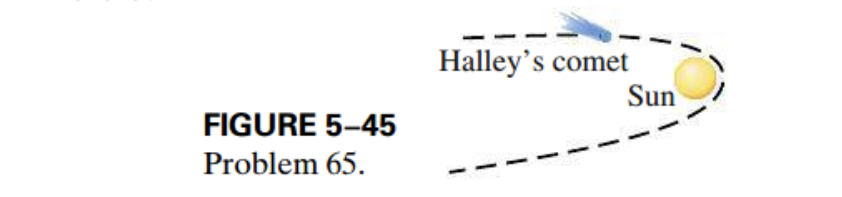











\f57. (I) Neptune is an average distance of 4.5 x 10⁹ km from the Sun. Estimate the length of the Neptunian year using the fact that the Earth is 1.50 x 10⁸ km from the Sun on average. 59. (1) Use Kepler's laws and the period of the Moon (27.4 d) to determine the period of an artificial satellite orbiting very near the Earth's surface.65. (ll) Halley's comet orbits the Sun roughly once every 76 years. It comes very close to the surface of the Sun on its closest approach (Fig. 545). Estimate the greatest distance of the comet from the Sun. Is it still \"in\" the solar system? What planet's orbit is nearest when it is out there? 31. (II) Two objects attract each other gravitationally with a force of 2.5 x 10'10 N when they are 0.25 m apart. Their total mass is 4.00 kg. Find their individual masses. 39. (II) Calculate the effective value of g, the acceleration ofgravity, at (a) 6400 m, and (b) 6400 km, above the Earth's surface. 63. (II) A driver notices that her 1080-kg car, when in neutral, slows down from 95 km/h to 65 km/h in about 7.0 s on a flat horizontal road. Approximately what power (watts and hp) is needed to keep the car traveling at a constant 80 km/h? 35. (II) A spring with k = 83 N/m hangs vertically next to a ruler. The end of the spring is next to the 15-cm mark on the ruler. If a 2.5-kg mass is now attached to the end of the spring, and the mass is allowed to fall, where will the end of the spring line up with the ruler marks when the mass is at its lowest position? 39. (II) A vertical spring (ignore its mass), whose spring constant is 875 N/m, is attached to a table and is compressed down by 0.160 m. (a) What upward speed can it give to a 0.380kg ball when released? (b) How high above its original position (spring compressed) will the ball fly? (II) In a certain library the first shelf is 15.0 cm off the ground, and the remaining four shelves are each spaced 38.0 cm above the previous one. Ifthe average book has a mass of 1.40 kg with a height of 22.0 cm, and an average shelf holds 28 books (standing vertically), how much work is required to fill all the shelves, assuming the books are all laying flat on the floor to start? 731 17. (I) How much work is required to stop an electron (m = 911x10 kg) which is moving with a speed of 1.10 x10⁶m/s? 51. (ll) What will a spring scale read for the weight of a 58.0-kg woman in an elevator that moves (a) upward with constant speed 5.0 m/s, (b) downward with constant speed 5.0 m/s, (c) with an upward acceleration 0.23 g, (d) with a downward acceleration 0.23 g, and (e) in free fall
Step by Step Solution
There are 3 Steps involved in it

Get step-by-step solutions from verified subject matter experts