







Question: Must use MySQL to implement the database you designed in Part I. Test the queries you used to create and populate the database in MySQL.
Must use MySQL to implement the database you designed in Part I. Test the queries you used to create and populate the database in MySQL. After successful completion of an SQL query: (ENTER INFO FOR DRY CLEANER BUSINESS using link provided)
https://www.chegg.com/homework-help/questions-and-answers/must-use-mysql-implement-database-designed-part--test-queries-used-create-populate-databas-q29124463
-Take a screen shot (Alt + Print Screen) that includes the query, the confirmation message, the results (if any), and your name.
ANSWER QUESTION 4.D & 4. E
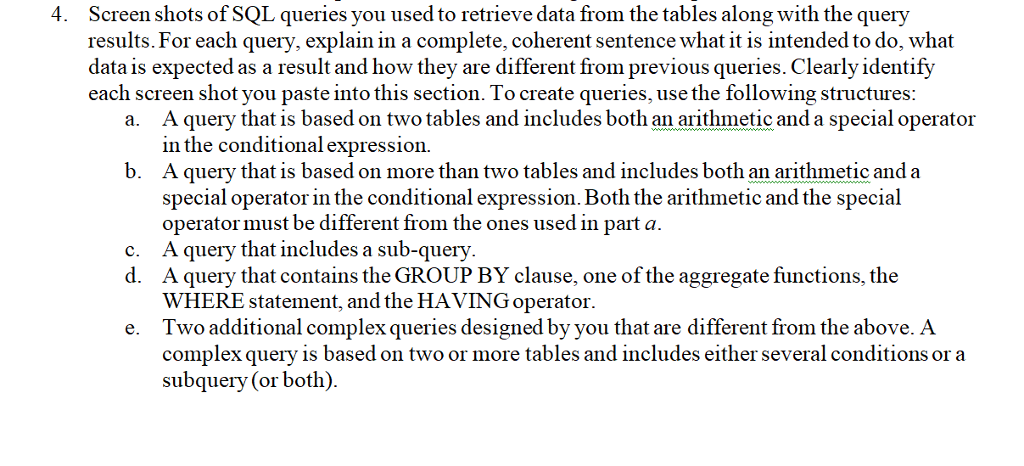
Screen shots of SQL queries you used to retrieve data from the tables along with the query results. For each query, explain in a complete, coherent sentence what it is intended to do, what data is expected as a result and how they are different from previous queries. Clearly identify each screen shot you paste into this section. To create queries, use the following structures 4. a. A query that is based on two tables and includes both an arithmetic and a special operator in the conditional expression. A query that is based on more than two tables and includes both an arithmetic and a special operator in the conditional expression. Both the arithmetic and the special operator must be different from the ones used in part a. A query that includes a sub-query A query that contains the GROUP BY clause, one of the aggregate functions, the WHERE statement, and the HAVING operator. Two additional complex queries designed by you that are different from the above. A complex query is based on two or more tables and includes either several conditions or a subquery (or both) b. c. d. e
Step by Step Solution
There are 3 Steps involved in it

Get step-by-step solutions from verified subject matter experts
 Study Help