Question: my post: A controlling financial interest is defined as an investment of 50% or more of the voting equity of another entity(or related group of
my post:
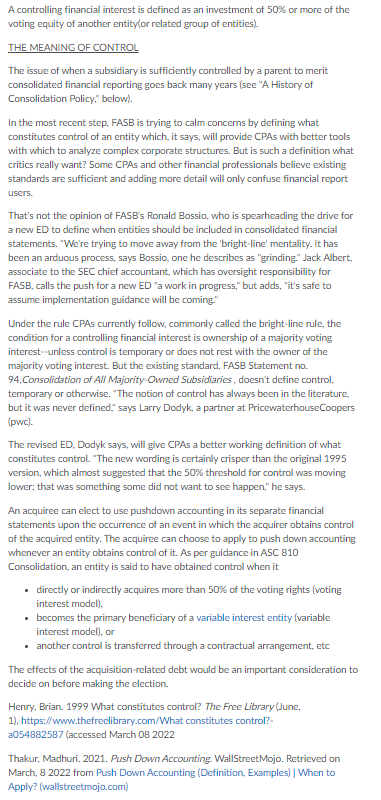
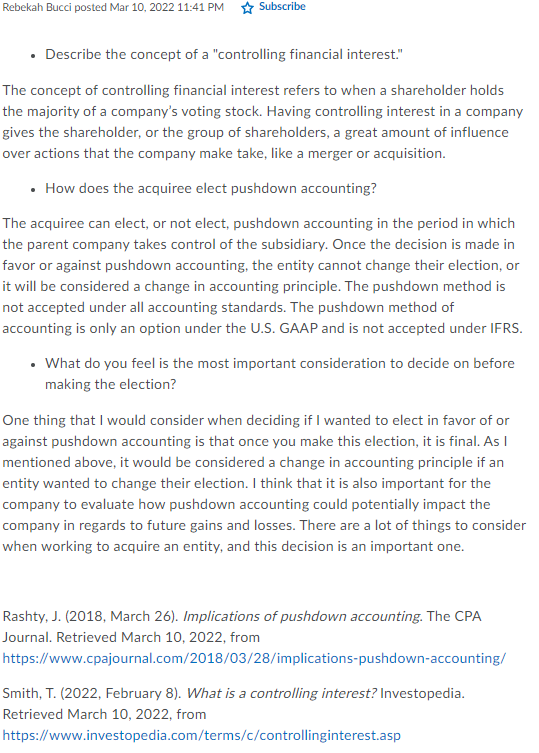
A controlling financial interest is defined as an investment of 50% or more of the voting equity of another entity(or related group of entities). THE MEANING OF CONTROL The issue of when a subsidiary is sufficiently controlled by a parent to merit consolidated financial reporting goes back many years (see "A History of Consolidation Policy," below. In the most recent step, FASB is trying to calm concerns by defining what constitutes control of an entity which, it says, will provide CPAs with better tools with which to analyze complex corporate structures. But is such a definition what critics really want? Some CPAs and other financial professionals believe existing standards are sufficient and adding more detail will only confuse financial report users. That's not the opinion of FASB's Ronald Bossio, who is spearheading the drive for a new ED to define when entities should be included in consolidated financial statements. "We're trying to move away from the 'bright-line' mentality. It has been an arduous process, says Bossio, one he describes as "grinding." Jack Albert, associate to the SEC chief accountant, which has oversight responsibility for FASB, calls the push for a new ED "a work in progress," but adds, "it's safe to assume implementation guidance will be coming." Under the rule CPAs currently follow, commonly called the bright-line rule, the condition for a controlling financial interest is ownership of a majority voting interest--unless control is temporary or does not rest with the owner of the majority voting interest. But the existing standard, FASB Statement no. 94, Consolidation of All Majority-Owned Subsidiaries, doesn't define control, temporary or otherwise. "The notion of control has always been in the literature. but it was never defined," says Larry Dodyk, a partner at PricewaterhouseCoopers (pwc). The revised ED, Dodyk says, will give CPAs a better working definition of what constitutes control. "The new wording is certainly crisper than the original 1995 version, which almost suggested that the 50% threshold for control was moving lower; that was something some did not want to see happen," he says. An acquiree can elect to use pushdown accounting in its separate financial statements upon the occurrence of an event in which the acquirer obtains control of the acquired entity. The acquiree can choose to apply to push down accounting whenever an entity obtains control of it. As per guidance in ASC 810 Consolidation, an entity is said to have obtained control when it . directly or indirectly acquires more than 50% of the voting rights (voting interest model). . becomes the primary beneficiary of a variable interest entity (variable interest model), or . another control is transferred through a contractual arrangement, etc The effects of the acquisition-related debt would be an important consideration to decide on before making the election. Henry, Brian. 1999 What constitutes control? The Free Library (June, 1), https:/www.thefreelibrary.com/What constitutes control?- 3054882587 (accessed March 08 2022 Thakur, Madhuri. 2021. Push Down Accounting. WallStreetMojo. Retrieved on March, 8 2022 from Push Down Accounting (Definition, Examples) | When to Apply? (wallstreetmojo.com)Rebekah Bucci posted Mar 10, 2022 11:41 PM Subscribe . Describe the concept of a "controlling financial interest." The concept of controlling financial interest refers to when a shareholder holds the majority of a company's voting stock. Having controlling interest in a company gives the shareholder, or the group of shareholders, a great amount of influence over actions that the company make take, like a merger or acquisition. . How does the acquiree elect pushdown accounting? The acquiree can elect, or not elect, pushdown accounting in the period in which the parent company takes control of the subsidiary. Once the decision is made in favor or against pushdown accounting, the entity cannot change their election, or it will be considered a change in accounting principle. The pushdown method is not accepted under all accounting standards. The pushdown method of accounting is only an option under the U.S. GAAP and is not accepted under IFRS. . What do you feel is the most important consideration to decide on before making the election? One thing that I would consider when deciding if I wanted to elect in favor of or against pushdown accounting is that once you make this election, it is final. As I mentioned above, it would be considered a change in accounting principle if an entity wanted to change their election. I think that it is also important for the company to evaluate how pushdown accounting could potentially impact the company in regards to future gains and losses. There are a lot of things to consider when working to acquire an entity, and this decision is an important one. Rashty, J. (2018, March 26). Implications of pushdown accounting. The CPA Journal. Retrieved March 10, 2022, from https://www.cpajournal.com/2018/03/28/implications-pushdown-accounting/ Smith, T. (2022, February 8). What is a controlling interest? Investopedia. Retrieved March 10, 2022, from https://www.investopedia.com/terms/c/controllinginterest.asp
Step by Step Solution
There are 3 Steps involved in it
1 Expert Approved Answer
Step: 1 Unlock
Question Has Been Solved by an Expert!
Get step-by-step solutions from verified subject matter experts
Step: 2 Unlock
Step: 3 Unlock
Students Have Also Explored These Related Accounting Questions!