







Question: my program is an advisorbot which is a command line program that can carry out various tasks to help a cryptocurrency investor analyse the data
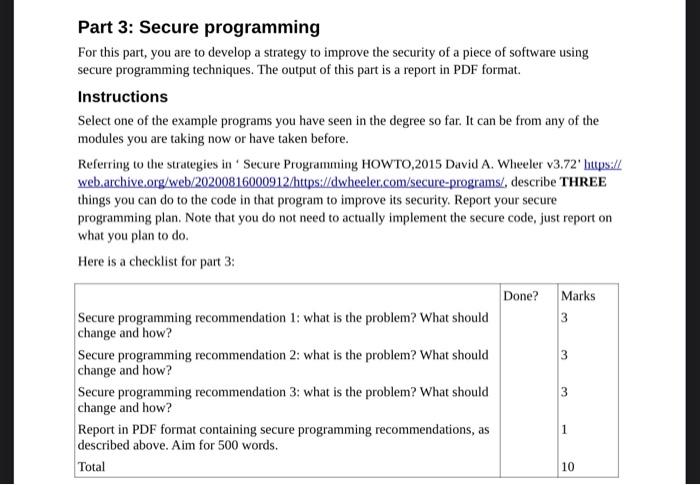
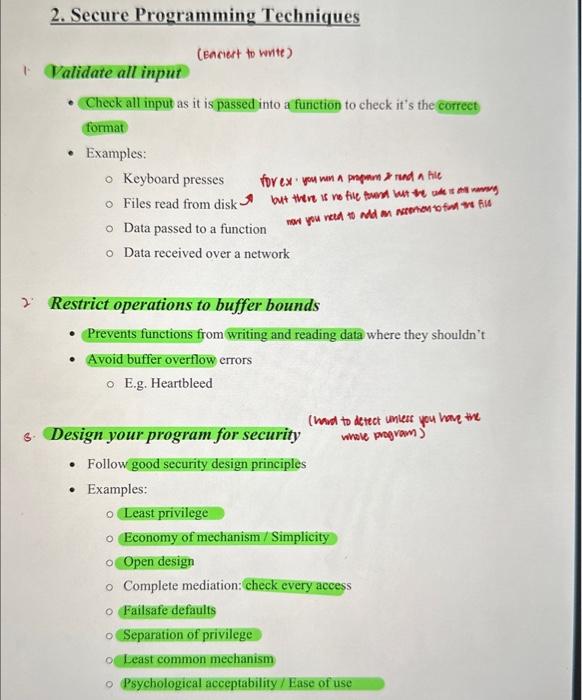
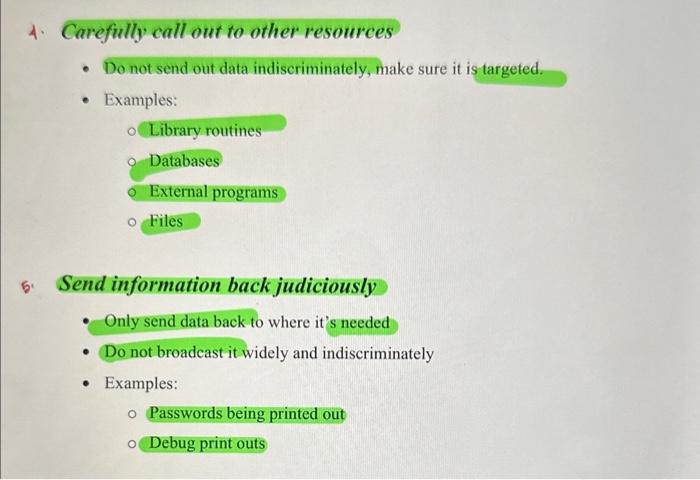
Part 3: Secure programming For this part, you are to develop a strategy to improve the security of a piece of software using secure programming techniques. The output of this part is a report in PDF format. Instructions Select one of the example programs you have seen in the degree so far. It can be from any of the modules you are taking now or have taken before. Referring to the strategies in 'Secure Programming HOWTO,2015 David A. Wheeler v3.72' hws:/l web.archive.org/web/20200816000912/https://dwheelercom/secure-programs/, describe THREE things you can do to the code in that program to improve its security. Report your secure programming plan. Note that you do not need to actually implement the secure code, just report on what you plan to do. (Eaciest to whte) 1. Validate all input - Check all input as it is passed into a function to check it's the correct format - Examples: Keyboard presses for ex younun a papan \& rad a alle Data received over a network Restrict operations to buffer bounds - Prevents functions from writing and reading data where they shouldn't - Avoid buffer overflow errors E.g. Heartbleed - Follow good security design principles - Examples: Least privilege Economy of mechanism / Simplicity Open design Complete mediation: check every access Failsafe defaults Separation of privilege Least common mechanism Psychological acceptability / Ease of use 4. Carefully call out to other resources - Do not send out data indiscriminately, make sure it is targeted. - Examples: Library routines Databases External programs 5. Send information back judiciously - Only send data back to where it's needed - Do not broadcast it widely and indiscriminately - Examples: Passwords being printed out Debug print outs
Step by Step Solution
There are 3 Steps involved in it

Get step-by-step solutions from verified subject matter experts
 Study Help