Question: My question for this case is. Apply the five steps of the Planning Process to Ubers development of its app-driven online cab service. Outline the
My question for this case is.
- Apply the five steps of the Planning Process to Ubers development of its app-driven online cab service.
- Outline the Strategic, Tactical, and Functional plans Uber has concerning its new self-driving car program. Show at least one plus and one minus within each of the plans.
- Plans rarely absolutely go to plan! It is impossible as variables in the environment keep changing and impact the company in different ways. What planning tools might Uber use to deal with some of the unexpected issues Uber has faced with its online cab business model.
- How might Uber use Management by Objectives to work with municipalities and provinces to create the infrastructure and legislation needed to achieve its self-driving car goals?
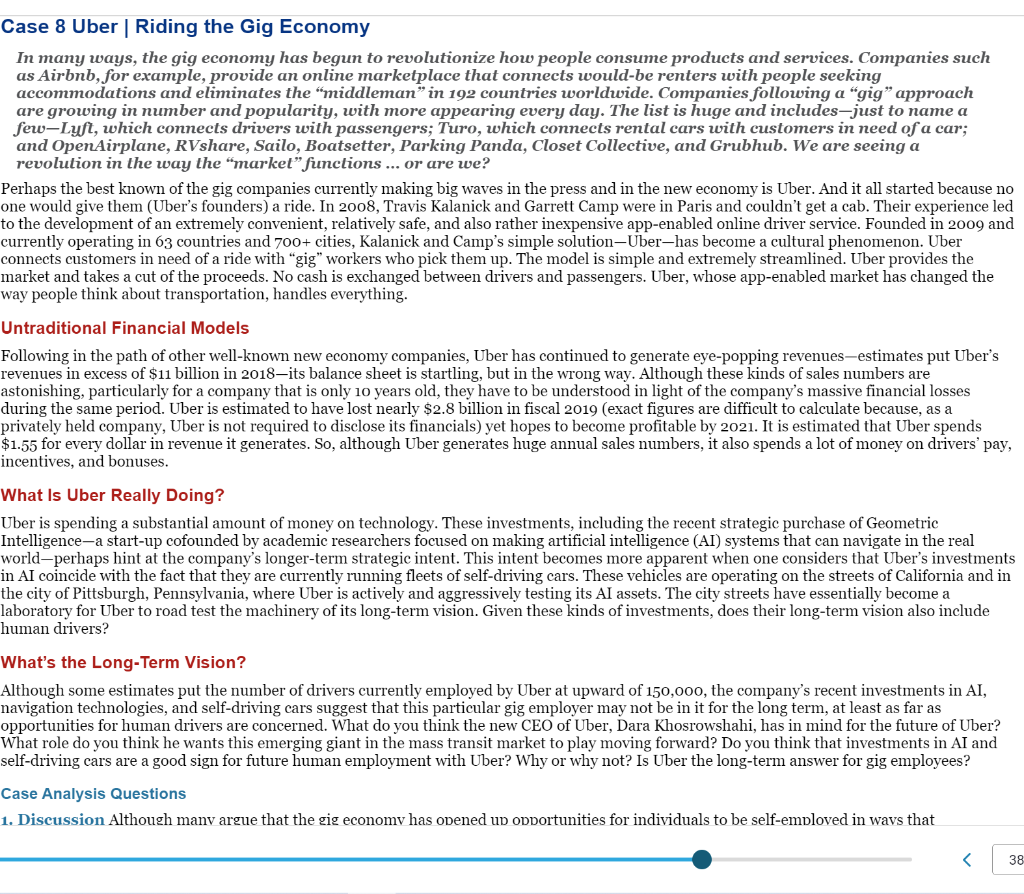
Case 8 Uber Riding the Gig Economy In many ways, the gig economy has begun to revolutionize how people consume products and services. Companies such as Airbnb, for example, provide an online marketplace that connects would-be renters with people seeking accommodations and eliminates the "middleman" in 192 countries worldwide. Companies following a "gig" approach are growing in number and popularity, with more appearing every day. The list is huge and includes-just to name a few-Lyft, which connects drivers with passengers; Turo, which connects rental cars with customers in need of a car; and OpenAirplane, RVshare, Sailo, Boatsetter, Parking Panda, Closet Collective, and Grubhub. We are seeing a revolution in the way the "market" functions... or are we? Perhaps the best known of the gig companies currently making big waves in the press and in the new economy is Uber. And it all started because no one would give them (Uber's founders) a ride. In 2008, Travis Kalanick and Garrett Camp were in Paris and couldn't get a cab. Their experience led to the development of an extremely convenient, relatively safe, and also rather inexpensive app-enabled online driver service. Founded in 2009 and currently operating in 63 countries and 700+ cities, Kalanick and Camp's simple solution-Uber-has become a cultural phenomenon. Uber connects customers in need of a ride with "gig workers who pick them up. The model is simple and extremely streamlined. Uber provides the market and takes a cut of the proceeds. No cash is exchanged between drivers and passengers. Uber, whose app-enabled market has changed the way people think about transportation, handles everything. Untraditional Financial Models Following in the path of other well-known new economy companies, Uber has continued to generate eye-popping revenues-estimates put Uber's revenues in excess of $11 billion in 2018-its balance sheet is startling, but in the wrong way. Although these kinds of sales numbers are astonishing, particularly for a company that is only 10 years old, they have to be understood in light of the company's massive financial losses during the same period. Uber is estimated to have lost nearly $2.8 billion in fiscal 2019 (exact figures are difficult to calculate because, as a privately held company, Uber is not required to disclose its financials) yet hopes to become profitable by 2021. It is estimated that Uber spends $1.55 for every dollar in revenue it generates. So, although Uber generates huge annual sales numbers, it also spends a lot of money on drivers' pay, incentives, and bonuses. What Is Uber Really Doing? Uber is spending a substantial amount of money on technology. These investments, including the recent strategic purchase of Geometric Intelligence-a start-up cofounded by academic researchers focused on making artificial intelligence (AI) systems that can navigate in the real world-perhaps hint at the company's longer-term strategic intent. This intent becomes more apparent when one considers that Uber's investments in AI coincide with the fact that they are currently running fleets of self-driving cars. These vehicles are operating on the streets of California and in the city of Pittsburgh, Pennsylvania, where Uber is actively and aggressively testing its AI assets. The city streets have essentially become a laboratory for Uber to road test the machinery of its long-term vision. Given these kinds of investments, does their long-term vision also include human drivers? What's the Long-Term Vision? Although some estimates put the number of drivers currently employed by Uber at upward of 150,000, the company's recent investments in AI, navigation technologies, and self-driving cars suggest that this particular gig employer may not be in it for the long term, at least as far as opportunities for human drivers are concerned. What do you think the new CEO of Uber, Dara Khosrowshahi, has in mind for the future of Uber? What role do you think he wants this emerging giant in the mass transit market to play moving forward? Do you think that investments in AI and self-driving cars are a good sign for future human employment with Uber? Why or why not? Is Uber the long-term answer for gig employees? Case Analysis Questions 1. Discussion Although many argue that the gig economy has opened up opportunities for individuals to be self-emploved in ways that 38









 Study Help