







Question: My question is 3.3, answer in python is preferable. B Assigiment LF13 C localhost:8888otebooks/Assignment 1 F18.ipynb Apps For quick access, place your bookmarks here on
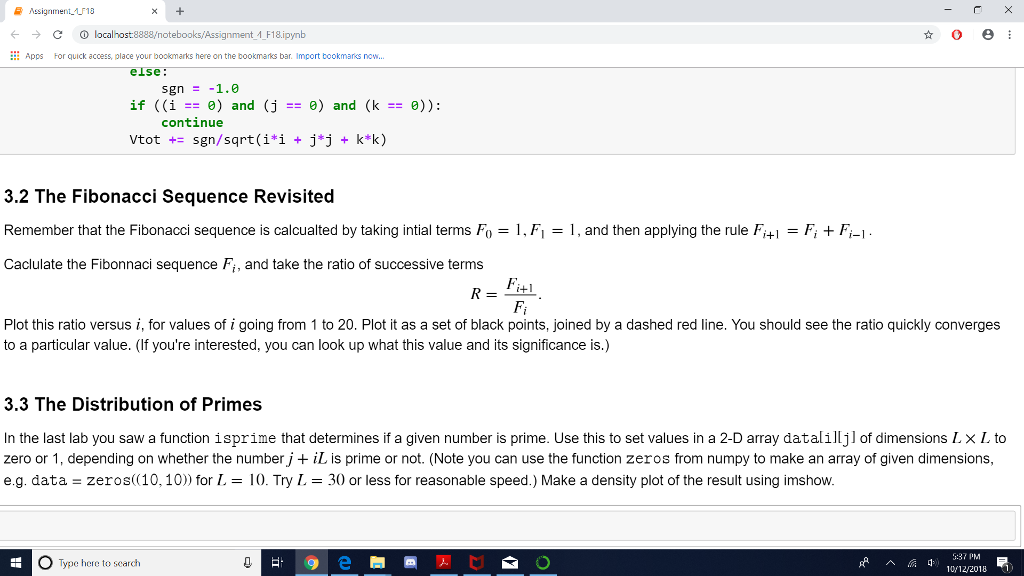
My question is 3.3, answer in python is preferable.
B Assigiment LF13 C localhost:8888otebooks/Assignment 1 F18.ipynb Apps For quick access, place your bookmarks here on the bookmarks bar. Import bookmarks now... sgn -1.0 if ((1-= ) and (j-= ) and (k- e)): continue Vtot sgn/sqrt (1+1 j*j k*k) += + + 3.2 The Fibonacci Sequence Revisited Remember that the Fibonacci sequence is calcualted by taking intial terms Fo = IF-I , and then applying the rule Fi+1 = Fi Caclulate the Fibonnaci sequence Fi, and take the ratio of successive terms Fi-i Plot this ratio versus i, for values of i going from 1 to 20. Plot it as a set of black points, joined by a dashed red line. You should see the ratio quickly converges to a particular value. (If you're interested, you can look up what this value and its significance is.) 3.3 The Distribution of Primes In the last lab you saw a function isprime that determines if a given number is prime. Use this to set values in a 2-D array datalilljl of dimensions Lx L to zero or 1, depending on whether the number j + iL is prime or not. (Note you can use the function zeros from numpy to make an array of given dimensions e.g. data = zeros(( 10, 10)) for 1.-10. Try 1.-30 or less for reasonable speed.) Make a density plot of the result using imshow O Type here to search 1012/2018
Step by Step Solution
There are 3 Steps involved in it

Get step-by-step solutions from verified subject matter experts
 Study Help