



Question: My questions are : 1) How would your answer change if you had a working capital needed of $15000 to be released at the end
My questions are :
1) How would your answer change if you had a working capital needed of $15000 to be released at the end of year 12 as well as an investment credit of 6% on the total investment includingsoftware and installation paid in year 1 and a required rate of return of 18%? Show computations.
2) Going back to part I: How would your answer change if you had a 30% tax rate? Show computations (Use 12 years straight line for depreciation for robot and software)
3 ) Compute IRR for Part 1, Part II, Part III
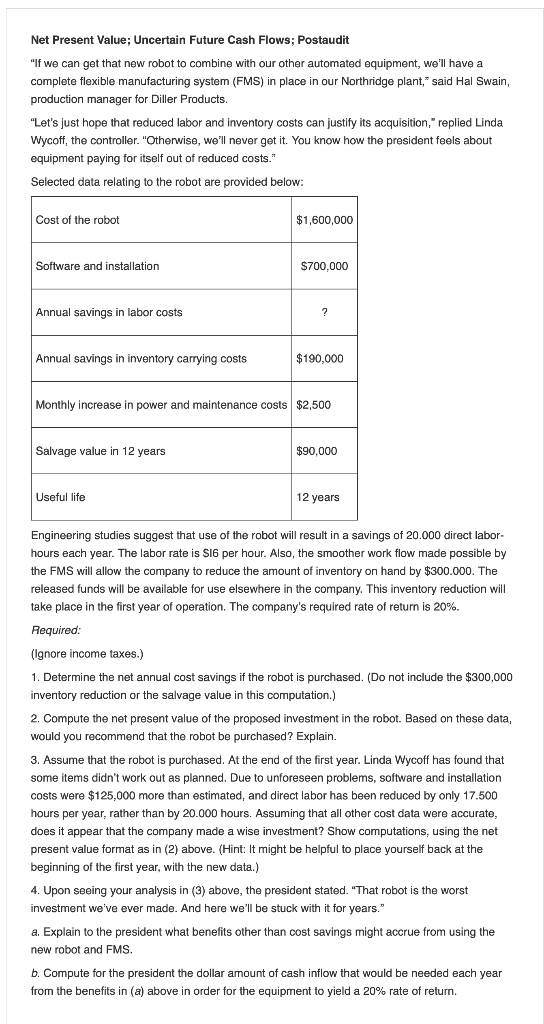
Net Present Value: Uncertain Future Cash Flows: Postaudit "If we can get that new robot to combine with our other automated equipment, we'll have a complete flexible manufacturing system (FMS) in place in our Northridge plant," said Hal Swain production manager for Diller Products "Let's just hope that reduced labor and inventory costs can justify its acquisition, replied Linda Wycoff, the controller. "Otherwise, we'll never get it. You know how the president feels about equipment paying for itself out of reduced costs." Selected data relating to the robot are provided below Cost of the robot $1,600,000 Software and installation $700,000 Annual savings in labor costs Annual savings in inventory carrying costs $190,000 Monthly increase in power and maintenance costs $2,500 Salvage value in 12 years $90,000 Useful life 12 years Engineering studies suggest that use of the robot will result in a savings of 20.000 direct labor hours each year. The labor rate is SI6 per hour. Also, the smoother work flow made possible by the FMS will allow the company to reduce the amount of inventory on hand by $300.000. The released funds will be available for use elsewhere in the company. This inventory reduction will take place in the first year of operation. The company's required rate of return is 20%. Required (Ignore income taxes.) 1. Determine the net annual cost savings if the robot is purchased. (Do not include the $300,000 inventory reduction or the salvage value in this computation.) 2. Compute the net present value of the proposed investment in the robot. Based on these data, would you recommend that the robot be purchased? Explain 3. Assume that the robot is purchased. At the end of the first year. Linda Wycoff has found that some items didn't work out as planned. Due to unforeseen problems, software and installation costs were $125,000 more than estimated, and direct labor has been reduced by only 17.500 hours per year, rather than by 20.000 hours. Assuming that all other cost data were accurate does it appear that the company made a wise investment? Show computations, using the net present value format as in (2) above. (Hint: It might be helpful to place yourself back at the beginning of the first year, with the new data.) 4. Upon seeing your analysis in (3) above, the president stated. "That robot is the worst investment we've ever made. And here we'll be stuck with it for years a. Explain to the president what benefits other than cost savings might accrue from using the new robot and FMS. b. Compute for the president the dollar amount of cash inflow that would be needed each year from the benefits in (a) above in order for the equipment to yield a 20% rate of return. Net Present Value: Uncertain Future Cash Flows: Postaudit "If we can get that new robot to combine with our other automated equipment, we'll have a complete flexible manufacturing system (FMS) in place in our Northridge plant," said Hal Swain production manager for Diller Products "Let's just hope that reduced labor and inventory costs can justify its acquisition, replied Linda Wycoff, the controller. "Otherwise, we'll never get it. You know how the president feels about equipment paying for itself out of reduced costs." Selected data relating to the robot are provided below Cost of the robot $1,600,000 Software and installation $700,000 Annual savings in labor costs Annual savings in inventory carrying costs $190,000 Monthly increase in power and maintenance costs $2,500 Salvage value in 12 years $90,000 Useful life 12 years Engineering studies suggest that use of the robot will result in a savings of 20.000 direct labor hours each year. The labor rate is SI6 per hour. Also, the smoother work flow made possible by the FMS will allow the company to reduce the amount of inventory on hand by $300.000. The released funds will be available for use elsewhere in the company. This inventory reduction will take place in the first year of operation. The company's required rate of return is 20%. Required (Ignore income taxes.) 1. Determine the net annual cost savings if the robot is purchased. (Do not include the $300,000 inventory reduction or the salvage value in this computation.) 2. Compute the net present value of the proposed investment in the robot. Based on these data, would you recommend that the robot be purchased? Explain 3. Assume that the robot is purchased. At the end of the first year. Linda Wycoff has found that some items didn't work out as planned. Due to unforeseen problems, software and installation costs were $125,000 more than estimated, and direct labor has been reduced by only 17.500 hours per year, rather than by 20.000 hours. Assuming that all other cost data were accurate does it appear that the company made a wise investment? Show computations, using the net present value format as in (2) above. (Hint: It might be helpful to place yourself back at the beginning of the first year, with the new data.) 4. Upon seeing your analysis in (3) above, the president stated. "That robot is the worst investment we've ever made. And here we'll be stuck with it for years a. Explain to the president what benefits other than cost savings might accrue from using the new robot and FMS. b. Compute for the president the dollar amount of cash inflow that would be needed each year from the benefits in (a) above in order for the equipment to yield a 20% rate of return
Step by Step Solution
There are 3 Steps involved in it

Get step-by-step solutions from verified subject matter experts