







Question: MyList.java import java.util.Iterator; public interface MyList { /** * Returns the number of elements in this list. * @return
MyList.java
import java.util.Iterator;
public interface MyList
/**
* Returns the number of elements in this list.
* @return the number of elements in this list
*/
int size();
/**
* Returns true if this list contains no elements.
* @return true if this list contains no elements
*/
boolean isEmpty();
/**
* Appends the specified element to the end of this list.
* @param element element to be appended to this list
* @return true
*/
boolean add(E element);
/**
* Returns the element at the specified position in this list.
* @param index index of the element to return
* @return the element at the specified position in this list
* @throws IndexOutOfBoundsException - if the index is out of range
* (index = size())
*/
E get(int index);
/**
* Replaces the element at the specified position in this list with the
* specified element.
* @param index index of the element to return
* @param element element to be stored at the specified position
* @return the element at the specified position in this list
* @throws IndexOutOfBoundsException - if the index is out of range
* (index = size())
*/
E set(int index, E element);
/**
* Removes all of the elements from this list.
*/
void clear();
/**
* Returns an iterator over the elements in this list in proper sequence.
* @return an iterator over the elements in this list in proper sequence
*/
Iterator
/***************************************************************************
* Signatures below this line are for homework. Implement the methods in
* both MyArrayList and MyLinkedList.
**************************************************************************/
/**
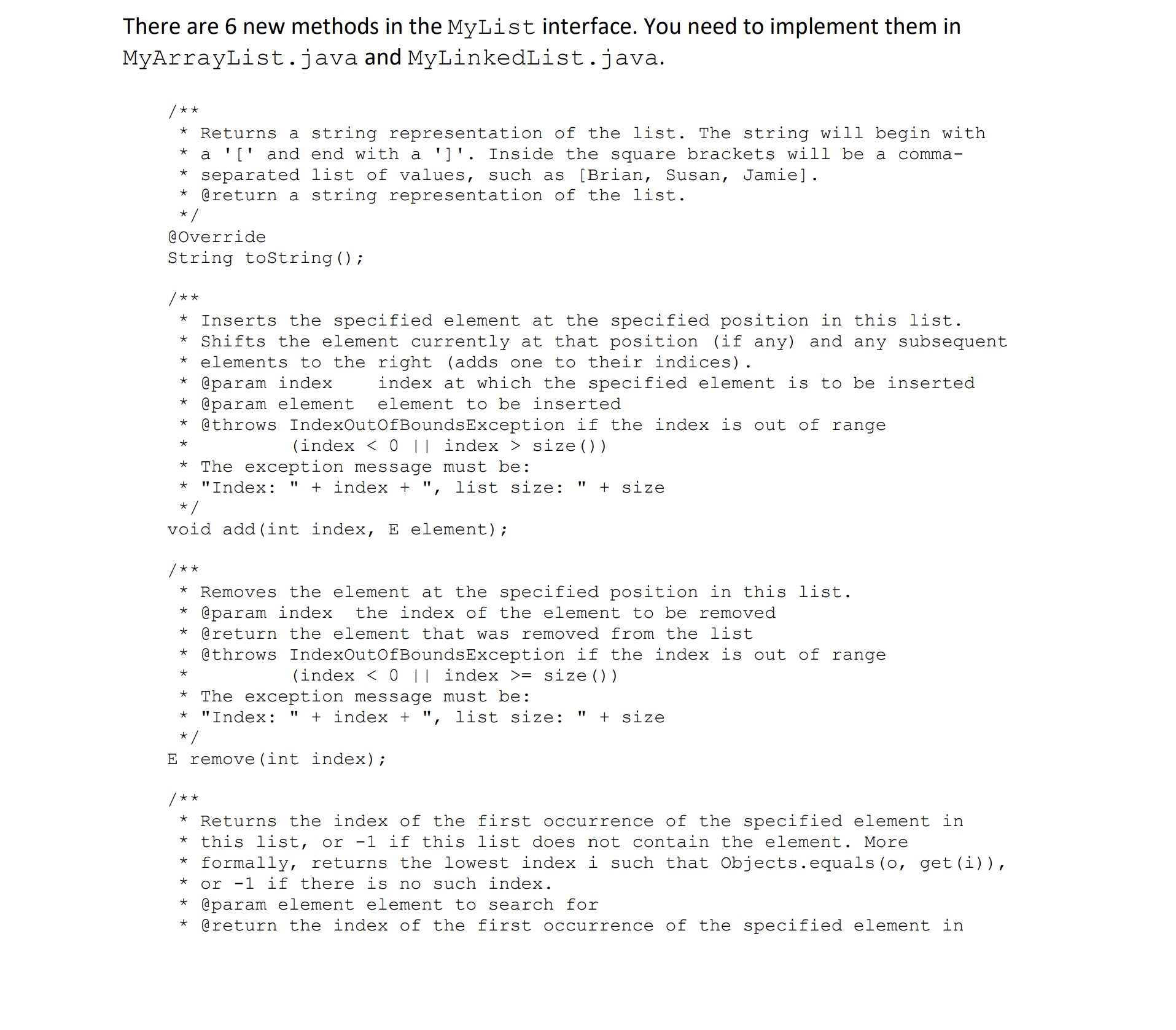
* Returns a string representation of the list. The string will begin with
* a '[' and end with a ']'. Inside the square brackets will be a comma-
* separated list of values, such as [Brian, Susan, Jamie].
* @return a string representation of the list
*/
@Override
String toString();
/**
* Inserts the specified element at the specified position in this list.
* Shifts the element currently at that position (if any) and any subsequent
* elements to the right (adds one to their indices).
* @param index index at which the specified element is to be inserted
* @param element element to be inserted
* @throws IndexOutOfBoundsException if the index is out of range
* (index size())
* The exception message must be:
* "Index: " + index + ", list size: " + size
*/
void add(int index, E element);
/**
* Removes the element at the specified position in this list.
* @param index the index of the element to be removed
* @return the element that was removed from the list
* @throws IndexOutOfBoundsException if the index is out of range
* (index = size())
* The exception message must be:
* "Index: " + index + ", list size: " + size
*/
E remove(int index);
/**
* Returns the index of the first occurrence of the specified element in
* this list, or -1 if this list does not contain the element. More
* formally, returns the lowest index i such that Objects.equals(o, get(i)),
* or -1 if there is no such index.
* @param element element to search for
* @return the index of the first occurrence of the specified element in
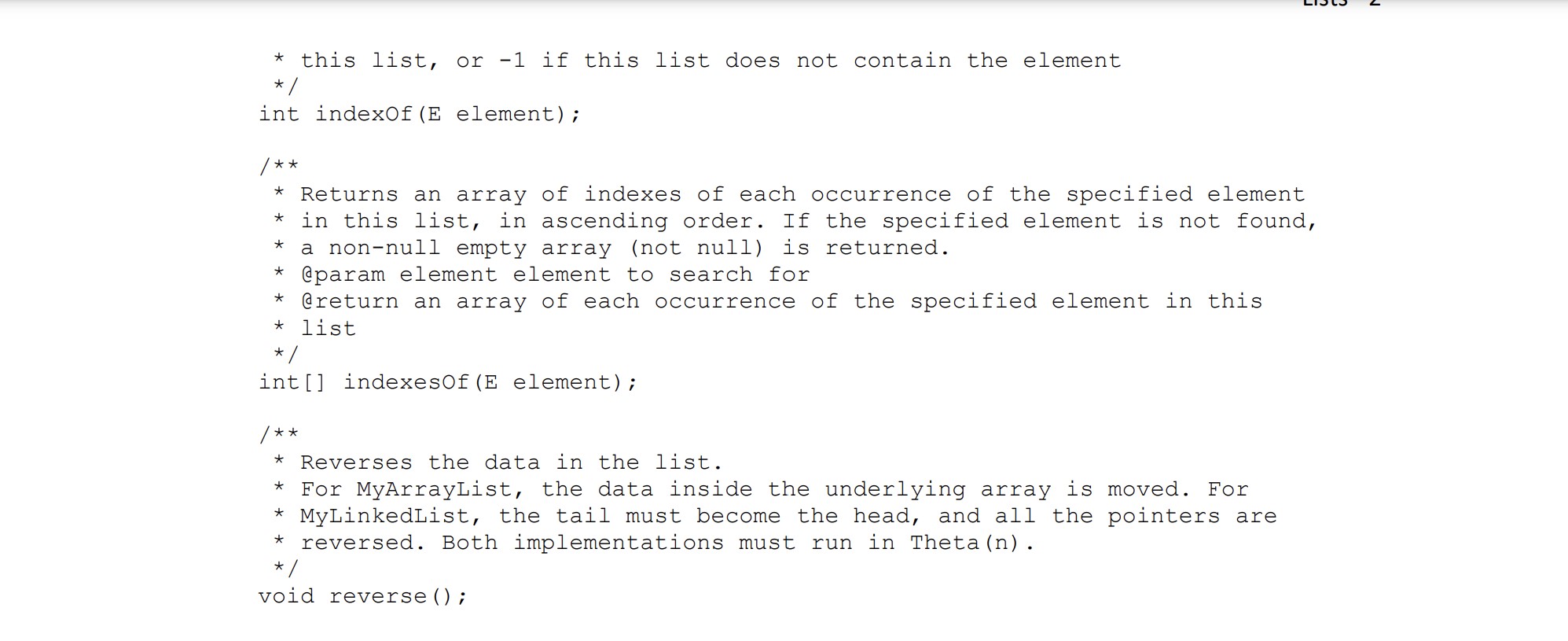
* this list, or -1 if this list does not contain the element
*/
int indexOf(E element);
/**
* Returns an array of indexes of each occurrence of the specified element
* in this list, in ascending order. If the specified element is not found,
* a non-null empty array (not null) is returned.
* @param element element to search for
* @return an array of each occurrence of the specified element in this
* list
*/
int[] indexesOf(E element);
/**
* Reverses the data in the list.
* For MyArrayList, the data inside the underlying array is moved. For
* MyLinkedList, the tail must become the head, and all the pointers are
* reversed. Both implementations must run in Theta(n).
*/
void reverse();
}
MyArrayList.java
import java.util.Iterator;
public class MyArrayList
/**
* Default initial capacity.
*/
private static final int DEFAULT_CAPACITY = 10;
/**
* The size of the ArrayList (the number of elements it contains).
*/
private int size;
/**
* The array buffer into which the elements of the ArrayList are stored.
* The capacity of the ArrayList is the length of this array buffer.
*/
Object[] elementData; // non-private to simplify nested class access
/**
* Constructs an empty list with the specified initial capacity.
* @param initialCapacity the initial capacity of the list
* @throws IllegalArgumentException if the specified initial capacity
* is negative
*/
public MyArrayList(int initialCapacity) {
if (initialCapacity throw new IllegalArgumentException("Illegal Capacity: " +
initialCapacity);
}
this.elementData = new Object[initialCapacity];
}
/**
* Constructs an empty list with an initial capacity of ten.
*/
public MyArrayList() {
this.elementData = new Object[DEFAULT_CAPACITY];
}
/**
* Returns the number of elements in this list.
* @return the number of elements in this list
*/
public int size() {
return size;
}
/**
* Returns true if this list contains no elements.
* @return true if this list contains no elements
*/
public boolean isEmpty() {
return size == 0;
}
/**
* Appends the specified element to the end of this list.
* @param element element to be appended to this list
* @return true
*/
public boolean add(E element) {
if (size + 1 > elementData.length) {
Object[] newData = new Object[size * 2 + 1];
for (int i = 0; i newData[i] = elementData[i];
}
elementData = newData;
}
elementData[size++] = element;
return true;
}
/**
* Returns the element at the specified position in this list.
* @param index index of the element to return
* @return the element at the specified position in this list
* @throws IndexOutOfBoundsException - if the index is out of range
* (index = size())
*/
public E get(int index) {
if (index = size) {
throw new IndexOutOfBoundsException(
"Index: " + index + ", list size: " + size);
}
return (E)elementData[index];
}
/**
* Replaces the element at the specified position in this list with the
* specified element.
* @param index index of the element to return
* @param element element to be stored at the specified position
* @return the element at the specified position in this list
* @throws IndexOutOfBoundsException - if the index is out of range
* (index = size())
*/
public E set(int index, E element) {
if (index = size) {
throw new IndexOutOfBoundsException(
"Index: " + index + ", list size: " + size);
}
E oldValue = (E)elementData[index];
elementData[index] = element;
return oldValue;
}
/**
* Removes all of the elements from this list.
*/
public void clear() {
// clear to let GC do its work
for (int i = 0; i elementData[i] = null;
}
size = 0;
}
/**
* Returns an iterator over the elements in this list (in proper
* sequence).
*
* The returned list iterator is fail-fast -- modification of the elements
* is not permitted during iteration.
*/
public Iterator
return new ListItr();
}
private class ListItr implements Iterator
private int current;
ListItr() {
current = 0;
}
@Override
public boolean hasNext() {
return current }
@Override
public E next() {
return (E)elementData[current++];
}
@Override
public void remove() {
throw new UnsupportedOperationException();
}
}
}
MyLinkedList.java
import java.util.Iterator;
public class MyLinkedList
private Node head, tail;
private int size;
/**
* Constructs an empty list.
*/
public MyLinkedList() {
head = tail = null;
size = 0;
}
/**
* Returns the number of elements in this list.
* @return the number of elements in this list
*/
public int size() {
return size;
}
/**
* Returns true if this list contains no elements.
* @return true if this list contains no elements
*/
public boolean isEmpty() {
return size == 0;
}
/**
* Replaces the element at the specified position in this list with the
* specified element.
* @param index index of the element to return
* @param element element to be stored at the specified position
* @return the element at the specified position in this list
* @throws IndexOutOfBoundsException - if the index is out of range
* (index = size())
*/
public E set(int index, E element) {
if (index = size) {
throw new IndexOutOfBoundsException(
"Index: " + index + ", list size: " + size);
}
Node p = head;
for (int i = 0; i E oldElement = p.element;
p.element = element;
return oldElement;
}
/**
* Returns the element at the specified position in this list.
* @param index index of the element to return
* @return the element at the specified position in this list
* @throws IndexOutOfBoundsException - if the index is out of range
* (index = size())
*/
public E get(int index) {
if (index = size) {
throw new IndexOutOfBoundsException(
"Index: " + index + ", list size: " + size);
}
Node p = head;
for (int i = 0; i return p.element;
}
/**
* Appends the specified element to the end of this list.
* @param element element to be appended to this list
* @return true
*/
public boolean add(E element) {
Node n = new Node(element);
if (head == null) {
head = tail = n;
} else {
tail.next = n;
tail = n;
}
size++;
return true;
}
/**
* Removes all of the elements from this list.
*/
public void clear() {
head = tail = null;
size = 0;
}
public Iterator
return new ListItr();
}
private class ListItr implements Iterator
private Node current;
ListItr() {
current = head;
}
@Override
public boolean hasNext() {
return current != null;
}
@Override
public E next() {
E element = current.element;
current = current.next;
return element;
}
@Override
public void remove() {
throw new UnsupportedOperationException();
}
}
private class Node {
Node next;
E element;
public Node(E element) {
this.element = element;
}
}
}
Please use MyList interface as the basis for the MyArrayList and MyLinkedList implementations.
There are 6 new methods in the MyList interface. You need to implement them in MyArrayList.java and MyLinkedList.java. /** * * Returns a string representation of the list. The string will begin with a'' and end with a ']'. Inside the square brackets will be a separated list of values, such as [Brian, Susan, Jamie]. comma- * @return a string representation of the list. @Override String toString(); /** * Inserts the specified element at the specified position in this list. * Shifts the element currently at that position (if any) and any subsequent * elements to the right (adds one to their indices). * @param index index at which the specified element is to be inserted * @param element element to be inserted * @throws IndexOutOfBoundsException if the index is out of range (index < 0 || index > size() ) * The exception message must be: * */ " " "Index: + index + ", list size: + size void add (int index, E element); /** * Removes the element at the specified position in this list. * @param index the index of the element to be removed * @return the element that was removed from the list * @throws IndexOutOfBoundsException if the index is out of range * (index < 0 || index >= size()) * The exception message must be: * "Index: " + index + " * 1 E remove (int index); /** list size: " + size * * Returns the index of the first occurrence of the specified element in this list, or -1 if this list does not contain the element. More * formally, returns the lowest index i such that Objects.equals (o, get(i)), * or -1 if there is no such index. * @param element element to search for * @return the index of the first occurrence of the specified element in
Step by Step Solution
There are 3 Steps involved in it

Get step-by-step solutions from verified subject matter experts
 Study Help