







Question: MyQueue queue int -front: int rear int -max: int +MyQueue(s int) MyQueue) tenqueue( int): int +dequeue: int top(t int&) int Class Attributes queue- a pointer
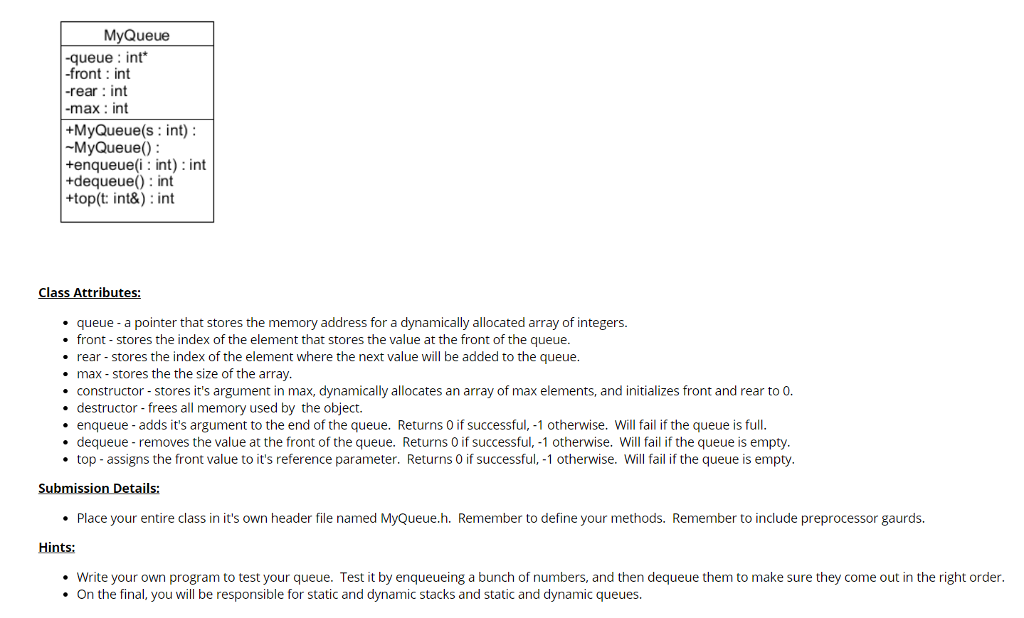
MyQueue queue int -front: int rear int -max: int +MyQueue(s int) MyQueue) tenqueue( int): int +dequeue: int top(t int&) int Class Attributes queue- a pointer that stores the memory address for a dynamically allocated array of integers. front stores the index of the element that stores the value at the front of the queue rear- stores the index of the element where the next value will be added to the queue max-stores the the size of the array. constructor - stores it's argument in max, dynamically allocates an array of max elements, and initializes front and rear to 0. destructor frees all memory used by the object. enqueue - adds it's argument to the end of the queue. Returns 0 if successful, -1 otherwise. Will fail if the queue is full dequeue removes the value at the front of the queue. Returns 0 if successful, -1 otherwise. Will fail if the queue is empty top assigns the front value to it's reference parameter. Returns 0 if successful, -1 otherwise. Will fail if the queue is empty Submission Details: Place your entire class in it's own header file named MyQueue.h. Remember to define your methods. Remember to include preprocessor gaurds. Hints: Write your own program to test your queue. Test it by enqueueing a bunch of numbers, and then dequeue them to make sure they come out in the right order. On the final, you will be responsible for static and dynamic stacks and static and dynamic queues
Step by Step Solution
There are 3 Steps involved in it

Get step-by-step solutions from verified subject matter experts
 Study Help