





Question: n 1. Consider the linear programming problem (P) machm subject to A3: 5 b, m 2 0, (19131)T3 C = (2'49 2,1)! and 9 *1
n 1. Consider the linear programming problem (P)
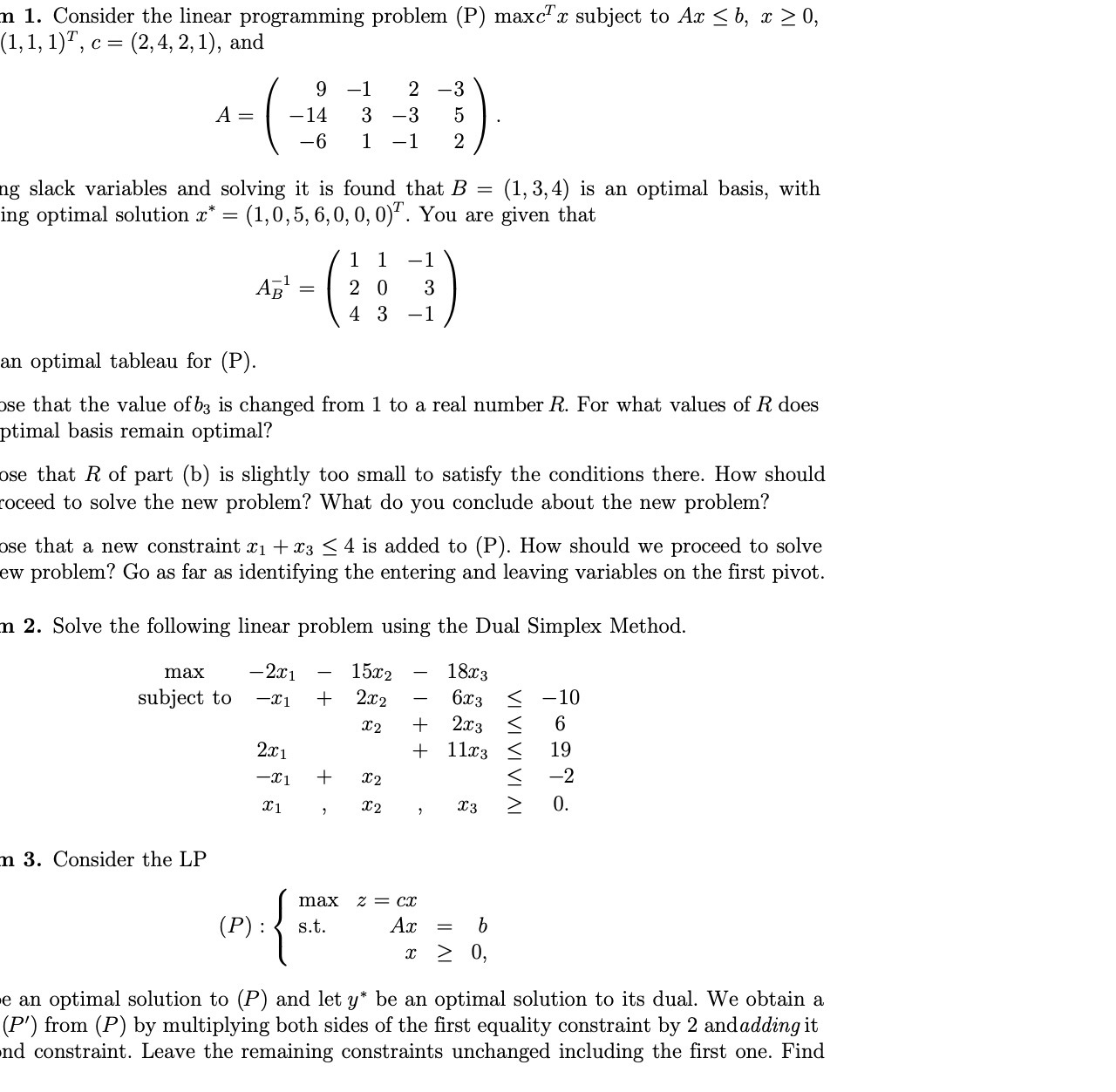
n 1. Consider the linear programming problem (P) machm subject to A3: 5 b, m 2 0, (19131)T3 C = (2'49 2,1)! and 9 *1 2 *3 A = 14 3 3 5 6 1 1 2 ng slack variables and solving it is found that B = (1,3,4) is an optimal basis, with ing optimal solution 22* = (1,0,5, 6,0, 0, (UT. You are given that 1 1 1 A31 = 2 0 3 4 3 1 an optimal tableau for (P). 386 that the value of 53 is changed from 1 to a real number R. For what values of R does ptimal basis remain Optimal? ose that R of part (b) is slightly too small to satisfy the conditions there. How should roceed to solve the new problem? What do you conclude about the new problem? ose that a new constraint :51 + $3 g 4 is added to (P). How should we proceed to solve ew problem? Go as far as identifying the entering and leaving variables on the rst pivot. .11 2. Solve the following linear problem using the Dual Simplex Method. max 25L'1 15272 181173 subject to x1 + 2332 6563 S 10 $2 + 2333. S 6 2m + 1 1333 S 19 :L'1 + $2 S _2 $1 , {2 , $3 2 0. n 3. Consider the LP 1) 0, R IV H e an optimal solution to (P) and let p" be an optimal solution to its dual. We obtain a (P') from (P) by multiplying both sides of the rst equality constraint by 2 and adding it -nd constraint. Leave the remaining constraints unchanged including the rst one. Find

Step by Step Solution

There are 3 Steps involved in it

1 Expert Approved Answer
Step: 1 Unlock blur-text-image

Question Has Been Solved by an Expert!

Get step-by-step solutions from verified subject matter experts

Step: 2 Unlock
Step: 3 Unlock

Students Have Also Explored These Related Mathematics Questions!