







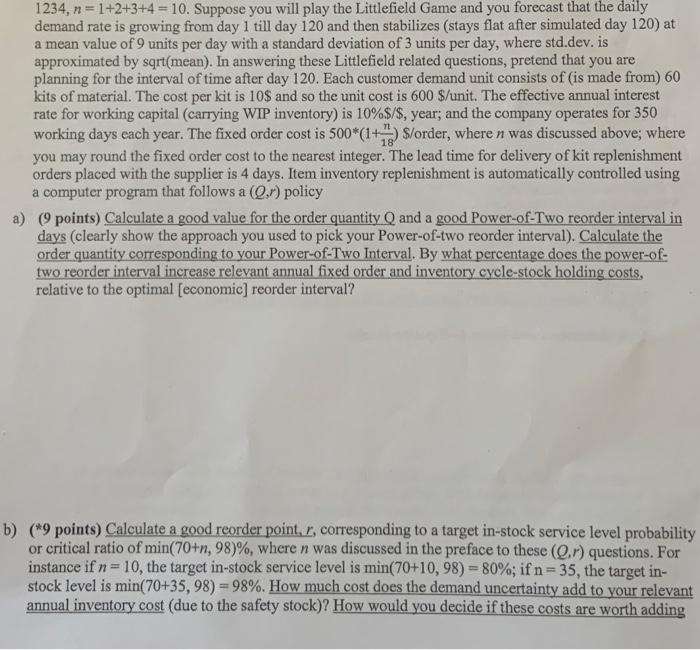
Question: n = 24 for this problem. 1234, n=1+2+3+4 = 10. Suppose you will play the Littlefield Game and you forecast that the daily demand rate
n = 24 for this problem.
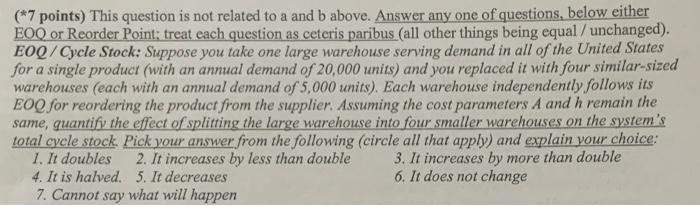
1234, n=1+2+3+4 = 10. Suppose you will play the Littlefield Game and you forecast that the daily demand rate is growing from day 1 till day 120 and then stabilizes (stays flat after simulated day 120) at a mean value of 9 units per day with a standard deviation of 3 units per day, where std.dev.is approximated by sqrt(mean). In answering these Littlefield related questions, pretend that you are planning for the interval of time after day 120. Each customer demand unit consists of (is made from) 60 kits of material. The cost per kit is 10$ and so the unit cost is 600 $/unit. The effective annual interest rate for working capital (carrying WIP inventory) is 10%$/$, year; and the company operates for 350 working days each year. The fixed order cost is 500*(1+" S/order, where n was discussed above; where you may round the fixed order cost to the nearest integer. The lead time for delivery of kit replenishment orders placed with the supplier is 4 days. Item inventory replenishment is automatically controlled using a computer program that follows a (0,7) policy a) (9 points) Calculate a good value for the order quantity Q and a good Power-of-Two reorder interval in days (clearly show the approach you used to pick your Power-of-two reorder interval). Calculate the order quantity corresponding to your Power-of-Two Interval. By what percentage does the power-of- two reorder interval increase relevant annual fixed order and inventory cycle-stock holding costs, relative to the optimal (economic) reorder interval? b) (*9 points) Calculate a good reorder point. r, corresponding to a target in-stock service level probability or critical ratio of min(70+n, 98)%, where n was discussed in the preface to these (Q.r) questions. For instance if n=10, the target in-stock service level is min(70+10,98) = 80%; if n=35, the target in- stock level is min(70+35,98) = 98%. How much cost does the demand uncertainty add to your relevant annual inventory cost (due to the safety stock)? How would you decide if these costs are worth adding (*7 points) This question is not related to a and b above. Answer any one of questions, below either EOQ or Reorder Point: treat each question as ceteris paribus (all other things being equal / unchanged). EOQ / Cycle Stock: Suppose you take one large warehouse serving demand in all of the United States for a single product (with an annual demand of 20,000 units) and you replaced it with four similar-sized warehouses (each with an annual demand of 5,000 units). Each warehouse independently follows its EOQ for reordering the product from the supplier. Assuming the cost parameters A and h remain the same, quantify the effect of splitting the large warehouse into four smaller warehouses on the system's total cycle stock. Pick your answer from the following (circle all that apply) and explain your choice: 1. It doubles 2. It increases by less than double 3. It increases by more than double 4. It is halved. 5. It decreases 6. It does not change 7. Cannot say what will happen
Step by Step Solution
There are 3 Steps involved in it
1 Expert Approved Answer
Step: 1 Unlock

Question Has Been Solved by an Expert!
Get step-by-step solutions from verified subject matter experts
Step: 2 Unlock
Step: 3 Unlock
 Study Help