


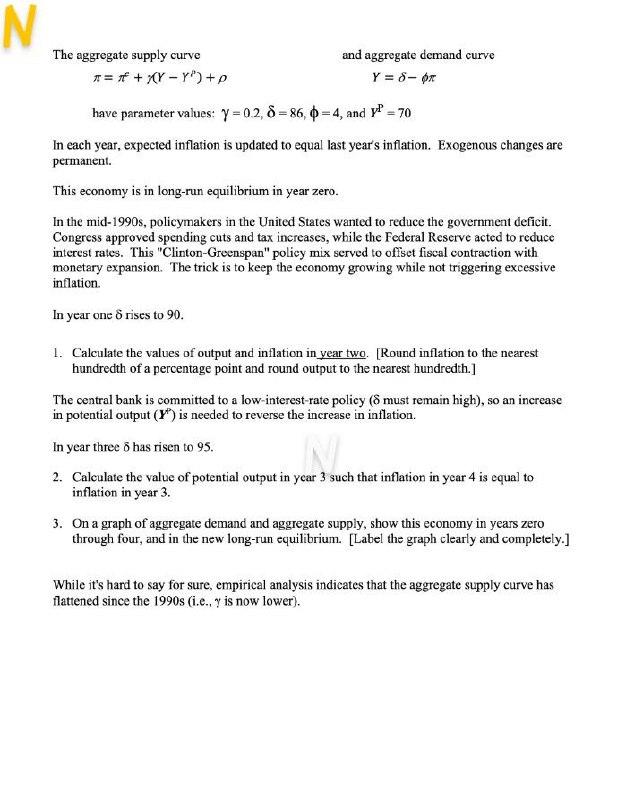
Question: N The aggregate supply curve = m + XY-Y') + p and aggregate demand curve Y = 8-ox have parameter values: y = 0.2, 8
N The aggregate supply curve = m + XY-Y') + p and

N The aggregate supply curve = m + XY-Y') + p and aggregate demand curve Y = 8-ox have parameter values: y = 0.2, 8 - 86,0 = 4, and y? = 70 In each year, expected inflation is updated to equal last year's inflation. Exogenous changes are permanent. This economy is in long-run equilibrium in year zero. In the mid-1990s, policymakers in the United States wanted to reduce the government deficit. Congress approved spending cuts and tax increases, while the Federal Reserve acted to reduce interest rates. This "Clinton-Greenspan" policy mix served to offset fiscal contraction with monetary expansion. The trick is to keep the economy growing while not triggering excessive inflation In year one rises to 90. 1. Calculate the values of output and inflation in year two. [Round inflation to the nearest hundredth of a percentage point and round output to the nearest hundredth.] The central bank is committed to a low-interest-rate policy (8 must remain high), so an increase in potential output (Y") is needed to reverse the increase in inflation. In year three 6 has risen to 95. 2. Calculate the value of potential output in ycar 3 such that inflation in year 4 is equal to inflation in year 3. 3. On a graph of aggregate demand and aggregate supply, show this economy in years zero through four, and in the new long-run equilibrium. [Label the graph clearly and completely.] While it's hard to say for sure, empirical analysis indicates that the aggregate supply curve has flattened since the 1990s (i.c., y is now lower)

Step by Step Solution

There are 3 Steps involved in it

1 Expert Approved Answer
Step: 1 Unlock blur-text-image

Question Has Been Solved by an Expert!

Get step-by-step solutions from verified subject matter experts

Step: 2 Unlock
Step: 3 Unlock

Students Have Also Explored These Related General Management Questions!