



Question: n We have talked about the fact that the sample mean estimator X = 1 =1 Xi is an unbiased estimator of the mean u
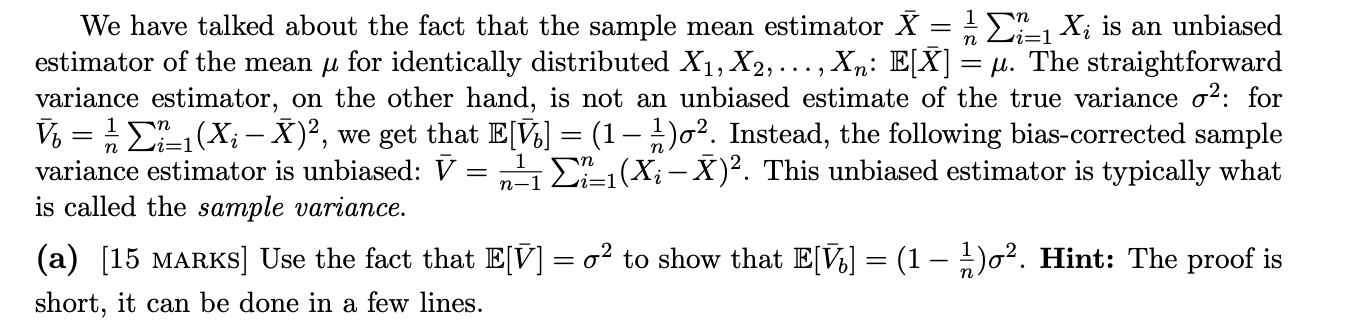
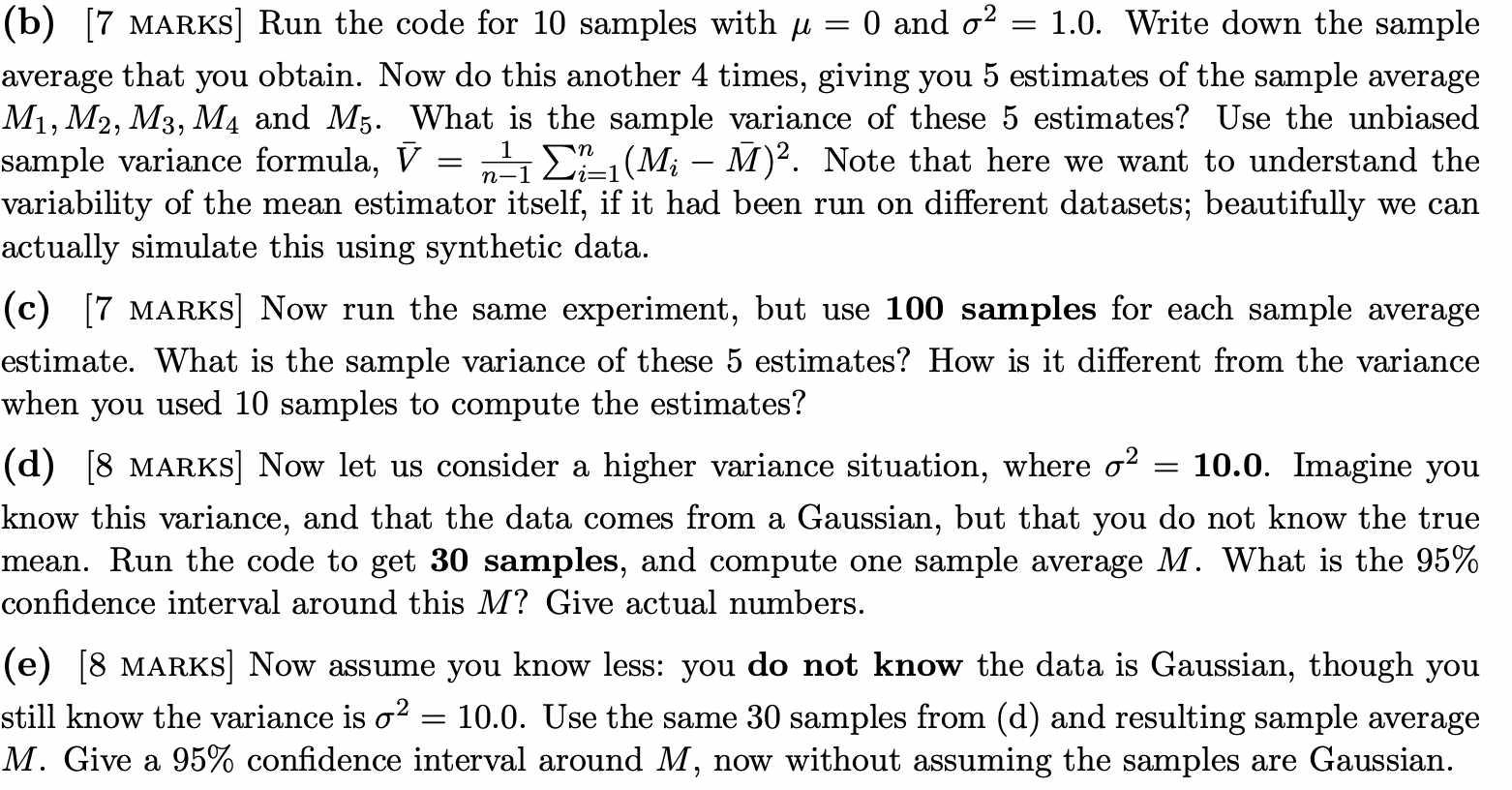
n We have talked about the fact that the sample mean estimator X = 1 =1 Xi is an unbiased estimator of the mean u for identically distributed X1, X2, ..., Xn: E[X] =u. The straightforward variance estimator, on the other hand, is not an unbiased estimate of the true variance o2: for Vo = h 211(Xi X)2, we get that E[W] = (1 - * )02. Instead, the following bias-corrected sample variance estimator is unbiased: 7 = n-1 L=(X; )2. This unbiased estimator is typically what is called the sample variance. (a) [15 MARKS] Use the fact that E[] = 02 to show that E[b] = (1 - 1)02. Hint: The proof is short, it can be done in a few lines. = i=1 = - 7 in = > (b) [7 MARKS] Run the code for 10 samples with u = 0 and 02 1.0. Write down the sample average that you obtain. Now do this another 4 times, giving you 5 estimates of the sample average M1, M2, M3, M4 and M5. What is the sample variance of these 5 estimates? Use the unbiased sample variance formula, V = n-1 2-1(M M)2. Note that here we want to understand the variability of the mean estimator itself, if it had been run on different datasets; beautifully we can actually simulate this using synthetic data. (c) [7 MARKS] Now run the same experiment, but use 100 samples for each sample average estimate. What is the sample variance of these 5 estimates? How is it different from the variance when you used 10 samples to compute the estimates? (d) [8 MARKS] Now let us consider a higher variance situation, where o? 10.0. Imagine you know this variance, and that the data comes from a Gaussian, but that you do not know the true mean. Run the code to get 30 samples, and compute one sample average M. What is the 95% confidence interval around this M? Give actual numbers. (e) [8 MARKS] Now assume you know less: you do not know the data is Gaussian, though you still know the variance is o2 = 10.0. Use the same 30 samples from (d) and resulting sample average M. Give a 95% confidence interval around M, now without assuming the samples are Gaussian. = n We have talked about the fact that the sample mean estimator X = 1 =1 Xi is an unbiased estimator of the mean u for identically distributed X1, X2, ..., Xn: E[X] =u. The straightforward variance estimator, on the other hand, is not an unbiased estimate of the true variance o2: for Vo = h 211(Xi X)2, we get that E[W] = (1 - * )02. Instead, the following bias-corrected sample variance estimator is unbiased: 7 = n-1 L=(X; )2. This unbiased estimator is typically what is called the sample variance. (a) [15 MARKS] Use the fact that E[] = 02 to show that E[b] = (1 - 1)02. Hint: The proof is short, it can be done in a few lines. = i=1 = - 7 in = > (b) [7 MARKS] Run the code for 10 samples with u = 0 and 02 1.0. Write down the sample average that you obtain. Now do this another 4 times, giving you 5 estimates of the sample average M1, M2, M3, M4 and M5. What is the sample variance of these 5 estimates? Use the unbiased sample variance formula, V = n-1 2-1(M M)2. Note that here we want to understand the variability of the mean estimator itself, if it had been run on different datasets; beautifully we can actually simulate this using synthetic data. (c) [7 MARKS] Now run the same experiment, but use 100 samples for each sample average estimate. What is the sample variance of these 5 estimates? How is it different from the variance when you used 10 samples to compute the estimates? (d) [8 MARKS] Now let us consider a higher variance situation, where o? 10.0. Imagine you know this variance, and that the data comes from a Gaussian, but that you do not know the true mean. Run the code to get 30 samples, and compute one sample average M. What is the 95% confidence interval around this M? Give actual numbers. (e) [8 MARKS] Now assume you know less: you do not know the data is Gaussian, though you still know the variance is o2 = 10.0. Use the same 30 samples from (d) and resulting sample average M. Give a 95% confidence interval around M, now without assuming the samples are Gaussian. =
Step by Step Solution
There are 3 Steps involved in it

Get step-by-step solutions from verified subject matter experts