







Question: Name: AC] SPH3U Waves and Sound Assignment 21. Each pulse moves with a speed of 100 cm/s. Each block represents 1 cm. A sample of
![Name: AC] SPH3U Waves and Sound Assignment 21. Each pulse moves](https://s3.amazonaws.com/si.experts.images/answers/2024/07/66881ed118eed_81666881ed0eb054.jpg)
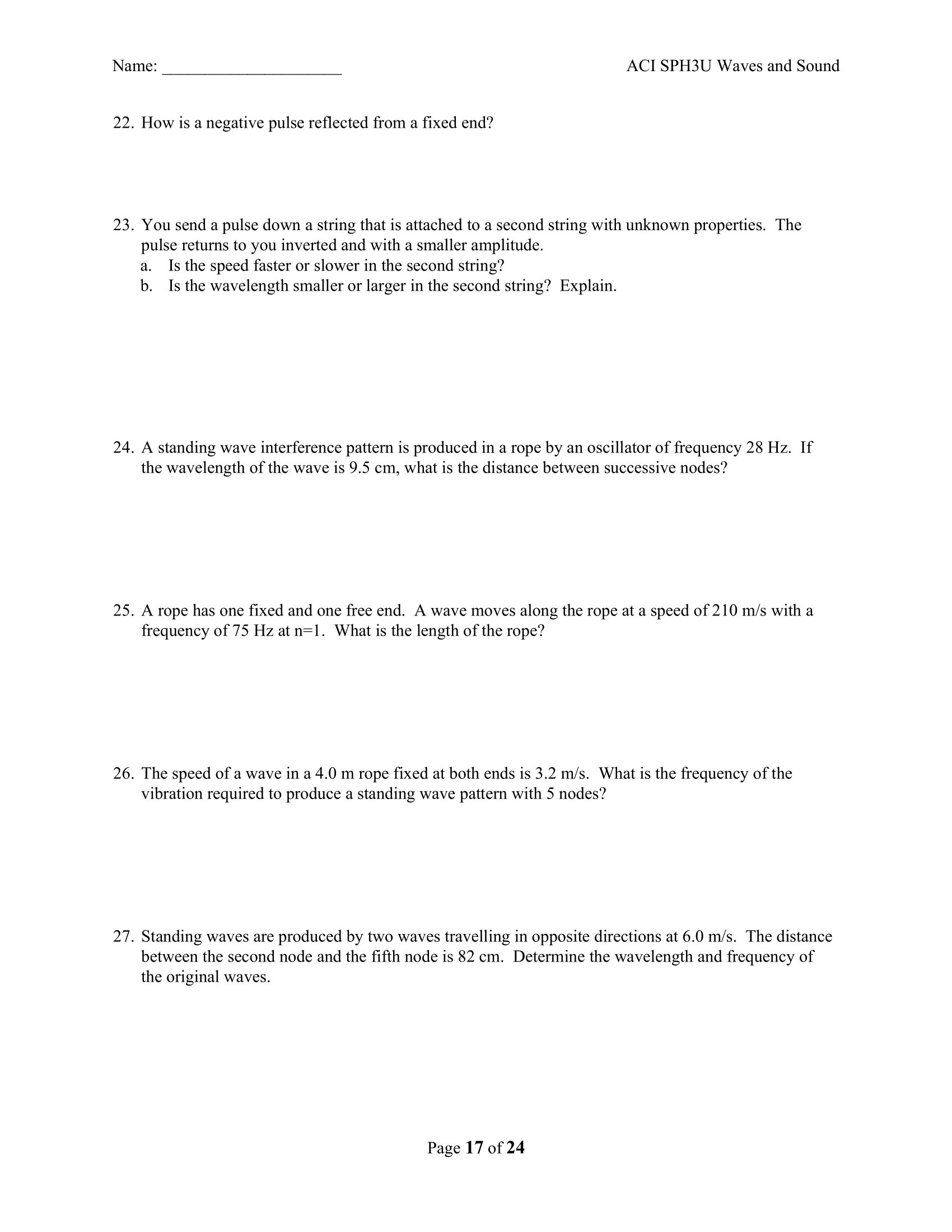
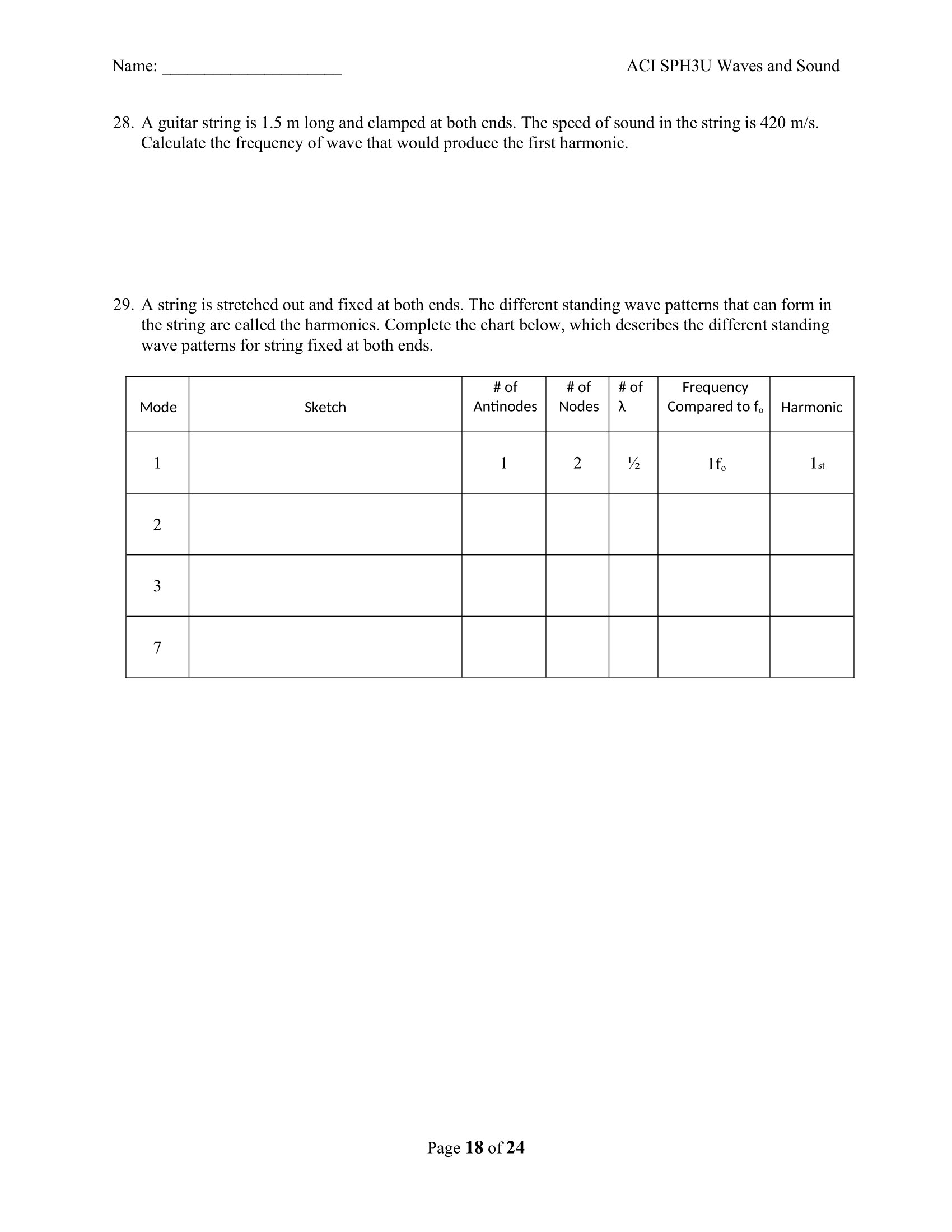
Name: AC] SPH3U Waves and Sound Assignment 21. Each pulse moves with a speed of 100 cm/s. Each block represents 1 cm. A sample of the interference process is shown in the rst column of diagrams. a. Study the sample process. Draw an t = 0 S arrow on the rst diagram showing the ' direction in which the pulses are travelling. .. M ii on m n I | b. At what time do the pulses begin to ;t = 0.02 sec! time will they nish? 'lll' At t: 0.02 s, what ,1 - 0.04 sec type of interference occurs? t 0 02 s t interfere? At what (1. At t = 0.03 s, explain how to nd the resulting wave shape. F0063 sec . 1: 0.08%] . ......... e. The second column of diagrams is an example for you to try. How many boxes will each pulse travel between diagrams? f. Complete the set of diagrams. Show the positions of the individual pulses with dashed lines and the resulting wave shape with a solid line. lAdapted from ActivigBased Tutorials, by Wittmann, M., et a1. [ohn Wiley, 2004 Page 16 on4 Name: AC] SPH3U Waves and Sound 22. How is a negative pulse reected from a xed end? 23. You send a pulse down a string that is attached to a second string with unknown properties. The pulse returns to you inverted and with a smaller amplitude. a. Is the speed faster or slower in the second string? b. Is the wavelength smaller or larger in the second string? Explain. 24. A standing wave interference pattern is produced in a rope by an oscillator of frequency 28 Hz. If the wavelength of the wave is 9.5 cm, what is the distance between successive nodes? 25. A rope has one fixed and one free end. A wave moves along the rope at a speed of 210 m/s with a frequency of 75 Hz at n=1. What is the length of the rope? 26. The speed of a wave in a 4.0 m rope fixed at both ends is 3.2 m/s. What is the frequency of the vibration required to produce a standing wave pattern with 5 nodes? 27. Standing waves are produced by two waves travelling in opposite directions at 6.0 m/s. The distance between the second node and the fifth node is 82 cm. Determine the wavelength and frequency of the original waves. Page 17 on4 Name: AC] SPH3U Waves and Sound 28. A guitar string is 1.5 m long and clamped at both ends. The speed of sound in the string is 420 m/s. Calculate the frequency of wave that would produce the rst harmonic. 29. A string is stretched out and fixed at both ends. The different standing wave patterns that can form in the string are called the harmonics. Complete the chart below, which describes the different standing wave patterns for string xed at both ends. Mode Sketch # of Antinodes # of Nodes #of Frequency Compared to fo Harmonic Page 18 of24
Step by Step Solution
There are 3 Steps involved in it

Get step-by-step solutions from verified subject matter experts
 Study Help