







Question: Name Displacement (change in position) Average Speed Average Velocity. Average Acceleration. Kinematic Formulas for Constant Acceleration Relative Velocity Formula 2 Af=f-f Vfy Savg =
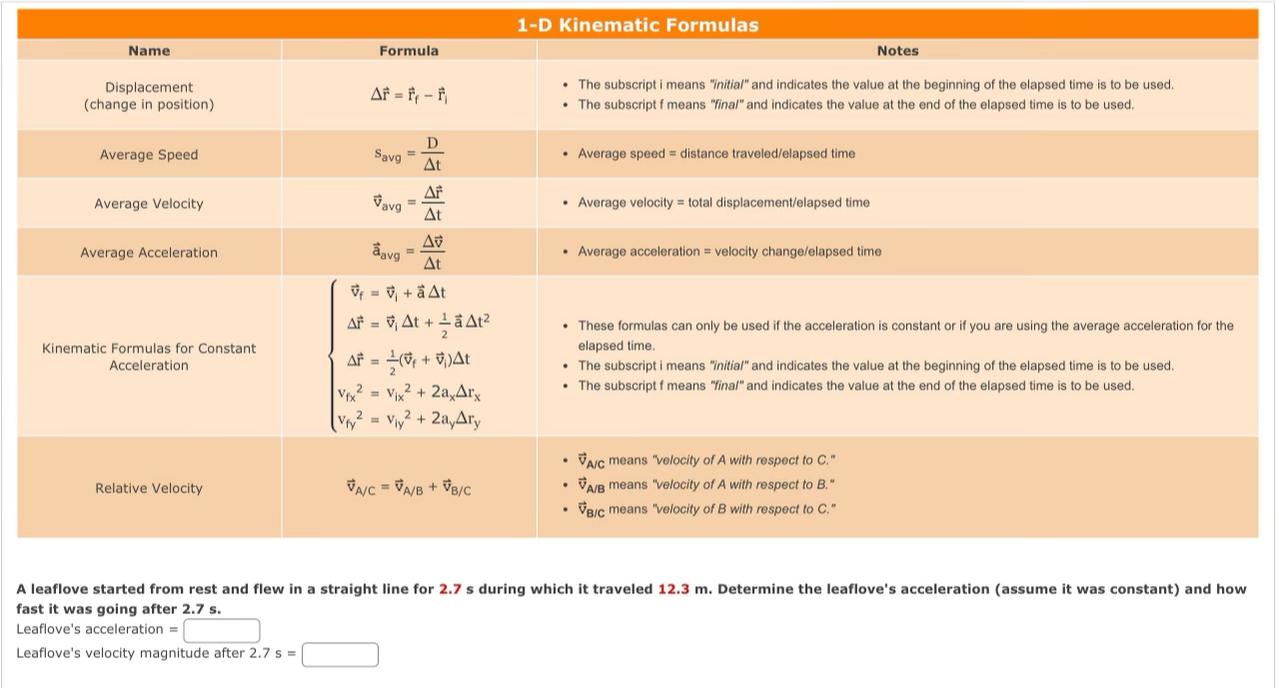
Name Displacement (change in position) Average Speed Average Velocity. Average Acceleration. Kinematic Formulas for Constant Acceleration Relative Velocity Formula 2 Af=f-f Vfy Savg = Vavg= Av At V = + a At A = At+-a4t * = =(v, + v}) (+)At aavg D At = Af At 2 Vx = Vx + 2axArx = Vy + 2a,Ary VA/C= VA/B + VB/C 1-D Kinematic Formulas The subscript i means "initial" and indicates the value at the beginning of the elapsed time is to be used. The subscript f means "final" and indicates the value at the end of the elapsed time is to be used. Average speed = distance traveled/elapsed time Average velocity = total displacement/elapsed time Average acceleration = velocity change/elapsed time Notes These formulas can only be used if the acceleration is constant or if you are using the average acceleration for the elapsed time. The subscript i means "initial" and indicates the value at the beginning of the elapsed time is to be used. The subscript f means "final" and indicates the value at the end of the elapsed time is to be used. . . VAIC means "velocity of A with respect to C." VA/B means "velocity of A with respect to B." VB/C means "velocity of B with respect to C." A leaflove started from rest and flew in a straight line for 2.7 s during which it traveled 12.3 m. Determine the leaflove's acceleration (assume it was constant) and how fast it was going after 2.7 s. Leaflove's acceleration = Leaflove's velocity magnitude after 2.7 s =
Step by Step Solution
3.46 Rating (153 Votes )
There are 3 Steps involved in it
The problem describes a leaflove a hypothetical object that started from rest flew in a straight lin... View full answer

Get step-by-step solutions from verified subject matter experts
 Study Help