





Question: Name: Lab Polynomial and Rational Functions Circle the best answer from the bolded, capitalized options to best complete each statement. 1. If a polynomial function
Name: Lab Polynomial and Rational FunctionsName: Lab Polynomial and Rational FunctionsName: Lab Polynomial and Rational Functions
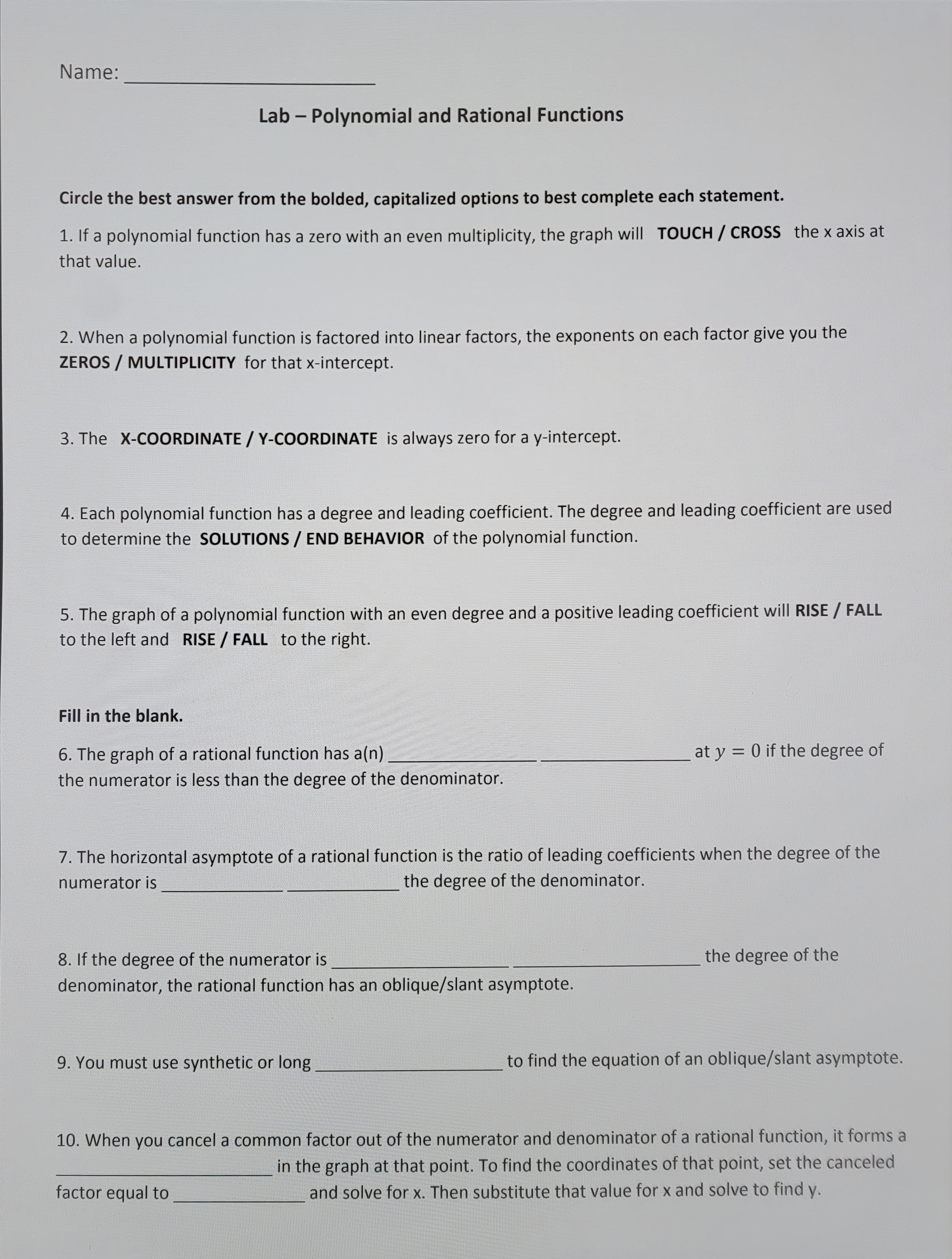
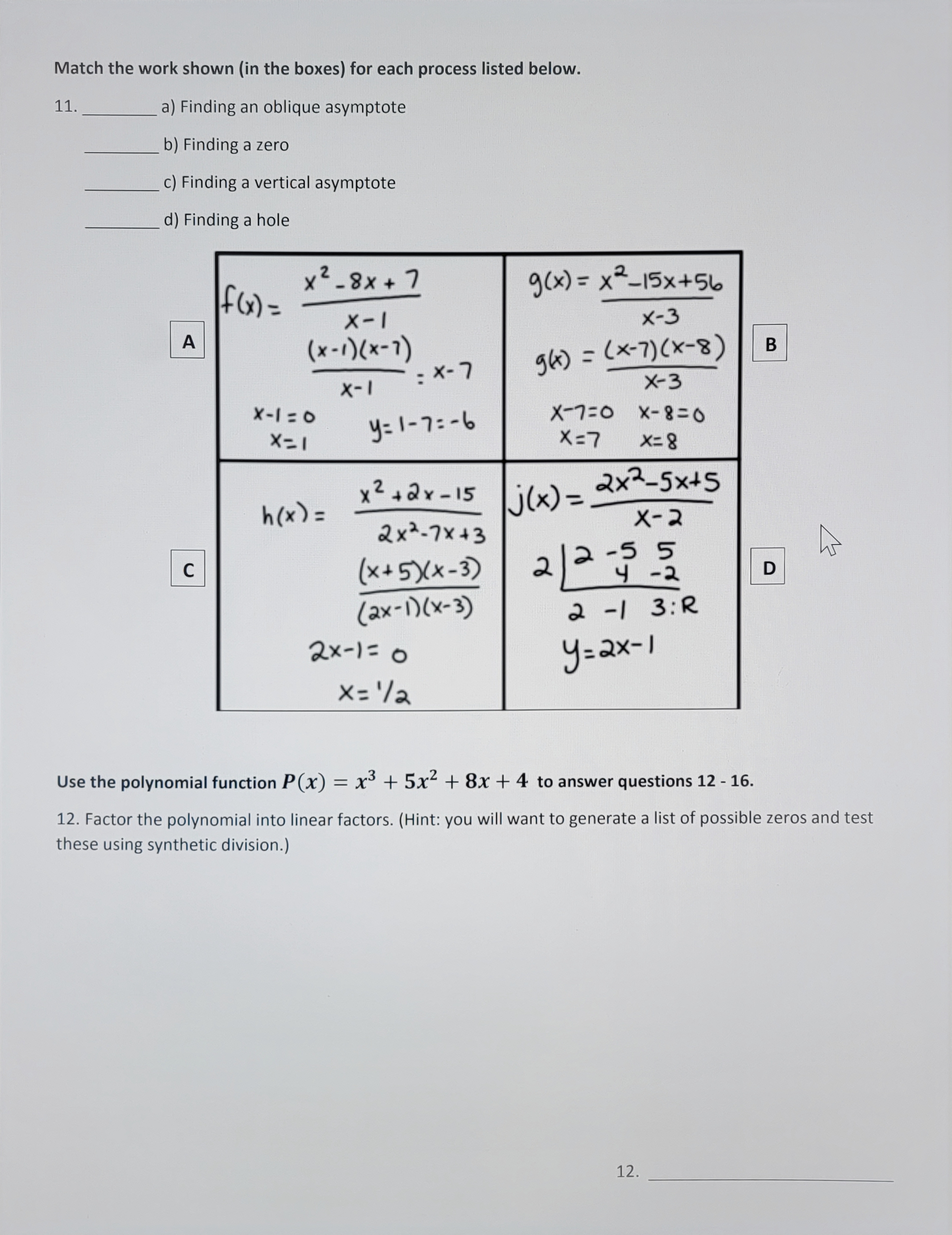
Name: Lab Polynomial and Rational Functions Circle the best answer from the bolded, capitalized options to best complete each statement. 1. If a polynomial function has a zero with an even multiplicity, the graph will TOUCH / CROSS the x axis at that value. 2. When a polynomial function is factored into linear factors, the exponents on each factor give you the ZEROS/ MULTIPLICITY for that x-intercept. 3. The X-COORDINATE / Y-COORDINATE is always zero for a y-intercept. 4. Each polynomial function has a degree and leading coefficient. The degree and leading coefficient are used to determine the SOLUTIONS / END BEHAVIOR of the polynomial function. 5. The graph of a polynomial function with an even degree and a positive leading coefficient will RISE / FALL to the left and RISE / FALL to the right. Fill in the blank. 6. The graph of a rational function has a(n) at y = 0 if the degree of the numerator is less than the degree of the denominator. 7. The horizontal asymptote of a rational function is the ratio of leading coefficients when the degree of the numerator is the degree of the denominator. 8. If the degree of the numerator is the degree of the denominator, the rational function has an oblique/slant asymptote. 9. You must use synthetic or long to find the equation of an oblique/slant asymptote. 10. when you cancel acommon factor out of the numerator and denominator of a rational function, it forms a in the graph at that point. To find the coordinates of that point, set the canceled factor equal to and solve for x. Then substitute that value for x and solve to find y. Match the work shown (in the boxes) for each process listed below. 11. a) Finding an oblique asymptote b) Finding a zero c) Finding a vertical asymptote d) Finding a hole Use the polynomial function P(x) = x3 + 5x2 + 8x + 4 to answer questions 12 - 16. 12. Factor the polynomial into linear factors. (Hint: you will want to generate a list of possible zeros and test these using synthetic division.) 12. 13. State the degree and leading coefficient. Then determine the end behavior. 13. degree L.C. End behavior: This graph to the left and to the right. 14. Find each zero, state the multiplicity and determine if the graph touches or crosses at that x-intercept. Fill in the table. Zero Multiplicity Touch or Cross 15. Sketch the graph of P(x) on the cartesian plane below. (Find the y-intercept and be sure to include this point on the graph.) 7 3 4 5 6% 16. Use your calculator to find the relative maximum and relative minimum for P(x). Write your answer as an ordered pair. Round to two decimal places. 16. rel. max: rel. min

Step by Step Solution

There are 3 Steps involved in it

1 Expert Approved Answer
Step: 1 Unlock blur-text-image
Question Has Been Solved by an Expert!

Get step-by-step solutions from verified subject matter experts

Step: 2 Unlock
Step: 3 Unlock

Students Have Also Explored These Related Mathematics Questions!