







Question: Name: Lecture Activity 08.01: Bivariate Correlations - Exercise, Stress, & Well-being Dr. Patel is conducting a research study to investigate the relationship between the
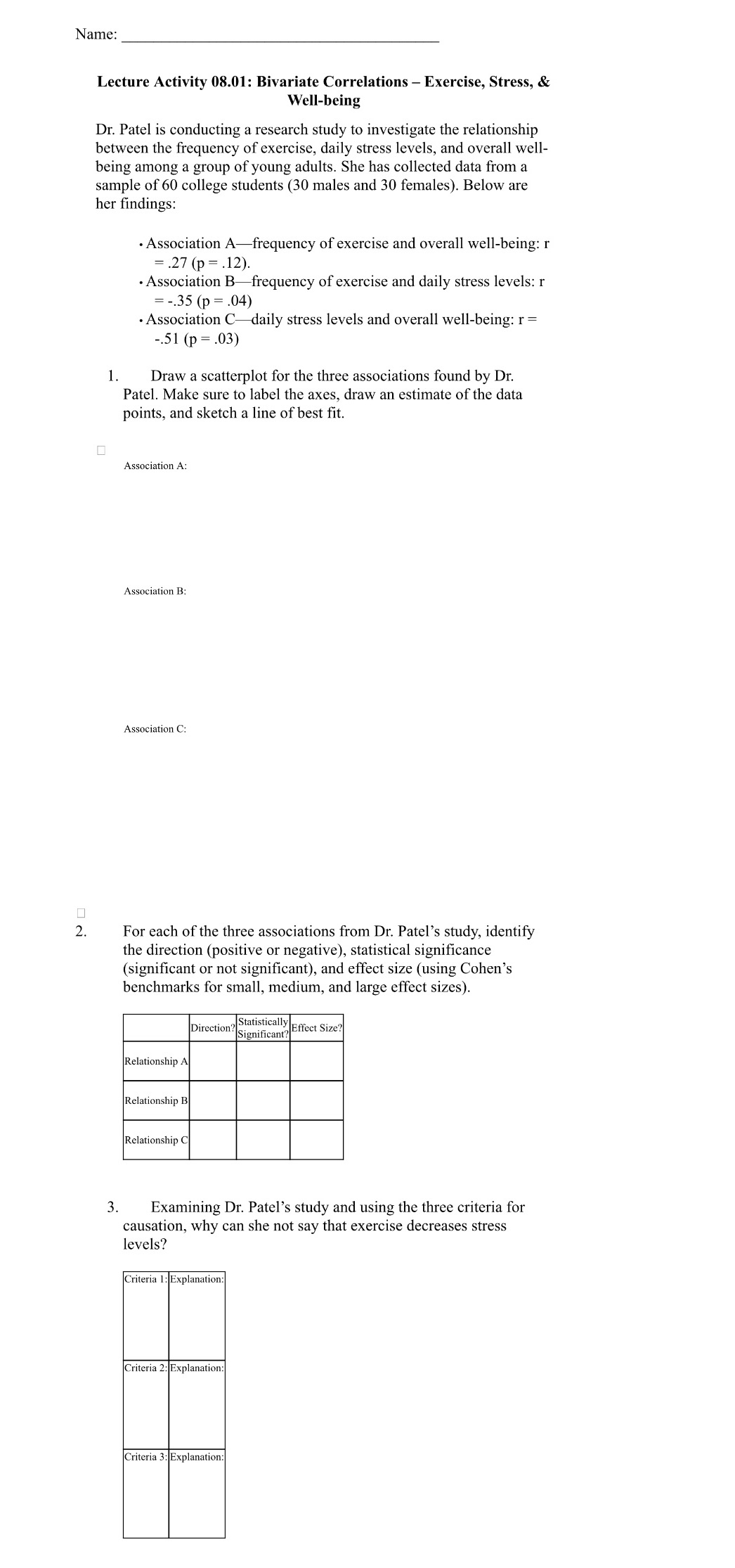
Name: Lecture Activity 08.01: Bivariate Correlations - Exercise, Stress, & Well-being Dr. Patel is conducting a research study to investigate the relationship between the frequency of exercise, daily stress levels, and overall well- being among a group of young adults. She has collected data from a sample of 60 college students (30 males and 30 females). Below are her findings: 1. Association A-frequency of exercise and overall well-being: r = .27 (p = .12). Association B-frequency of exercise and daily stress levels: r = -.35 (p = .04) Association C-daily stress levels and overall well-being: r = -.51 (p = .03) Draw a scatterplot for the three associations found by Dr. Patel. Make sure to label the axes, draw an estimate of the data points, and sketch a line of best fit. Association A: Association B: Association C: i 2. For each of the three associations from Dr. Patel's study, identify the direction (positive or negative), statistical significance (significant or not significant), and effect size (using Cohen's benchmarks for small, medium, and large effect sizes). Direction? Statistically Significant? Effect Size? 3. Relationship A Relationship B Relationship C Examining Dr. Patel's study and using the three criteria for causation, why can she not say that exercise decreases stress levels? Criteria 1: Explanation: Criteria 2: Explanation: Criteria 3: Explanation:
Step by Step Solution
There are 3 Steps involved in it
The image you uploaded contains a set of questions related to a research study by Dr Pate... View full answer

Get step-by-step solutions from verified subject matter experts
 Study Help