







Question: Name: Lecture Activity 08.02: The Association Between Watching TV & Reading Dr. Hernandez conducted a study to investigate the relationship between the number of
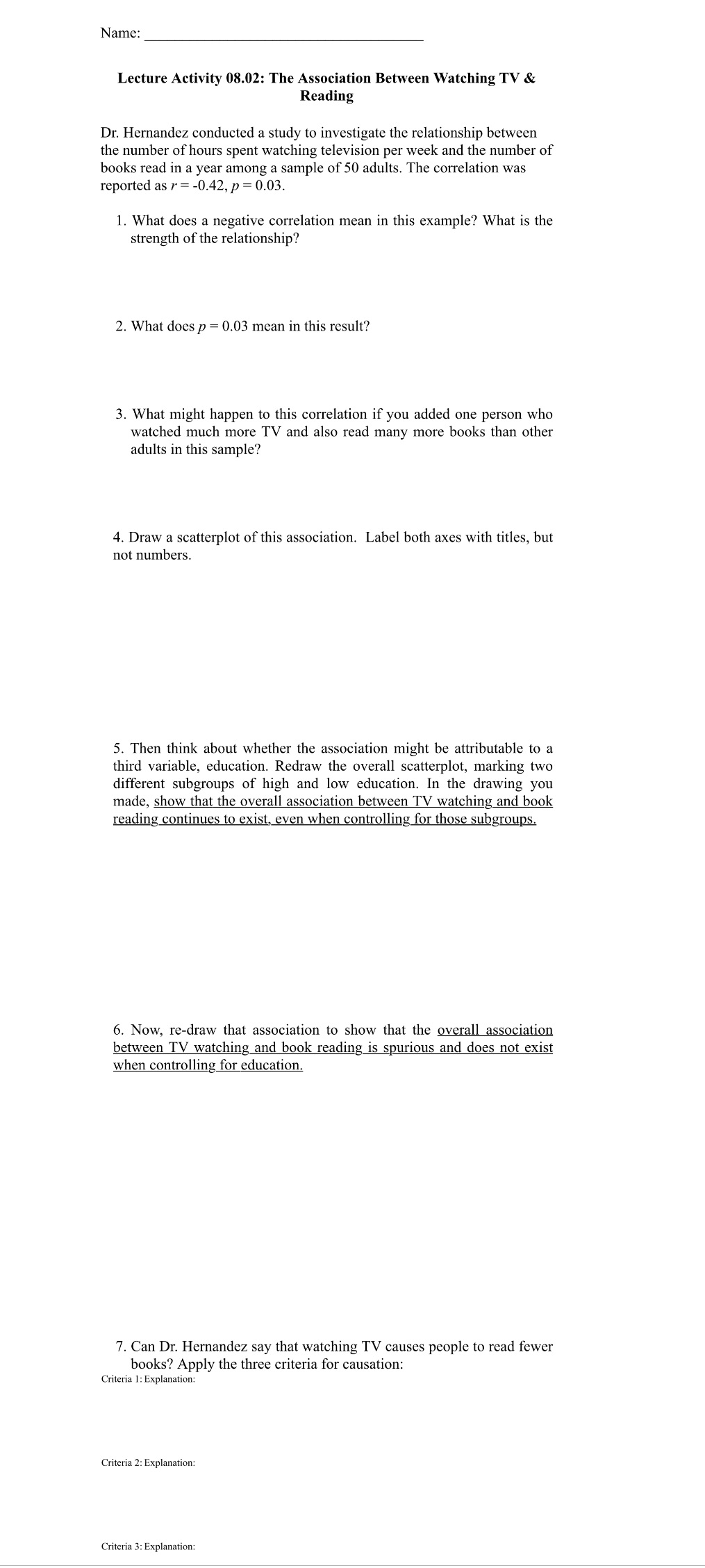
Name: Lecture Activity 08.02: The Association Between Watching TV & Reading Dr. Hernandez conducted a study to investigate the relationship between the number of hours spent watching television per week and the number of books read in a year among a sample of 50 adults. The correlation was reported as r = -0.42, p=0.03. 1. What does a negative correlation mean in this example? What is the strength of the relationship? 2. What does p = 0.03 mean in this result? 3. What might happen to this correlation if you added one person who watched much more TV and also read many more books than other adults in this sample? 4. Draw a scatterplot of this association. Label both axes with titles, but not numbers. 5. Then think about whether the association might be attributable to a third variable, education. Redraw the overall scatterplot, marking two different subgroups of high and low education. In the drawing you made, show that the overall association between TV watching and book reading continues to exist, even when controlling for those subgroups. 6. Now, re-draw that association to show that the overall association between TV watching and book reading is spurious and does not exist when controlling for education. 7. Can Dr. Hernandez say that watching TV causes people to read fewer books? Apply the three criteria for causation: Criteria 1: Explanation: Criteria 2: Explanation: Criteria 3: Explanation:
Step by Step Solution
There are 3 Steps involved in it

Get step-by-step solutions from verified subject matter experts
 Study Help