







Question: Name: Score: Address: Mathematics 3 Module | MODULE TEST Solve the following problems. Round off the final answers to two decimal places. When you are
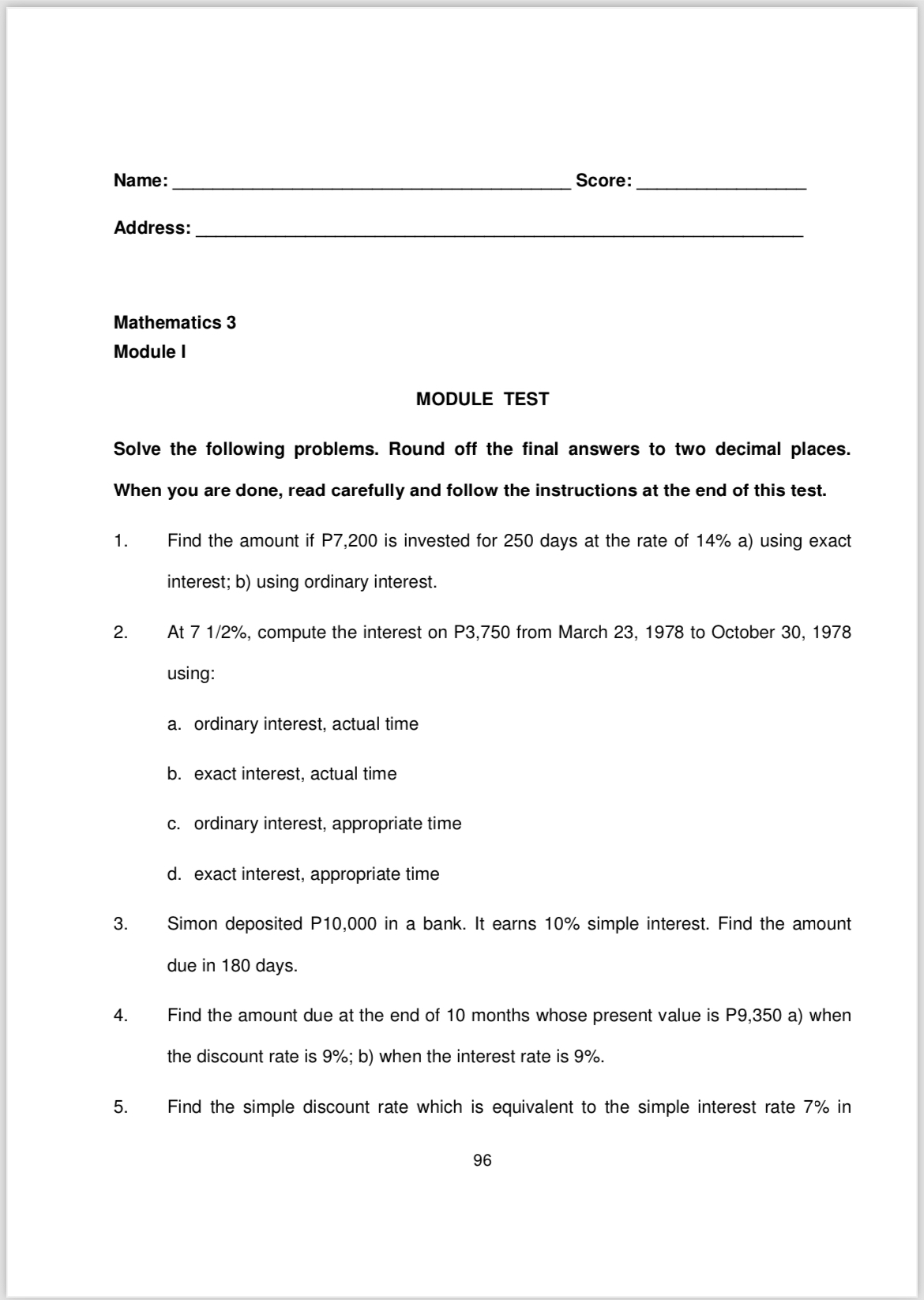
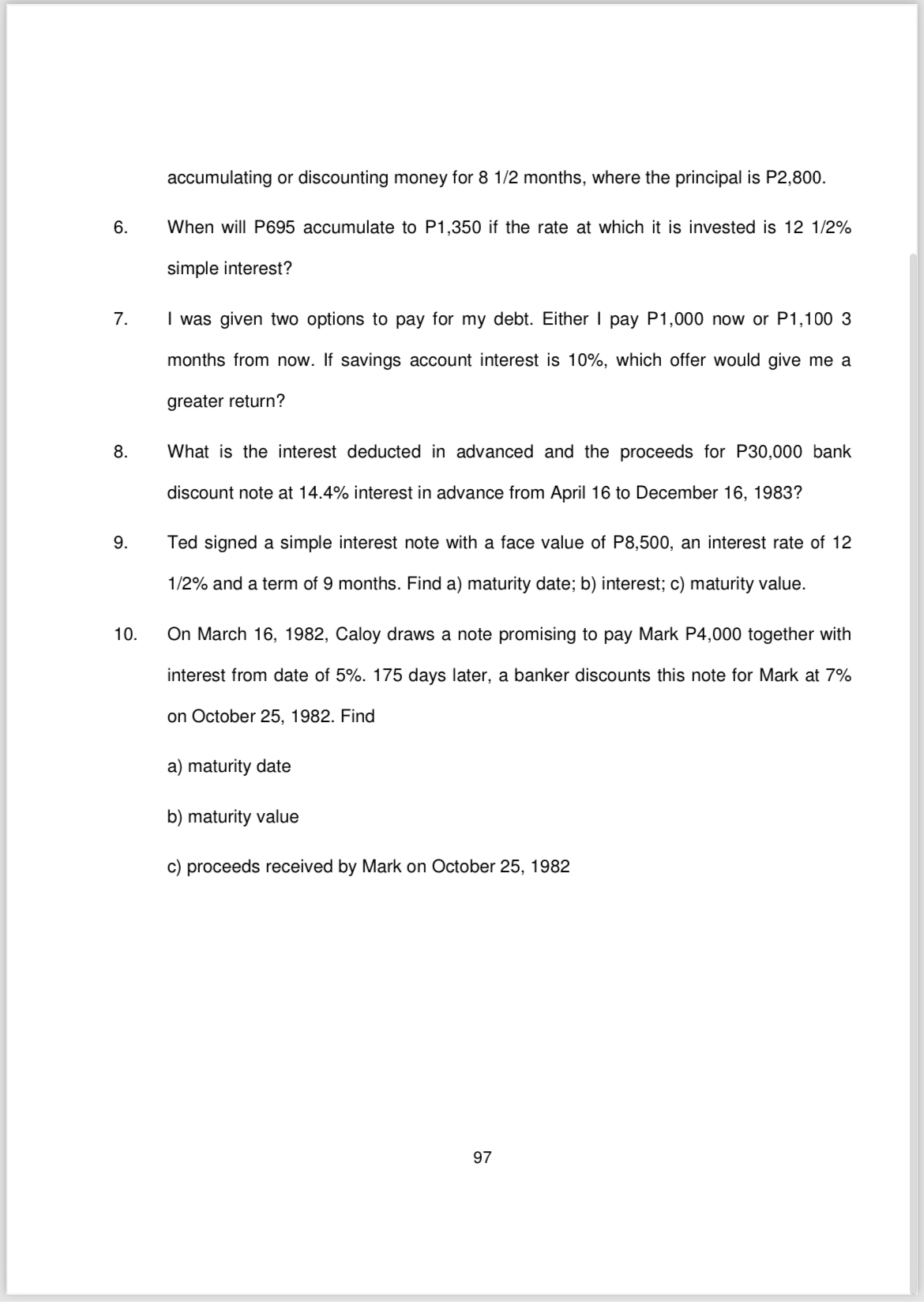
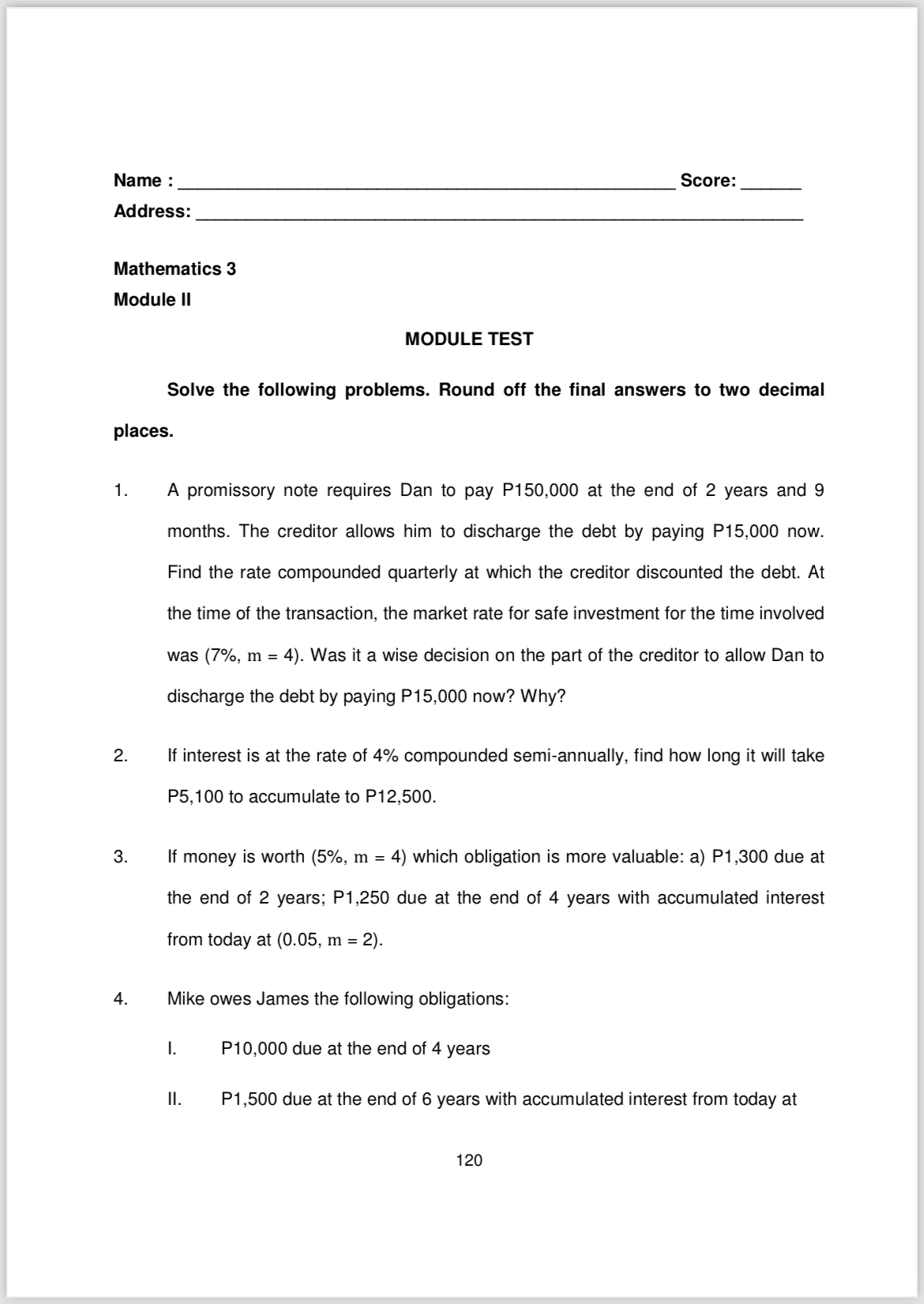
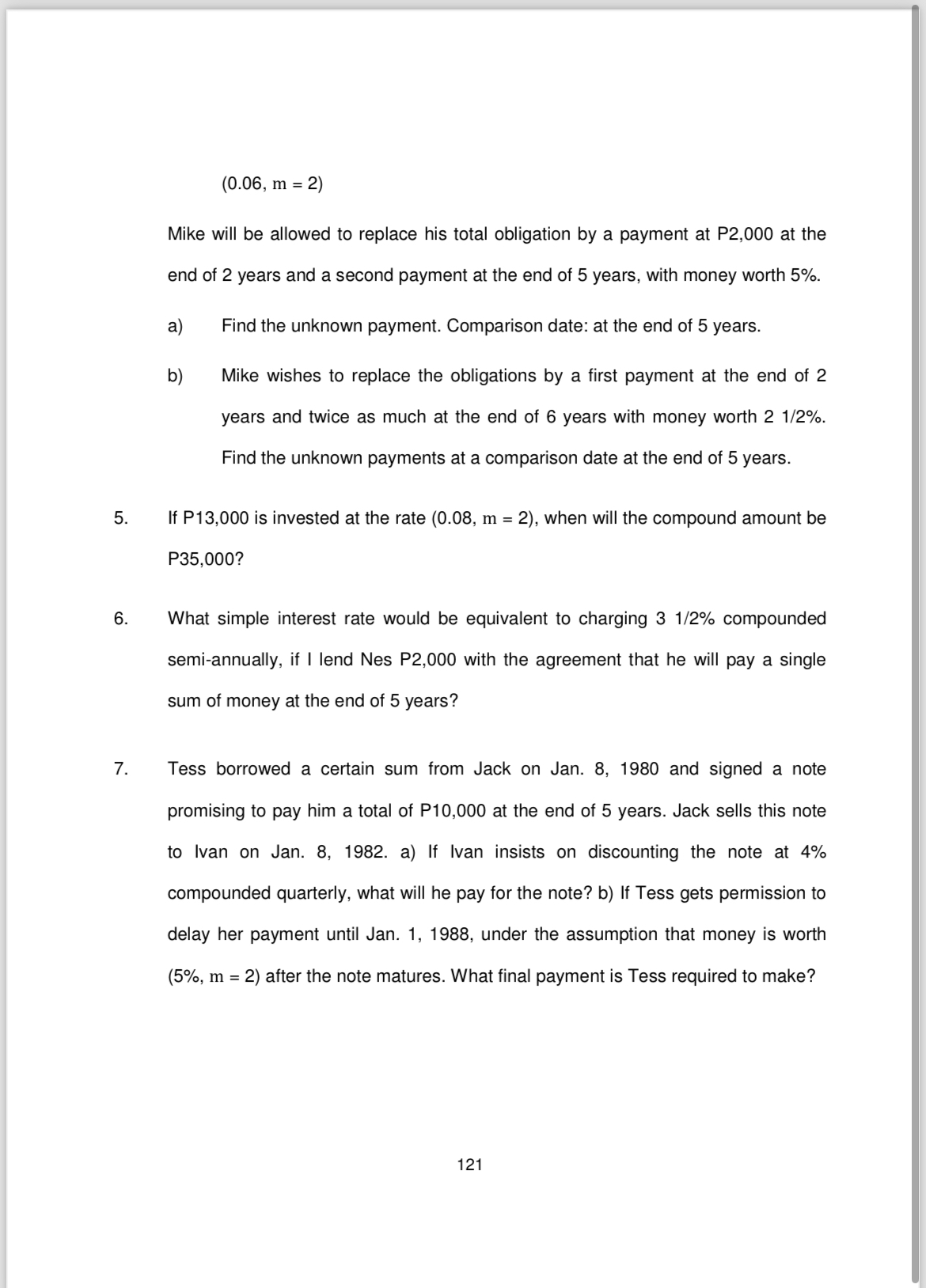
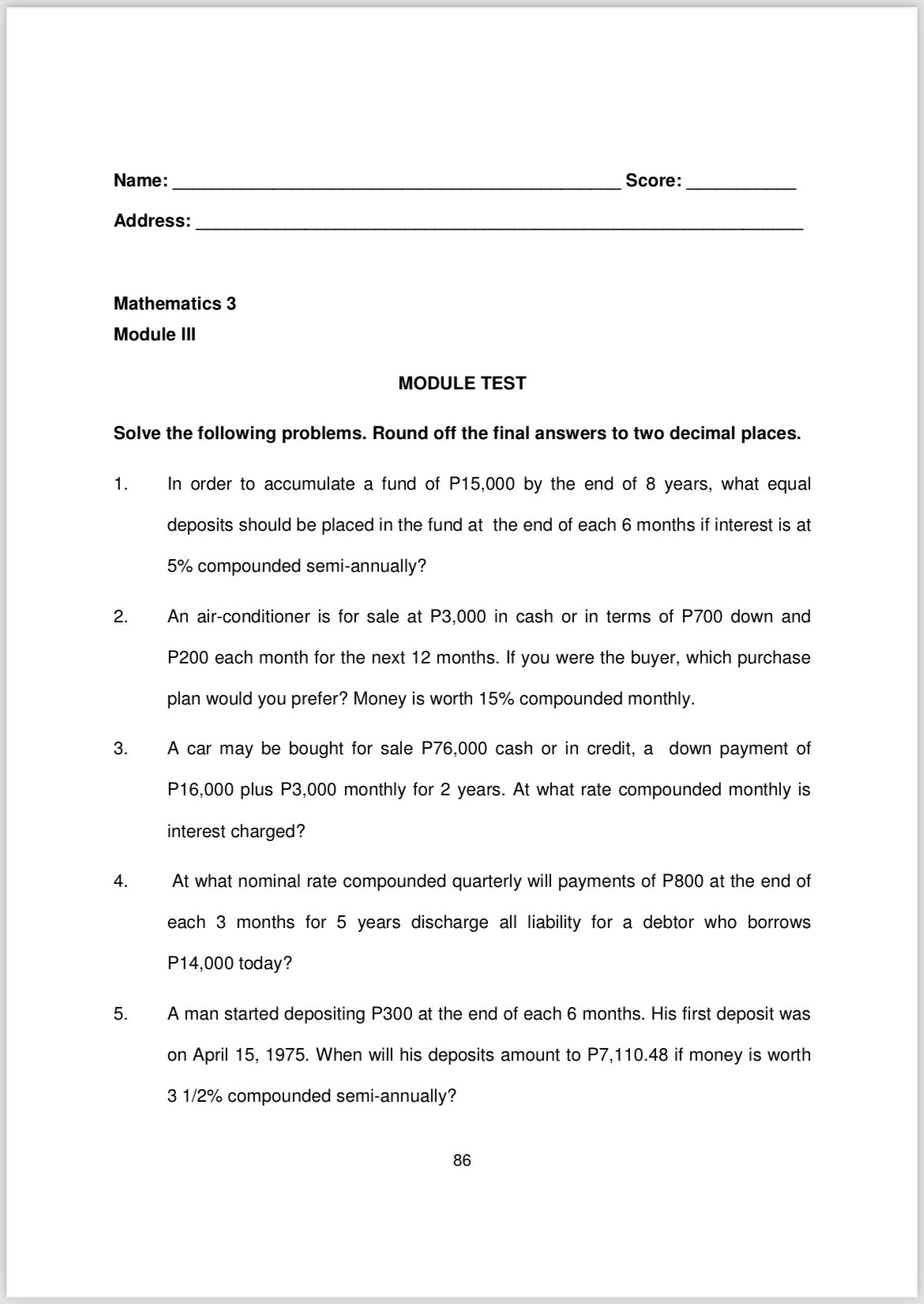
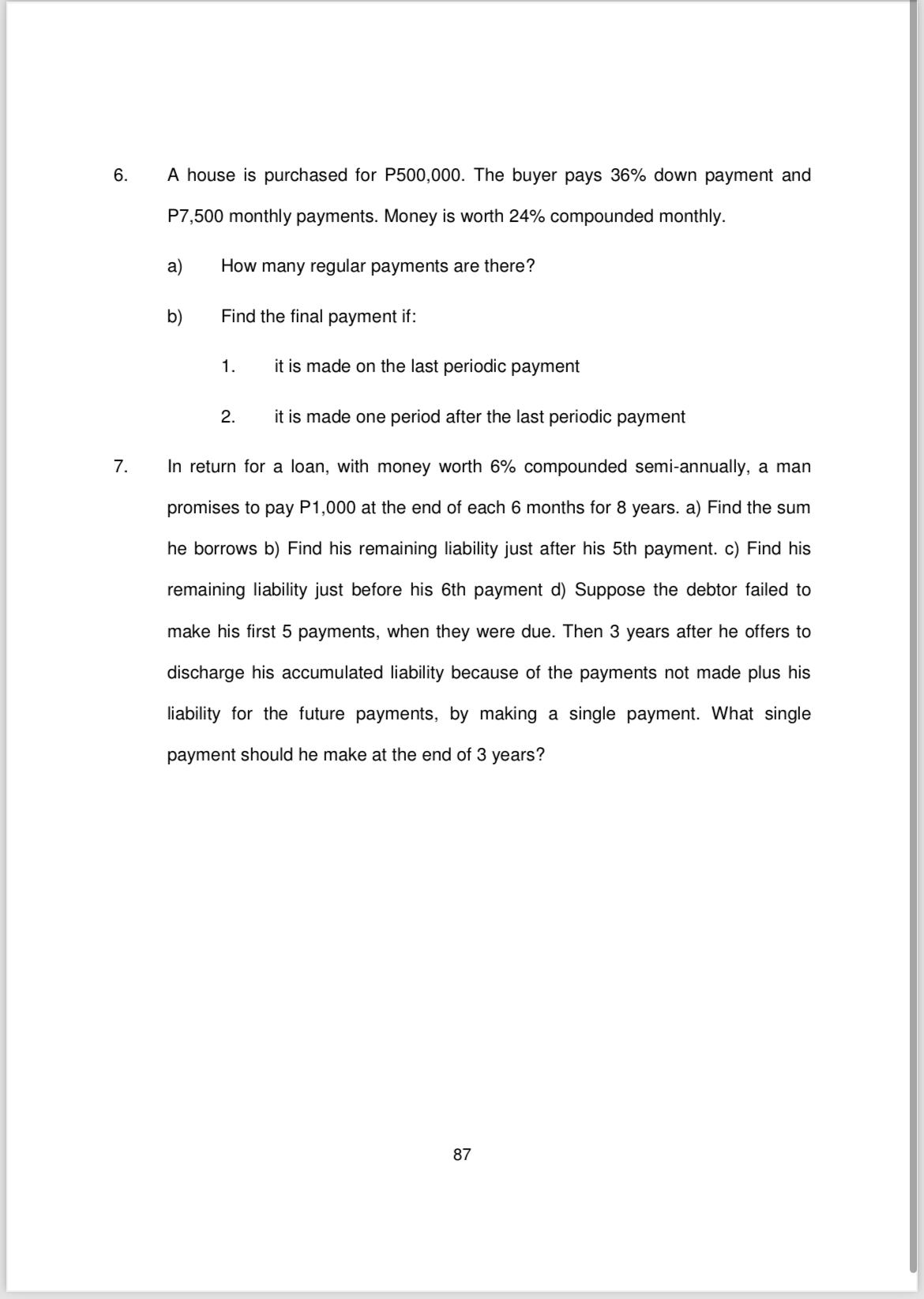
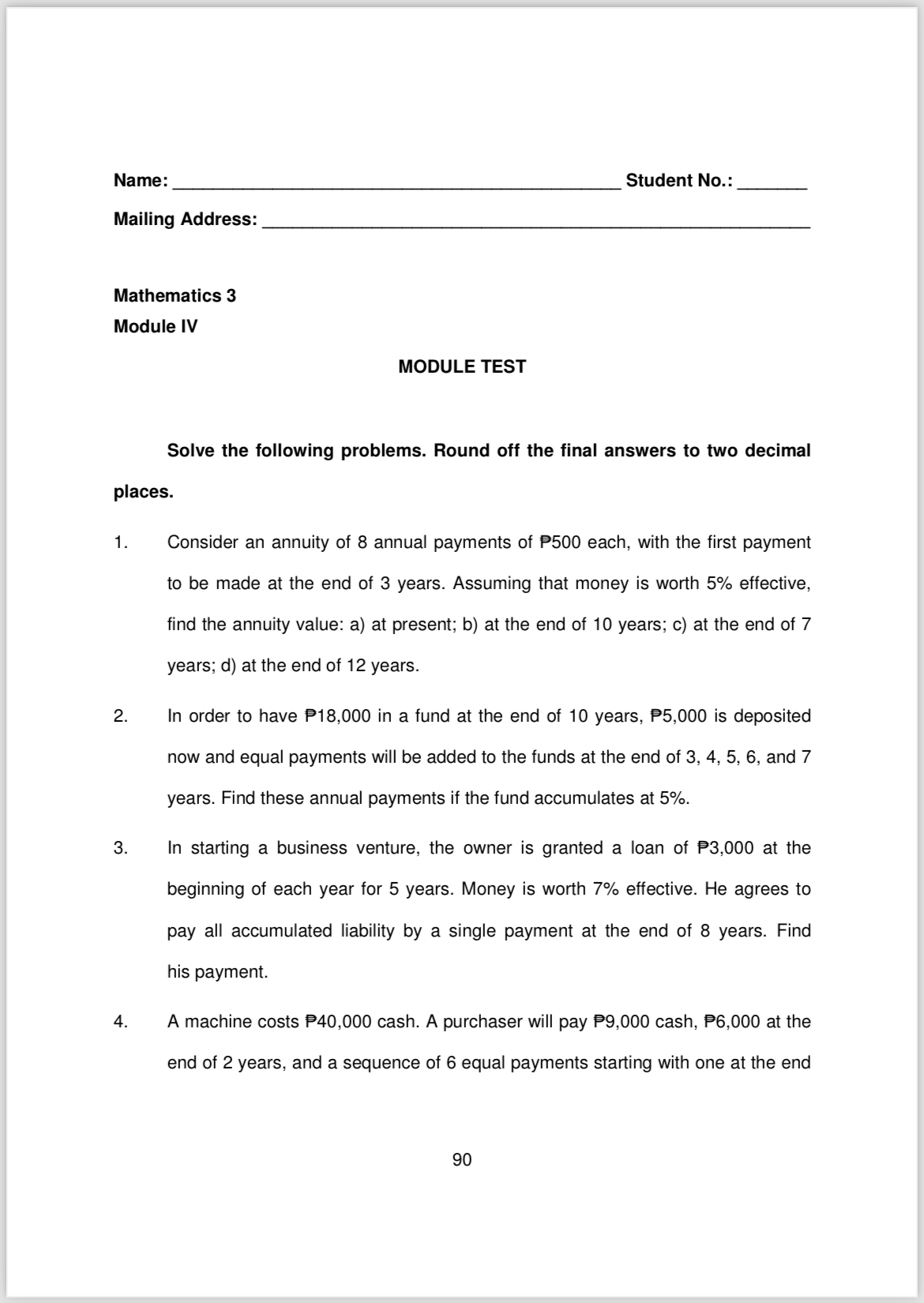
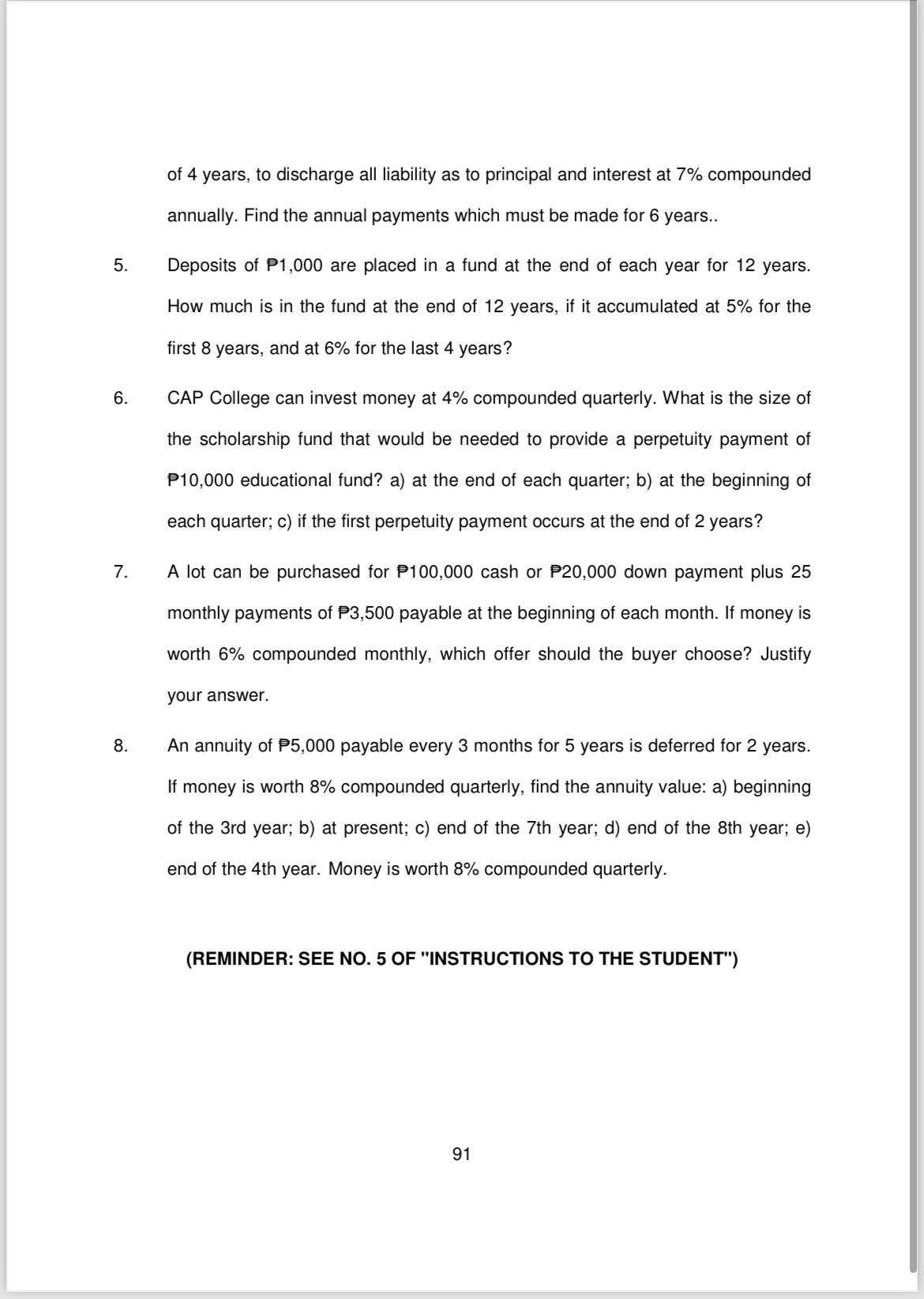
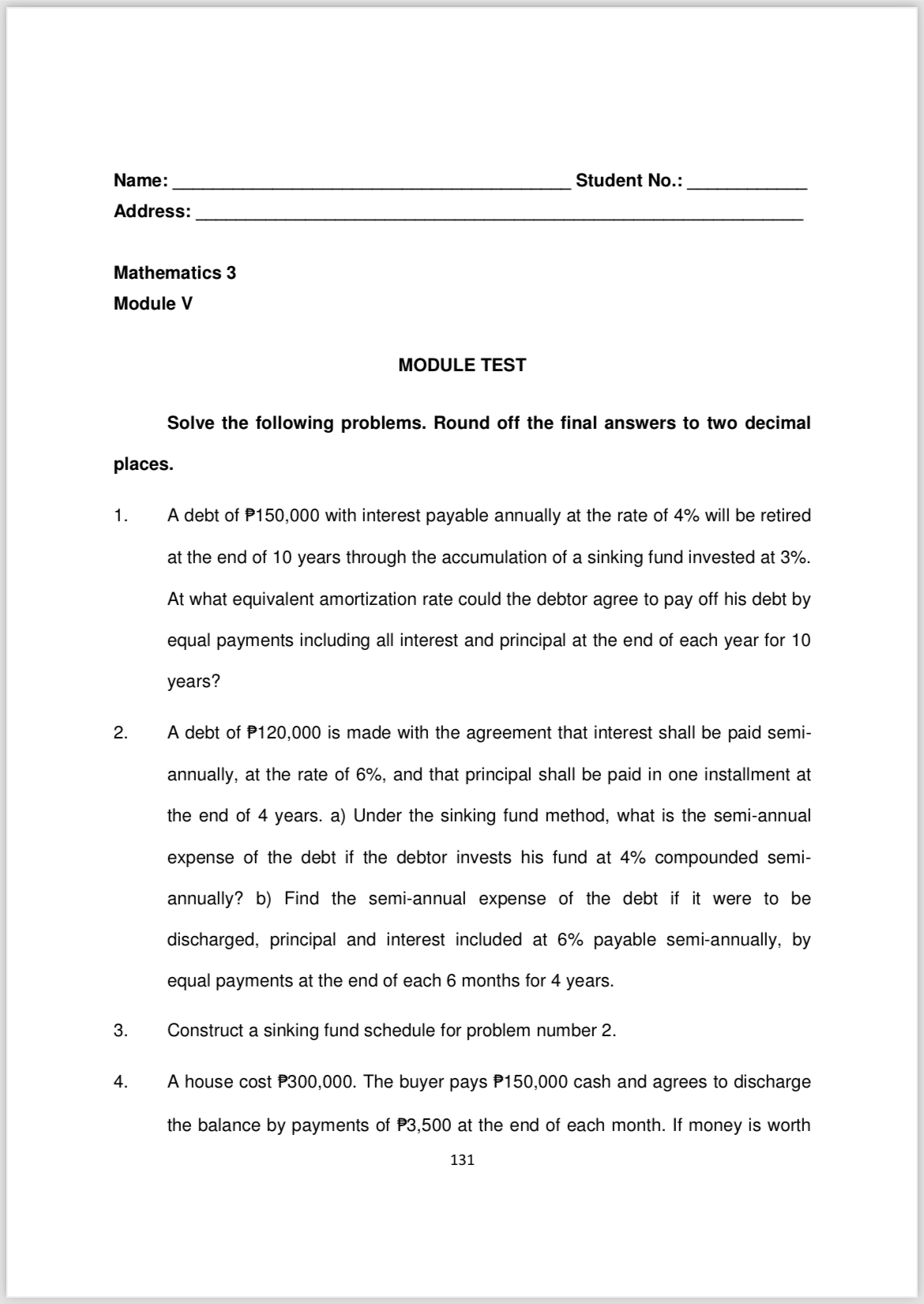
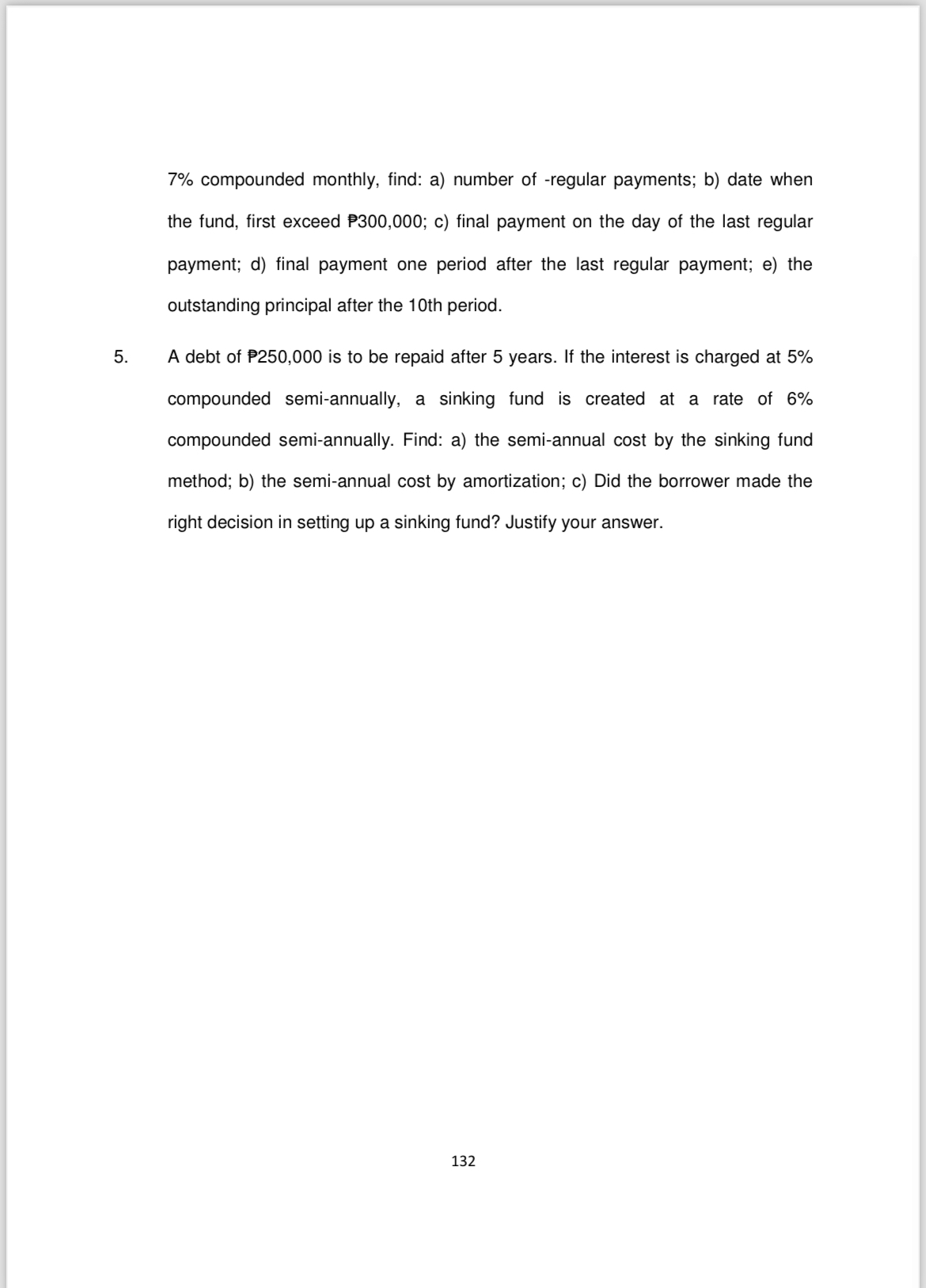
Name: Score: Address: Mathematics 3 Module | MODULE TEST Solve the following problems. Round off the final answers to two decimal places. When you are done, read carefully and follow the instructions at the end of this test. 1. Find the amount if P7,200 is invested for 250 days at the rate of 14% a) using exact interest; b) using ordinary interest. 2. At 7 1/2%, compute the interest on P3,750 from March 23, 1978 to October 30, 1978 using: a. ordinary interest, actual time b. exact interest, actual time c. ordinary interest, appropriate time d. exact interest, appropriate time 3. Simon deposited P10,000 in a bank. It earns 10% simple interest. Find the amount due in 180 days. 4, Find the amount due at the end of 10 months whose present value is P9,350 a) when the discount rate is 9%; b) when the interest rate is 9%. D Find the simple discount rate which is equivalent to the simple interest rate 7% in 96 10. accumulating or discounting money for 8 1/2 months, where the principal is P2,800. When will P695 accumulate to P1,350 if the rate at which it is invested is 12 1/2% simple interest? | was given two options to pay for my debt. Either | pay P1,000 now or P1,100 3 months from now. If savings account interest is 10%, which offer would give me a greater return? What is the interest deducted in advanced and the proceeds for P30,000 bank discount note at 14.4% interest in advance from April 16 to December 16, 19837 Ted signed a simple interest note with a face value of P8,500, an interest rate of 12 1/2% and a term of 9 months. Find a) maturity date; b) interest; c) maturity value. On March 16, 1982, Caloy draws a note promising to pay Mark P4,000 together with interest from date of 5%. 175 days later, a banker discounts this note for Mark at 7% on October 25, 1982. Find a) maturity date b) maturity value c) proceeds received by Mark on October 25, 1982 97 Name : Score: Address: Mathematics 3 Module i MODULE TEST Solve the following problems. Round off the final answers to two decimal places. 1. A promissory note requires Dan to pay P150,000 at the end of 2 years and 9 months. The creditor allows him to discharge the debt by paying P15.000 now. Find the rate compounded quarterly at which the creditor discounted the debt. At the time of the transaction, the market rate for safe investment for the time involved was (7%, m = 4). Was it a wise decision on the part of the creditor to allow Dan to discharge the debt by paying P15,000 now? Why? 2. If interest is at the rate of 4% compounded semi-annually, find how long it will take P5,100 to accumulate to P12,500. 3. If money is worth (5%, m = 4) which obligation is more valuable: a) P1,300 due at the end of 2 years; P1,250 due at the end of 4 years with accumulated interest from today at (0.05, m = 2). 4. Mike owes James the following obligations: l. P10,000 due at the end of 4 years Il. P1,500 due at the end of 6 years with accumulated interest from today at 120 (0.06, m = 2) Mike will be allowed to replace his total obligation by a payment at P2,000 at the end of 2 years and a second payment at the end of 5 years, with money worth 5%. a) Find the unknown payment. Comparison date: at the end of 5 years. b) Mike wishes to replace the obligations by a first payment at the end of 2 years and twice as much at the end of 6 years with money worth 2 1/2%. Find the unknown payments at a comparison date at the end of 5 years. If P13,000 is invested at the rate (0.08, m = 2), when will the compound amount be P35,0007 What simple interest rate would be equivalent to charging 3 1/2% compounded semi-annually, if | lend Nes P2,000 with the agreement that he will pay a single sum of money at the end of 5 years? Tess borrowed a certain sum from Jack on Jan. 8, 1980 and signed a note promising to pay him a total of P10,000 at the end of 5 years. Jack sells this note to Ivan on Jan. 8, 1982. a) If Ivan insists on discounting the note at 4% compounded quarterly, what will he pay for the note? b) If Tess gets permission to delay her payment until Jan. 1, 1988, under the assumption that money is worth (5%, m = 2) after the note matures. What final payment is Tess required to make? 121 Name: Score: Address: Mathematics 3 Module lll MODULE TEST Solve the following problems. Round off the final answers to two decimal places. In order to accumulate a fund of P15,000 by the end of 8 years, what equal deposits should be placed in the fund at the end of each 6 months if interest is at 5% compounded semi-annually? An air-conditioner is for sale at P3,000 in cash or in terms of P700 down and P200 each month for the next 12 months. If you were the buyer, which purchase plan would you prefer? Money is worth 15% compounded monthly. A car may be bought for sale P76,000 cash or in credit, a down payment of P16.000 plus P3.000 monthly for 2 years. At what rate compounded monthly is interest charged? At what nominal rate compounded quarterly will payments of P800 at the end of each 3 months for 5 years discharge all liability for a debtor who borrows P14,000 today? A man started depositing P300 at the end of each 6 months. His first deposit was on April 15, 1975. When will his deposits amount to P7,110.48 if money is worth 3 1/2% compounded semi-annually? 86 A house is purchased for P500,000. The buyer pays 36% down payment and P7,500 monthly payments. Money is worth 24% compounded monthly. a) How many regular payments are there? b) Find the final payment if: 1 it is made on the last periodic payment 2. it is made one period after the last periodic payment In return for a loan, with money worth 6% compounded semi-annually, a man promises to pay P1,000 at the end of each 6 months for 8 years. a) Find the sum he borrows b) Find his remaining liability just after his 5th payment. ) Find his remaining liability just before his 6th payment d) Suppose the debtor failed to make his first 5 payments, when they were due. Then 3 years after he offers to discharge his accumulated liability because of the payments not made plus his liability for the future payments, by making a single payment. What single payment should he make at the end of 3 years? 87 Name: Mailing Address: Student No.: Mathematics 3 Module IV MODULE TEST Solve the following problems. Round off the final answers to two decimal places. Consider an annuity of 8 annual payments of 500 each, with the first payment to be made at the end of 3 years. Assuming that money is worth 5% effective, find the annuity value: a) at present; b) at the end of 10 years; c) at the end of 7 years; d) at the end of 12 years. In order to have P18,000 in a fund at the end of 10 years, 5,000 is deposited now and equal payments will be added to the funds at the end of 3, 4, 5, 6, and 7 years. Find these annual payments if the fund accumulates at 5%. In starting a business venture, the owner is granted a loan of 3,000 at the beginning of each year for 5 years. Money is worth 7% effective. He agrees to pay all accumulated liability by a single payment at the end of 8 years. Find his payment. A machine costs 40,000 cash. A purchaser will pay 9,000 cash, 6,000 at the end of 2 years, and a sequence of 6 equal payments starting with one at the end 90 of 4 years, to discharge all liability as to principal and interest at 7% compounded annually. Find the annual payments which must be made for 6 years.. Deposits of P1,000 are placed in a fund at the end of each year for 12 years. How much is in the fund at the end of 12 years, if it accumulated at 5% for the first 8 years, and at 6% for the last 4 years? CAP College can invest money at 4% compounded quarterly. What is the size of the scholarship fund that would be needed to provide a perpetuity payment of P10,000 educational fund? a) at the end of each quarter; b) at the beginning of each quarter; c) if the first perpetuity payment occurs at the end of 2 years? A lot can be purchased for 100,000 cash or P20,000 down payment plus 25 monthly payments of 3,500 payable at the beginning of each month. If money is worth 6% compounded monthly, which offer should the buyer choose? Justify your answer. An annuity of 5,000 payable every 3 months for 5 years is deferred for 2 years. If money is worth 8% compounded quarterly, find the annuity value: a) beginning of the 3rd year; b) at present; c) end of the 7th year; d) end of the 8th year; e) end of the 4th year. Money is worth 8% compounded quarterly. (REMINDER: SEE NO. 5 OF "INSTRUCTIONS TO THE STUDENT") 91 Name: Student No.: Address: Mathematics 3 Module V MODULE TEST Solve the following problems. Round off the final answers to two decimal places. 1. A debt of P150,000 with interest payable annually at the rate of 4% will be retired at the end of 10 years through the accumulation of a sinking fund invested at 3%. At what equivalent amortization rate could the debtor agree to pay off his debt by equal payments including all interest and principal at the end of each year for 10 years? 2. A debt of #120,000 is made with the agreement that interest shall be paid semi- annually, at the rate of 6%, and that principal shall be paid in one installment at the end of 4 years. a) Under the sinking fund method, what is the semi-annual expense of the debt if the debtor invests his fund at 4% compounded semi- annually? b) Find the semi-annual expense of the debt if it were to be discharged, principal and interest included at 6% payable semi-annually, by equal payments at the end of each 6 months for 4 years. 8. Construct a sinking fund schedule for problem number 2. 4. A house cost P300,000. The buyer pays 150,000 cash and agrees to discharge the balance by payments of 3,500 at the end of each month. If money is worth 131 7% compounded monthly, find: a) number of -regular payments; b) date when the fund, first exceed P300,000; c) final payment on the day of the last regular payment; d) final payment one period after the last regular payment; e) the outstanding principal after the 10th period. A debt of P250,000 is to be repaid after 5 years. If the interest is charged at 5% compounded semi-annually, a sinking fund is created at a rate of 6% compounded semi-annually. Find: a) the semi-annual cost by the sinking fund method; b) the semi-annual cost by amortization; c) Did the borrower made the right decision in setting up a sinking fund? Justify your answer. 132
Step by Step Solution
There are 3 Steps involved in it

Get step-by-step solutions from verified subject matter experts
 Study Help