Question: Name The Just Noticeable Difference (jnd) is the minimum amount of change in a stimulus that can be detected. Using sound as an example, if
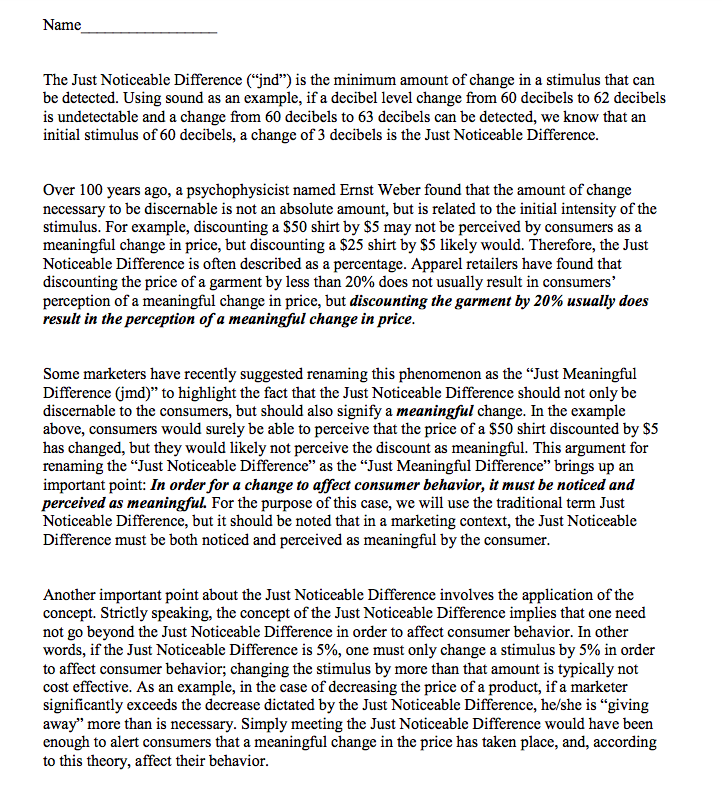
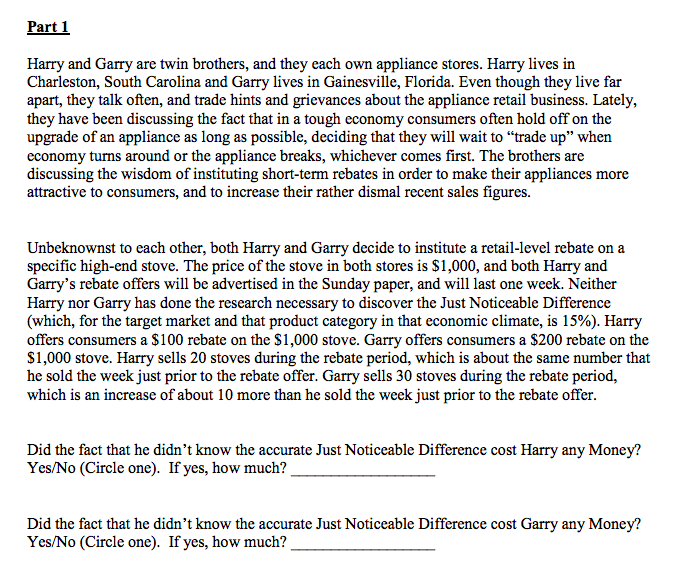
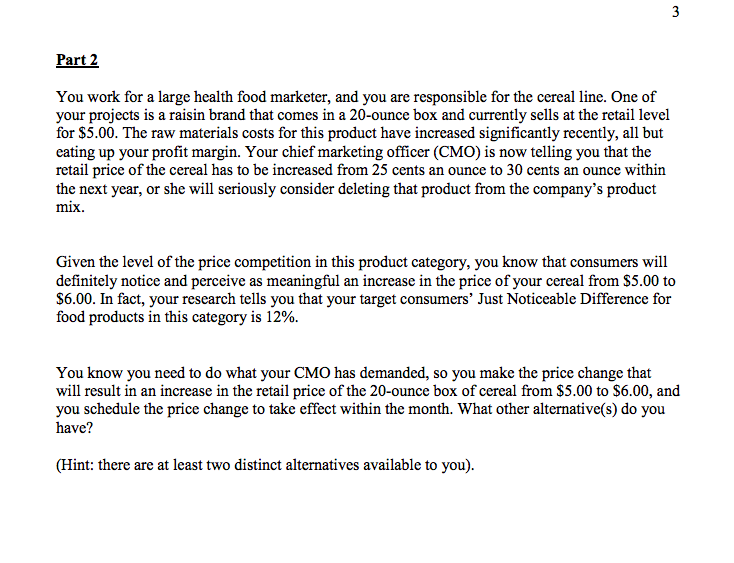
Name The Just Noticeable Difference (jnd") is the minimum amount of change in a stimulus that can be detected. Using sound as an example, if a decibel level change from 60 decibels to 62 decibels is undetectable and a change from 60 decibels to 63 decibels can be detected, we know that an initial stimulus of 60 decibels, a change of 3 decibels is the Just Noticeable Difference. Over 100 years ago, a psychophysicist named Ernst Weber found that the amount of change necessary to be discernable is not an absolute amount, but is related to the initial intensity of the stimulus. For example, discounting a $50 shirt by $5 may not be perceived by consumers as a meaningful change in price, but discounting a $25 shirt by $5 likely would. Therefore, the Just Noticeable Difference is often described as a percentage. Apparel retailers have found that discounting the price of a garment by less than 20% does not usually result in consumers' perception of a meaningful change in price, but discounting the garment by 20% usually does result in the perception of a meaningful change in price. Some marketers have recently suggested renaming this phenomenon as the "Just Meaningful Difference (jmd)" to highlight the fact that the Just Noticeable Difference should not only be discernable to the consumers, but should also signify a meaningful change. In the example above, consumers would surely be able to perceive that the price of a $50 shirt discounted by $5 has changed, but they would likely not perceive the discount as meaningful. This argument for renaming the "Just Noticeable Difference" as the "Just Meaningful Difference" brings up an important point: In order for a change to affect consumer behavior, it must be noticed and perceived as meaningful. For the purpose of this case, we will use the traditional term Just Noticeable Difference, but it should be noted that in a marketing context, the Just Noticeable Difference must be both noticed and perceived as meaningful by the consumer. Another important point about the Just Noticeable Difference involves the application of the concept. Strictly speaking, the concept of the Just Noticeable Difference implies that one need not go beyond the Just Noticeable Difference in order to affect consumer behavior. In other words, if the Just Noticeable Difference is 5%, one must only change a stimulus by 5% in order to affect consumer behavior; changing the stimulus by more than that amount is typically not cost effective. As an example, in the case of decreasing the price of a product, if a marketer significantly exceeds the decrease dictated by the Just Noticeable Difference, he/she is "giving away" more than is necessary. Simply meeting the Just Noticeable Difference would have been enough to alert consumers that a meaningful change in the price has taken place, and, according to this theory, affect their behavior. Part 1 Harry and Garry are twin brothers, and they each own appliance stores. Harry lives in Charleston, South Carolina and Garry lives in Gainesville, Florida. Even though they live far apart, they talk often, and trade hints and grievances about the appliance retail business. Lately, they have been discussing the fact that in a tough economy consumers often hold off on the upgrade of an appliance as long as possible, deciding that they will wait to trade up" when economy turns around or the appliance breaks, whichever comes first. The brothers are discussing the wisdom of instituting short-term rebates in order to make their appliances more attractive to consumers, and to increase their rather dismal recent sales figures. Unbeknownst to each other, both Harry and Garry decide to institute a retail-level rebate on a specific high-end stove. The price of the stove in both stores is $1,000, and both Harry and Garry's rebate offers will be advertised in the Sunday paper, and will last one week. Neither Harry nor Garry has done the research necessary to discover the Just Noticeable Difference (which, for the target market and that product category in that economic climate, is 15%). Harry offers consumers a $100 rebate on the $1,000 stove. Garry offers consumers a $200 rebate on the $1,000 stove. Harry sells 20 stoves during the rebate period, which is about the same number that he sold the week just prior to the rebate offer. Garry sells 30 stoves during the rebate period, which is an increase of about 10 more than he sold the week just prior to the rebate offer. Did the fact that he didn't know the accurate Just Noticeable Difference cost Harry any Money? Yes/No (Circle one). If yes, how much? Did the fact that he didn't know the accurate Just Noticeable Difference cost Garry any Money? Yes/No (Circle one). If yes, how much? Part 2 You work for a large health food marketer, and you are responsible for the cereal line. One of your projects is a raisin brand that comes in a 20-ounce box and currently sells at the retail level for $5.00. The raw materials costs for this product have increased significantly recently, all but eating up your profit margin. Your chief marketing officer (CMO) is now telling you that the retail price of the cereal has to be increased from 25 cents an ounce to 30 cents an ounce within the next year, or she will seriously consider deleting that product from the company's product mix. Given the level of the price competition in this product category, you know that consumers will definitely notice and perceive as meaningful an increase in the price of your cereal from $5.00 to $6.00. In fact, your research tells you that your target consumers' Just Noticeable Difference for food products in this category is 12%. You know you need to do what your CMO has demanded, so you make the price change that will result in an increase in the retail price of the 20-ounce box of cereal from $5.00 to $6.00, and you schedule the price change to take effect within the month. What other alternative(s) do you have? (Hint: there are at least two distinct alternatives available to you)









 Study Help