







Question: Nanoengineering can be exploited to design more efficient catalysts. Catalytic activity, how good a catalyst is at facilitating a reaction, depends on composition and nanostructure.
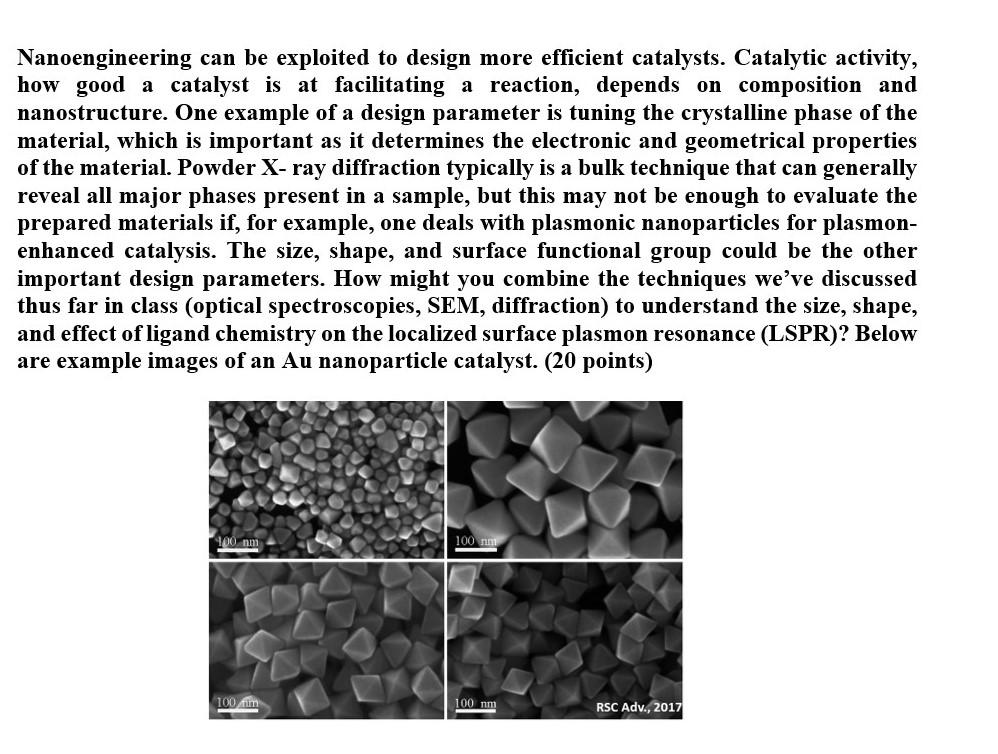
Nanoengineering can be exploited to design more efficient catalysts. Catalytic activity, how good a catalyst is at facilitating a reaction, depends on composition and nanostructure. One example of a design parameter is tuning the crystalline phase of the material, which is important as it determines the electronic and geometrical properties of the material. Powder X-ray diffraction typically is a bulk technique that can generally reveal all major phases present in a sample, but this may not be enough to evaluate the prepared materials if, for example, one deals with plasmonic nanoparticles for plasmon- enhanced catalysis. The size, shape, and surface functional group could be the other important design parameters. How might you combine the techniques we've discussed thus far in class (optical spectroscopies, SEM, diffraction) to understand the size, shape, and effect of ligand chemistry on the localized surface plasmon resonance (LSPR)? Below are example images of an Au nanoparticle catalyst. (20 points) 100 nm 100 nm 100 tim 100 nm RSC Adv., 2017
Step by Step Solution
There are 3 Steps involved in it

Get step-by-step solutions from verified subject matter experts
 Study Help