



Question: Nature - inspired materials and structures have received a lot of attention over the past couple of years, drawing from a field that frequently is
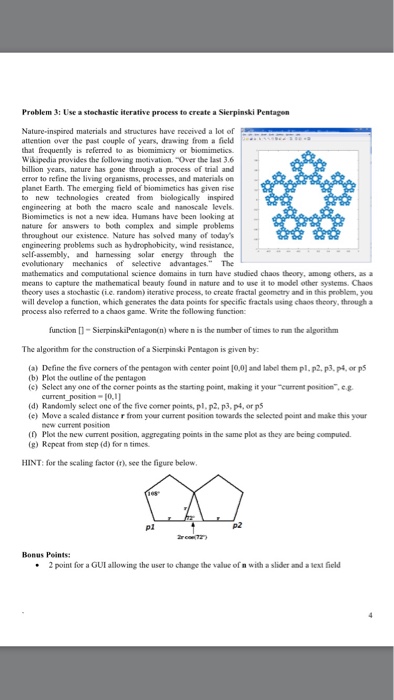
Nature - inspired materials and structures have received a lot of attention over the past couple of years, drawing from a field that frequently is referred to as biomimicry or biometries. Wikipedia provides the following motivation. "Over the last 3.6 billion years, nature has gone through a process of trial and error to refine the living organisms, processes, and materials on planet Earth. The emerging field of biomimetics has given rise to new technologies created from biologically inspired engineering at both the macro scale and nanoscale levels. Biomimetics is not a new idea. Humans have been looking at nature for answers to both complex and simple problems throughout our existence. Nature has solved many of today's engineering problems such as hydrophobicity, wind resistance, self - assembly, and harnessing solar energy through the of evolutionary mechanics selective advantages "The and computational science domains in turn have studied chaos theory, among others. means to capture the mathematical beauty found in nature and to use it to model other systems. Chaos uses a stochastic (ie. random) iterative process, to create fractal geometry and in this problem. you which generates the data points for specific fractals using chaos theory. through will develop a function process also referred to a chaos game. Write the following function: function: function []-SierpinskiPentagon(n) where n is the number of times torts the algorithm The algorithm The algorithm for the construction of Sierpinski Pentagon is given by: (a) Define the five corners of the pentagon with center point [0, 0] and label them p1 p2.p3.p4.or p5 (b) Plot the outline of the pentagon (c) Select any one of the comer points as the starting point, making it your current position c. g. current_position - [0.1] (d) Randomly select one of the five comer points, p1, p2, p3, P4, or p5 (e) Move a scaled distance r from your current position towards the selected point and make this your new current position (f) Plot the new current position, aggregating points in the same plot as they being computed. (g) Repeat from step (d) for n times. 2 point for a GUI allowing the user to change the value of n with a slider and a text field
Step by Step Solution
There are 3 Steps involved in it

Get step-by-step solutions from verified subject matter experts