



Question: ncome is to be evaluated under four different situations as follows: a. Prices are rising: (1) Situation A: FIFO is used. (2) Situation B: LIFO
ncome is to be evaluated under four different situations as follows: a. Prices are rising: (1) Situation A: FIFO is used. (2) Situation B: LIFO is used. b. Prices are falling: (1) Situation C: FIFO is used. (2) Situation D: LIFO is used. The basic data common to all four situations are sales, 500 units for $15,000; beginning inventory, 300 units; purchases, 420 units; ending inventory, 220 units; and operating expenses, $3,900. The income tax rate is 40%. Required: Complete the following tabulation for each situation. In Situations A and B (prices rising), assume the following: beginning inventory, 300 units at $10 = $3,000; purchases, 420 units at $12 = $5,040. In Situations C and D (prices falling), assume the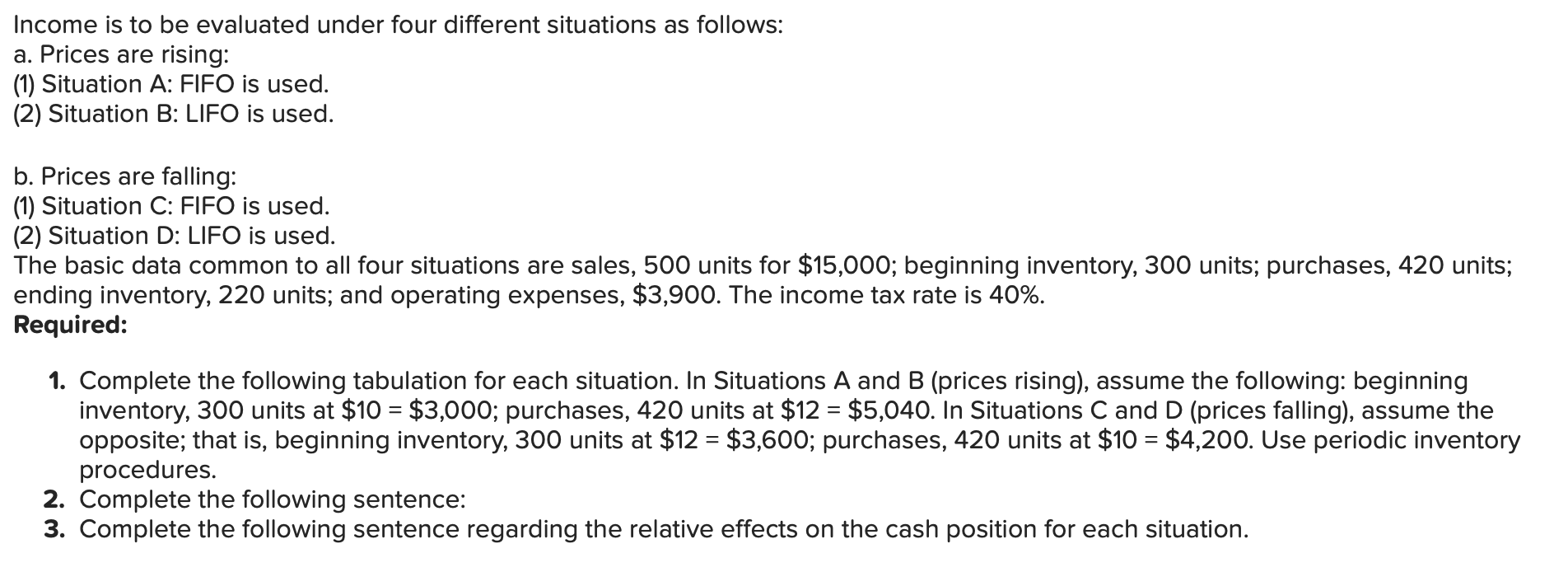
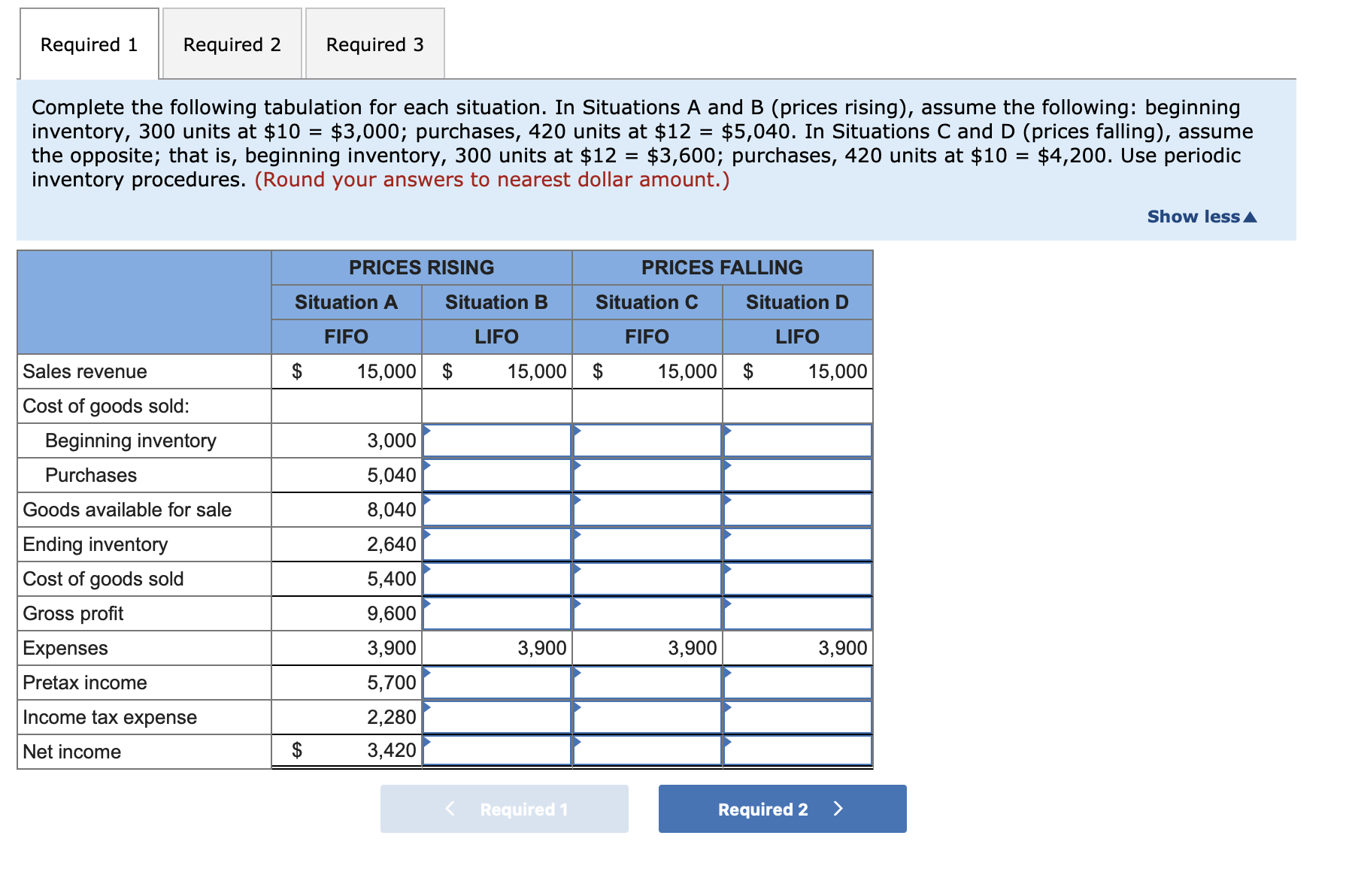
Income is to be evaluated under four different situations as follows: a. Prices are rising: (1) Situation A: FIFO is used. (2) Situation B: LIFO is used. b. Prices are falling: (1) Situation C: FIFO is used. (2) Situation D: LIFO is used. The basic data common to all four situations are sales, 500 units for $15,000; beginning inventory, 300 units; purchases, 420 units; ending inventory, 220 units; and operating expenses, $3,900. The income tax rate is 40%. Required: 1. Complete the following tabulation for each situation. In Situations A and B (prices rising), assume the following: beginning inventory, 300 units at $10=$3,000; purchases, 420 units at $12=$5,040. In Situations C and D (prices falling), assume the opposite; that is, beginning inventory, 300 units at $12=$3,600; purchases, 420 units at $10=$4,200. Use periodic inventory procedures. 2. Complete the following sentence: 3. Complete the following sentence regarding the relative effects on the cash position for each situation. Complete the following tabulation for each situation. In Situations A and B (prices rising), assume the following: beginning inventory, 300 units at $10=$3,000; purchases, 420 units at $12=$5,040. In Situations C and D (prices falling), assume the opposite; that is, beginning inventory, 300 units at $12=$3,600; purchases, 420 units at $10=$4,200. Use periodic inventory procedures. (Round your answers to nearest dollar amount.)
Step by Step Solution
There are 3 Steps involved in it

Get step-by-step solutions from verified subject matter experts