Question: NEE HELP WITH QUESTION 20 AND 22 QUESTION 18 Questions 18 to 22 introduce uncertainty to the original situation presented in Question 11 with the
NEE HELP WITH QUESTION 20 AND 22
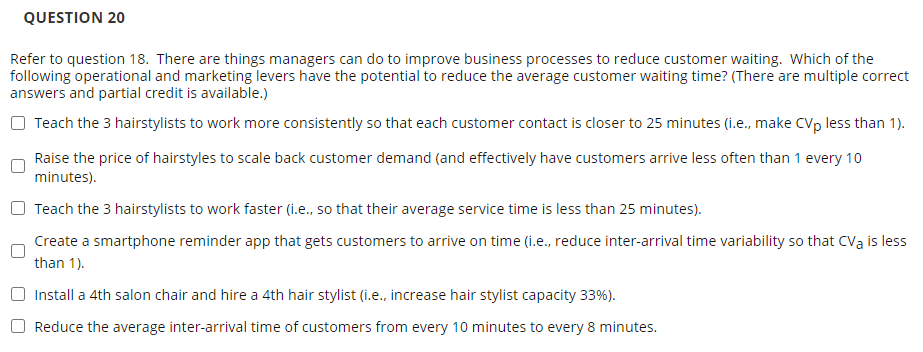

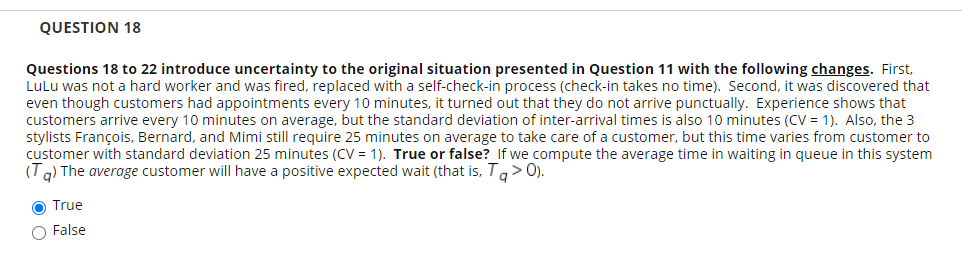
QUESTION 18 Questions 18 to 22 introduce uncertainty to the original situation presented in Question 11 with the following changes. First, Lulu was not a hard worker and was fired, replaced with a self-check-in process (check-in takes no time). Second, it was discovered that even though customers had appointments every 10 minutes, it turned out that they do not arrive punctually. Experience shows that customers arrive every 10 minutes on average, but the standard deviation of inter-arrival times is also 10 minutes (CV = 1). Also, the 3 stylists Franois, Bernard, and Mimi still require 25 minutes on average to take care of a customer, but this time varies from customer to customer with standard deviation 25 minutes (CV = 1). True or false? If we compute the average time in waiting in queue in this system (T) The average customer will have a positive expected wait (that is, Tg > 0). O True O False QUESTION 20 Refer to question 18. There are things managers can do to improve business processes to reduce customer waiting. Which of the following operational and marketing levers have the potential to reduce the average customer waiting time? (There are multiple correct answers and partial credit is available.) Teach the 3 hairstylists to work more consistently so that each customer contact is closer to 25 minutes (i.e., make CVp less than 1). Raise the price of hairstyles to scale back customer demand (and effectively have customers arrive less often than 1 every 10 minutes). Teach the 3 hairstylists to work faster (i.e., so that their average service time is less than 25 minutes). Create a smartphone reminder app that gets customers to arrive on time (i.e., reduce inter-arrival time variability so that CVa is less than 1). Install a 4th salon chair and hire a 4th hair stylist (i.e., increase hair stylist capacity 33%). Reduce the average inter-arrival time of customers from every 10 minutes to every 8 minutes. QUESTION 22 Again, recall Little's Law. An escalator can be used two ways: A person can stand and let the escalator take her to the other end. Or the person can walk the escalator, reaching the other end faster. Suppose by walking a person reaches the other end in 60% of the time she takes just standing. However, when all walk the escalator, they need more space between them to avoid bumping into each other. Thus, the number of persons who can be on the escalator at the same time reduces by 50%. Which method (everyone standing vs. everyone walking) allows escalator to be used by most people per unit of time? Explain briefly. For full credit, you must use Little's Law to prove it









 Study Help