







Question: Need a step-by-step derivation on how to go from equation 9.6-22 to 9.6-23 For a Newtonian fluid which is incompressible in the sense that (@plT)p=0,
Need a step-by-step derivation on how to go from equation 9.6-22 to 9.6-23
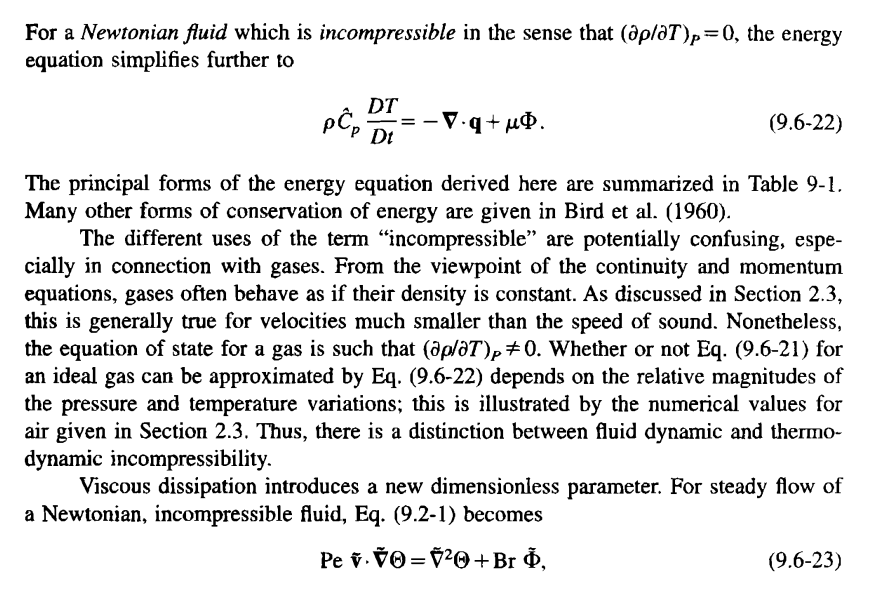
For a Newtonian fluid which is incompressible in the sense that (@plT)p=0, the energy equation simplifies further to DT pp Di V.q+uo. + (9.6-22) The principal forms of the energy equation derived here are summarized in Table 9-1. Many other forms of conservation of energy are given in Bird et al. (1960). The different uses of the term "incompressible are potentially confusing, espe- cially in connection with gases. From the viewpoint of the continuity and momentum equations, gases often behave as if their density is constant. As discussed in Section 2.3, this is generally true for velocities much smaller than the speed of sound. Nonetheless, the equation of state for a gas is such that (Oplat): 70. Whether or not Eq. (9.6-21) for an ideal gas can be approximated by Eq. (9.6-22) depends on the relative magnitudes of the pressure and temperature variations; this is illustrated by the numerical values for air given in Section 2.3. Thus, there is a distinction between fluid dynamic and thermo- dynamic incompressibility. Viscous dissipation introduces a new dimensionless parameter. For steady flow of a Newtonian, incompressible fluid, Eq. (9.2-1) becomes Pe . o=f?@+Br , (9.6-23)
Step by Step Solution
There are 3 Steps involved in it

Get step-by-step solutions from verified subject matter experts
 Study Help