







Question: need all only L 2009 - May (1] {C} (b) PQ Ltd. makes and sells a labour-intensive product. Mat Its labour force has a learning
![need all only L 2009 - May (1] {C} (b) PQ](https://dsd5zvtm8ll6.cloudfront.net/si.experts.images/questions/2024/09/66f79c6c04171_46766f79c6b768d3.jpg)

need all only
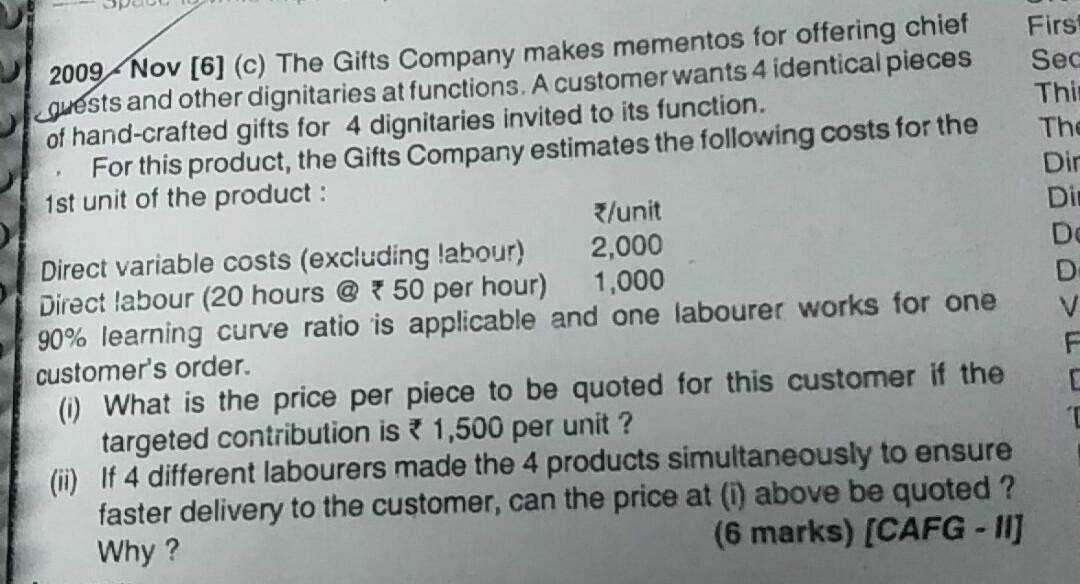
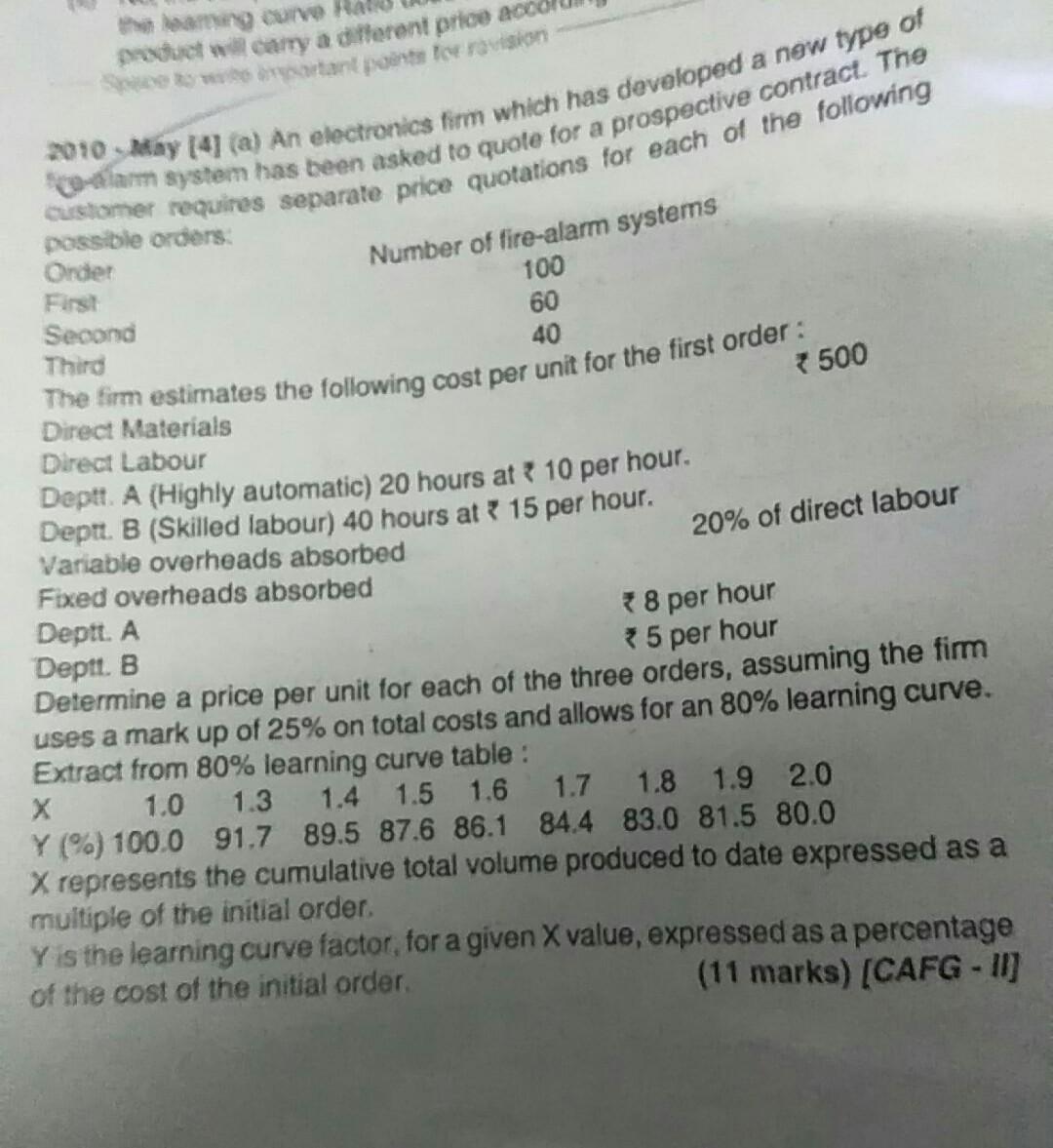
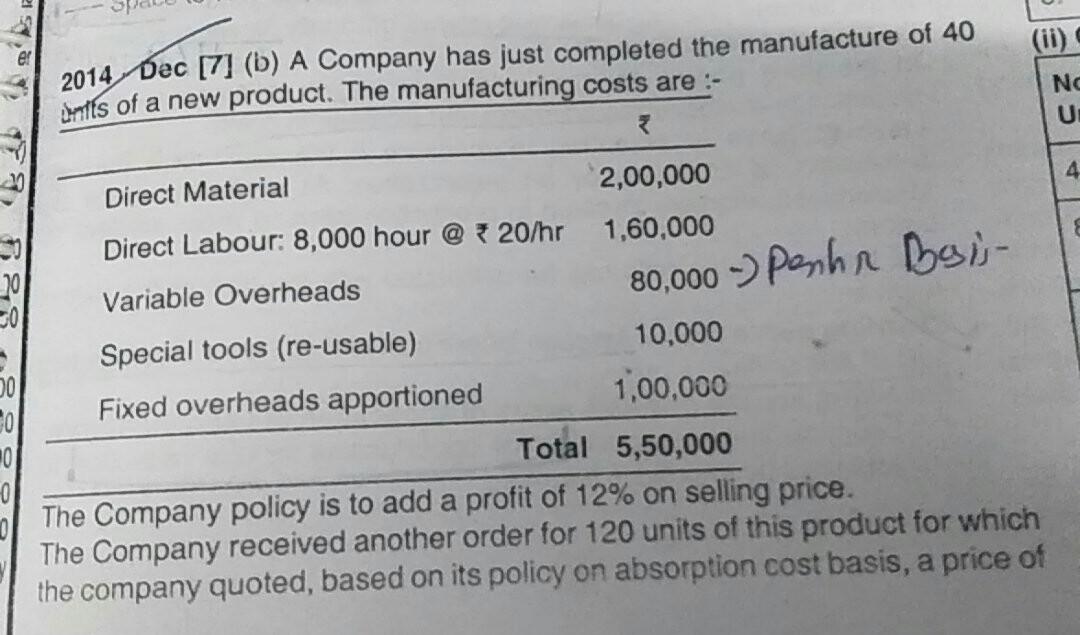
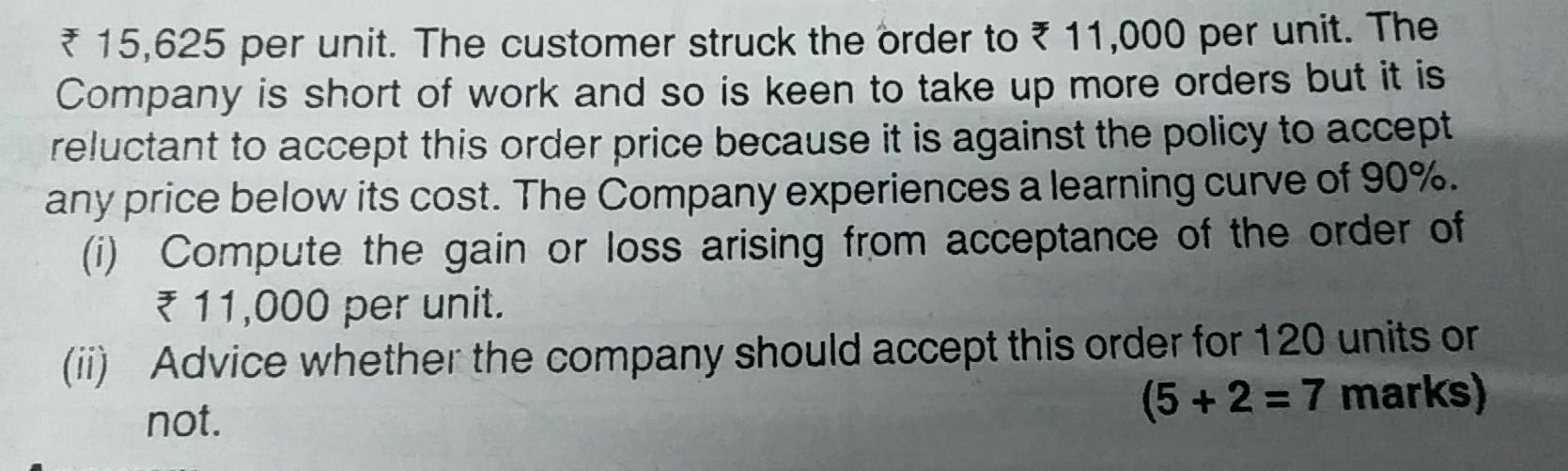
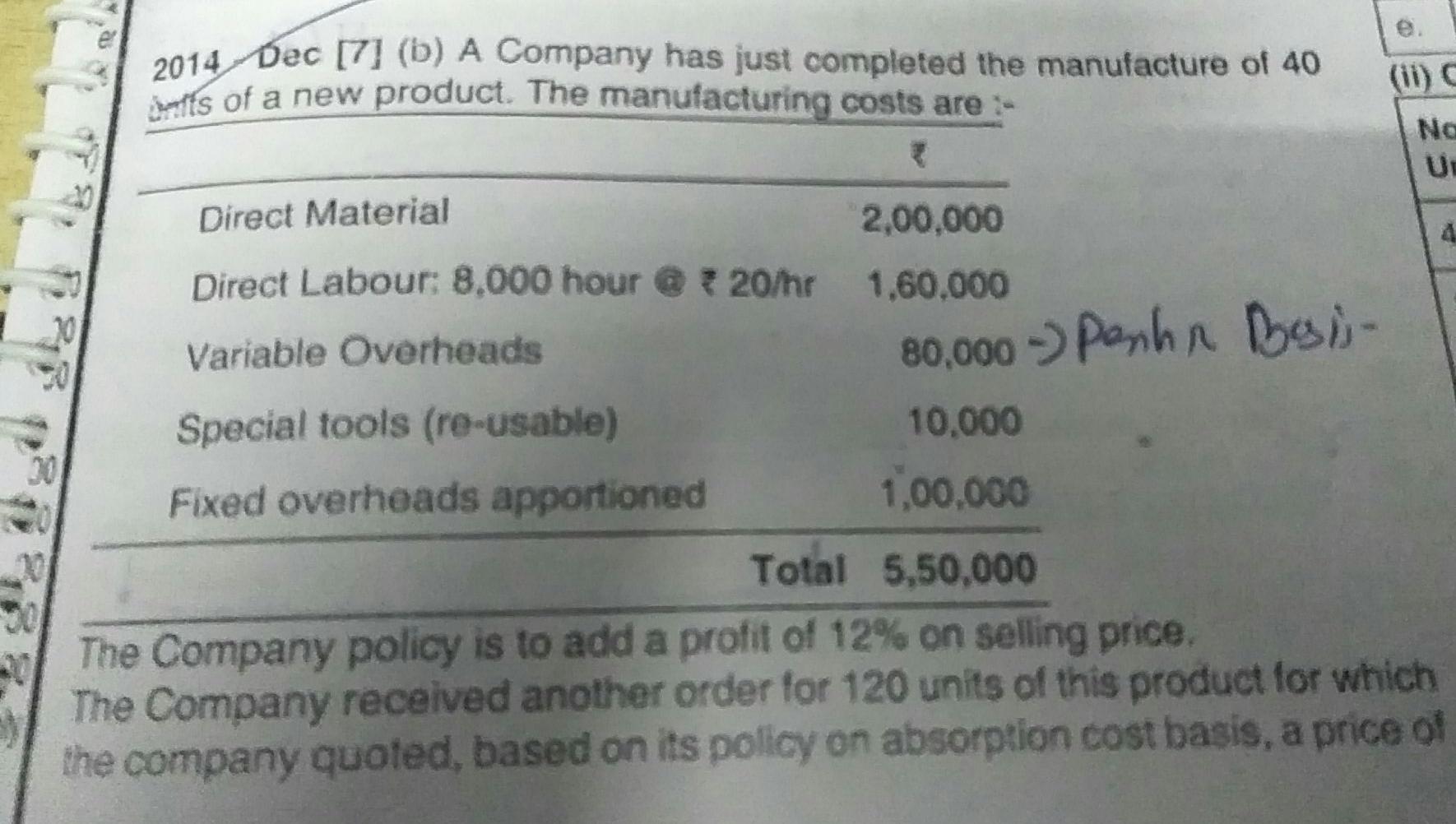
L 2009 - May (1] {C} (b) PQ Ltd. makes and sells a labour-intensive product. Mat Its labour force has a learning rate of 80%, applicable only to direct labour Var and not to variable overhead. Va The cost per unit of the first product is as follows: Direct materials 10,000 Ift Direct labour 8,000 (@ 4 per hour) be Variable overhead 2,000 Total variable cost 20,000 V PQ Ltd. has received an order from X Ltd. for 4 units of the product. Another customer, Y Ltd. is also interested in purchasing 4 units of the product. PQ Ltd. has the capacity to fulfil both the orders. Y Ltd. presently purchases this product in the market for 17,200 and is willing to pay this price per unit of PQ's product. But X Ltd. lets PQ choose one of the following options : () A price of * 16,500 per unit for the 4 units it proposes to take from PQ. (Or) (ii) Supply X Ltd.'s idle labour force to PQ, for only 4 units of production, with PQ having to pay only Re. 1 per labour hour to X Ltd.'s workers. X Ltd.'s workers will be withdrawn after the first 4 units are produced. In this case, PQ need not use its labour for producing X Ltd.'s requirement. X Ltd. assures PQ that its labour force also has a learning rate of 80%. In this option, X Ltd. offers to buy the product from PQ at only 14,000 per unit. X and Y shall not know of each other's offer. Firs Sec This The Dir Dit DO D V 2009 Nov [6] (c) The Gifts Company makes mementos for offering chief quests and other dignitaries at functions. A customer wants 4 identical pieces of hand-crafted gifts for 4 dignitaries invited to its function. For this product, the Gifts Company estimates the following costs for the 1st unit of the product : /unit Direct variable costs (excluding labour) 2,000 Direct labour (20 hours @ * 50 per hour) 1,000 90% learning curve ratio 'is applicable and one labourer works for one customer's order. (1) What is the price per piece to be quoted for this customer if the targeted contribution is 1,500 per unit ? (ii) If 4 different labourers made the 4 products simultaneously to ensure faster delivery to the customer, can the price at (i) above be quoted ? Why? (6 marks) [CAFG - Il] the larg curve product carry a different price ad tant points to revision 2010 May (4) (a) An electronics form which has developed a new type of -larm system has been asked to quote for a prospective contract. The possible orders customer requires separate price quotations for each of the following Order Number of fire-alarm systems 100 60 40 500 20% of direct labour *8 per hour 5 per hour Second Third The firm estimates the following cost per unit for the first order: Direct Materials Direct Labour Deptt. A (Highly automatic) 20 hours at 10 per hour. Deptt. B (Skilled labour) 40 hours at 15 per hour. Variable overheads absorbed Fixed overheads absorbed Deptt. A Deptt. B Determine a price per unit for each of the three orders, assuming the firm uses a mark up of 25% on total costs and allows for an 80% learning curve. Extract from 80% learning curve table : X 1.0 1.3 1.4 1.5 1.6 1.7 1.8 1.9 2.0 Y (%) 100.0 91.7 89.5 87.6 86.1 84.4 83.0 81.5 80.0 X represents the cumulative total volume produced to date expressed as a multiple of the initial order. Y is the learning curve factor for a given X value, expressed as a percentage of the cost of the initial order. (11 marks) [CAFG - I] Nc U 48o99 7 4 80,000 - pasha Bai 2014 Dec [7] (b) A Company has just completed the manufacture of 40 Onits of a new product. The manufacturing costs are :- E Direct Material 2,00,000 Direct Labour: 8,000 hour @ 20/hr 1,60,000 30 30 Variable Overheads Special tools (re-usable) 10,000 00 00 Fixed overheads apportioned 1,00,000 10 Total 5,50,000 0 0 0 The Company policy is to add a profit of 12% on selling price. The Company received another order for 120 units of this product for which the company quoted, based on its policy on absorption cost basis, a price of * 15,625 per unit. The customer struck the order to 11,000 per unit. The Company is short of work and so is keen to take up more orders but it is reluctant to accept this order price because it is against the policy to accept any price below its cost. The Company experiences a learning curve of 90%. (0) Compute the gain or loss arising from acceptance of the order of * 11,000 per unit. (ii) Advice whether the company should accept this order for 120 units or not. (5 + 2 = 7 marks) 2019 - June [5] (b) What do you understand by Learning Curve? What are its different phases? State the possible areas of application of Learning Curve. reducir 2014 Dec [7] (b) A Company has just completed the manufacture of 40 afts of a new product. The manufacturing costs are :- Na U Direct Material 2,00.000 Direct Labour: 8.000 hour @ 20/hr 1.60.000 Variable Overheads 80,000 - Panha Bois- Special tools (re-usable) 10.000 30 Fixed overheads apportioned 1,00.000 Total 5,50.000 30 The Company policy is to add a profit of 12% on selling price. The Company received another order for 120 units of this product for which the company quoted, based on its policy on absorption cost basis, a price of
Step by Step Solution
There are 3 Steps involved in it

Get step-by-step solutions from verified subject matter experts
 Study Help