



Question: Need an Ideas or idea at least for a project Implement a non-trivial algorithm in the context of a real-world application. A very fuzzy definition
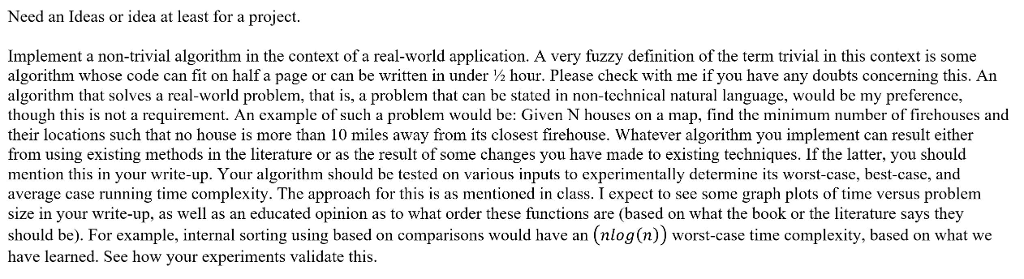
Need an Ideas or idea at least for a project Implement a non-trivial algorithm in the context of a real-world application. A very fuzzy definition of the term trivial in this context is some algorithm whose code can fit on half a page or can be written in under hour. Please check with me if you have any doubts concerning this. An algorithm that solves a real-world problem, that is, a problem that can be stated in non-technical natural language, would be my preference, though this is not a requirement. An example of such a problem would be: Given N houses on a map, find the minimum number of firehouses and their locations such that no house is more than 10 miles away from its closest firehouse. Whatever algorithm you implement can result either from using existing methods in the literature or as the result of some changes you have made to existing techniques. If the latter, you should mention this in your write-up. Your algorithm should be tested on various inputs to experimentally determine its worst-case, best-case, and average case running time complexity. The approach for this is as mentioned in class. I expect to see some graph plots of time versus problem size in your write-up, as well as an educated opinion as to what order these functions are (based on what the book or the literature says they should be). For example, internal sorting using based on comparisons would have an (nlog(n)) worst-case time complexity, based on what we have learned. See how your experiments validate this Need an Ideas or idea at least for a project Implement a non-trivial algorithm in the context of a real-world application. A very fuzzy definition of the term trivial in this context is some algorithm whose code can fit on half a page or can be written in under hour. Please check with me if you have any doubts concerning this. An algorithm that solves a real-world problem, that is, a problem that can be stated in non-technical natural language, would be my preference, though this is not a requirement. An example of such a problem would be: Given N houses on a map, find the minimum number of firehouses and their locations such that no house is more than 10 miles away from its closest firehouse. Whatever algorithm you implement can result either from using existing methods in the literature or as the result of some changes you have made to existing techniques. If the latter, you should mention this in your write-up. Your algorithm should be tested on various inputs to experimentally determine its worst-case, best-case, and average case running time complexity. The approach for this is as mentioned in class. I expect to see some graph plots of time versus problem size in your write-up, as well as an educated opinion as to what order these functions are (based on what the book or the literature says they should be). For example, internal sorting using based on comparisons would have an (nlog(n)) worst-case time complexity, based on what we have learned. See how your experiments validate this
Step by Step Solution
There are 3 Steps involved in it

Get step-by-step solutions from verified subject matter experts