







Question: NEED ANALYSIS PART 1 , 2 , 4 PLEAAAAASE INCLUDE MATLAB CODE ALL THE THINGS YOU NEED IS IN PICTURE INCLUDING DATA TABLE 3 comes
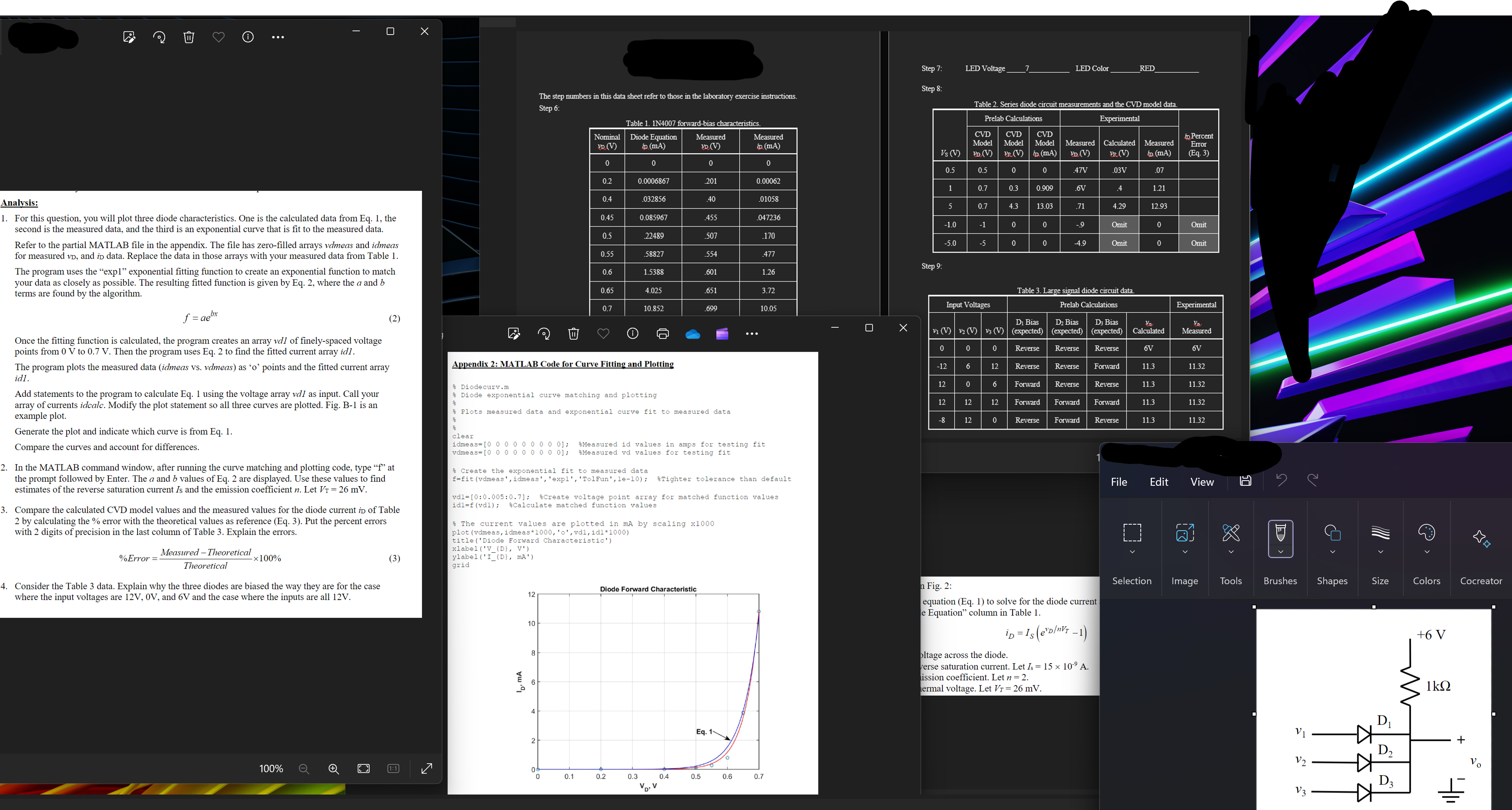
NEED ANALYSIS PART PLEAAAAASE INCLUDE MATLAB CODE ALL THE THINGS YOU NEED IS IN PICTURE INCLUDING DATA TABLE comes from circuit, For this question, you will plot three diode characteristics. One is the calculated data from Eqthe second is the measured data, and the third is an exponential curve that is fit to the measured data.Refer to the partial MATLAB file in the appendix. The file has zerofilled arrays vdmeas and idmeas for measured vDand iD data. Replace the data in those arrays with your measured data from Table The program uses the expexponential fitting function to create an exponential function to match your data as closely as possible. The resulting fitted function is given by Eqwhere the a and b terms are found by the algorithm. Once the fitting function is calculated, the program creates an array vdof finelyspaced voltage points from V to VThen the program uses Eqto find the fitted current array id The program plots the measured data idmeas vsvdmeasas opoints and the fitted current array idAdd statements to the program to calculate Equsing the voltage array vdas input. Call your array of currents idcalc. Modify the plot statement so all three curves are plotted. Fig. Bis an example plot. Generate the plot and indicate which curve is from Eq Compare the curves and account for differences. In the MATLAB command window, after running the curve matching and plotting code, type fat the prompt followed by Enter. The a and b values of Eqare displayed. Use these values to find estimates of the reverse saturation current IS and the emission coefficient nLet VT mVConsider the Table data Explain why the three diodes are biased the way they are for the case where the input voltages are VVand V and the case where the inputs are all VWILL RATE ALL THUMBS QUICK DATA IS IN PICTURES ALL DATA NEEDED IS IN PICTURES
Step by Step Solution
There are 3 Steps involved in it
1 Expert Approved Answer
Step: 1 Unlock

Question Has Been Solved by an Expert!
Get step-by-step solutions from verified subject matter experts
Step: 2 Unlock
Step: 3 Unlock
 Study Help