







Question: *** NEED ANSWER IMMEDIATELY *** (20 MARKS) SECTION B: CASE STUDY There is ONE (1) case study in this section. Answer all questions. Labour Relations

*** NEED ANSWER IMMEDIATELY ***
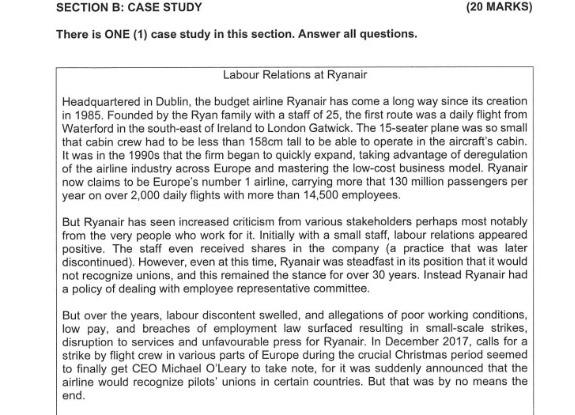
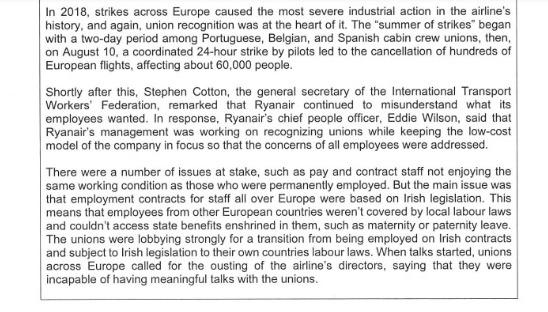
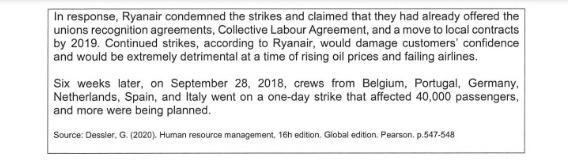
(20 MARKS) SECTION B: CASE STUDY There is ONE (1) case study in this section. Answer all questions. Labour Relations at Ryanair Headquartered in Dublin, the budget airline Ryanair has come a long way since its creation in 1985. Founded by the Ryan family with a staff of 25, the first route was a daily flight from Waterford in the south-east of Ireland to London Gatwick. The 15-seater plane was so small that cabin crew had to be less than 158cm tall to be able to operate in the aircraft's cabin. It was in the 1990s that the firm began to quickly expand, taking advantage of deregulation of the airline industry across Europe and mastering the low-cost business model. Ryanair now claims to be Europe's number 1 airline, carrying more that 130 million passengers per year on over 2,000 daily flights with more than 14,500 employees. But Ryanair has seen increased criticism from various stakeholders perhaps most notably from the very people who work for it. Initially with a small staff, labour relations appeared positive. The staff even received shares in the company (a practice that was later discontinued). However, even at this time, Ryanair was steadfast in its position that it would not recognize unions, and this remained the stance for over 30 years. Instead Ryanair had a policy of dealing with employee representative committee. But over the years, labour discontent sweiled, and allegations of poor working conditions, low pay, and breaches of employment law surfaced resulting in small-scale strikes, disruption to services and unfavourable press for Ryanair. In December 2017, calls for a strike by flight crew in various parts of Europe during the crucial Christmas period seemed to finally get CEO Michael O'Leary to take note, for it was suddenly announced that the airline would recognize pilots' unions in certain countries. But that was by no means the end. In 2018, strikes across Europe caused the most severe industrial action in the airline's history, and again, union recognition was at the heart of it. The "summer of strikes" began with a two-day period among Portuguese, Belgian, and Spanish cabin crew unions, then, on August 10, a coordinated 24-hour strike by pilots led to the cancellation of hundreds of European flights, affecting about 60,000 people. Shortly after this, Stephen Cotton, the general secretary of the International Transport Workers' Federation, remarked that Ryanair continued to misunderstand what its employees wanted. In response, Ryanair's chief people officer, Eddie Wilson, said that Ryanair's management was working on recognizing unions while keeping the low-cost model of the company in focus so that the concerns of all employees were addressed. There were a number of issues at stake, such as pay and contract staff not enjoying the same working condition as those who were permanently employed. But the main issue was that employment contracts for staff all over Europe were based on Irish legislation. This means that employees from other European countries weren't covered by local labour laws and couldn't access state benefits enshrined in them, such as maternity or paternity leave. The unions were lobbying strongly for a transition from being employed on Irish contracts and subject to Irish legislation to their own countries labour laws. When talks started, unions across Europe called for the ousting of the airline's directors, saying that they were incapable of having meaningful talks with the unions. In response, Ryanair condemned the strikes and claimed that they had already offered the unions recognition agreements, Collective Labour Agreement, and a move to local contracts by 2019. Continued strikes, according to Ryanair, would damage customers' confidence and would be extremely detrimental at a time of rising oil prices and failing airlines, Six weeks later, on September 28, 2018, crews from Belgium, Portugal, Germany, Netherlands, Spain, and Italy went on a one-day strike that affected 40,000 passengers, and more were being planned. Source: Dessier. G. (2010). Human resource management, 16h edition Global edition Pearson, p.547-548 3. Describe the demands of the various unions that led to the September 2018 strikes Provide TWO (2) suggestions for Ryanair's management consideration to prevent the strikeStep by Step Solution
There are 3 Steps involved in it
1 Expert Approved Answer
Step: 1 Unlock

Question Has Been Solved by an Expert!
Get step-by-step solutions from verified subject matter experts
Step: 2 Unlock
Step: 3 Unlock
 Study Help