







Question: Need answers to (a), (b), (c), (d) and explain the analysis for each step Need abcdanswers and explain 1. NPV vs IRR rules Consider the
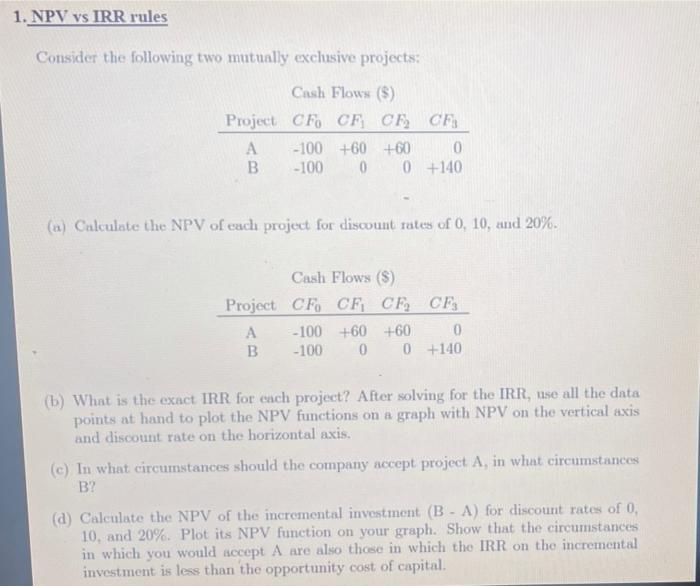
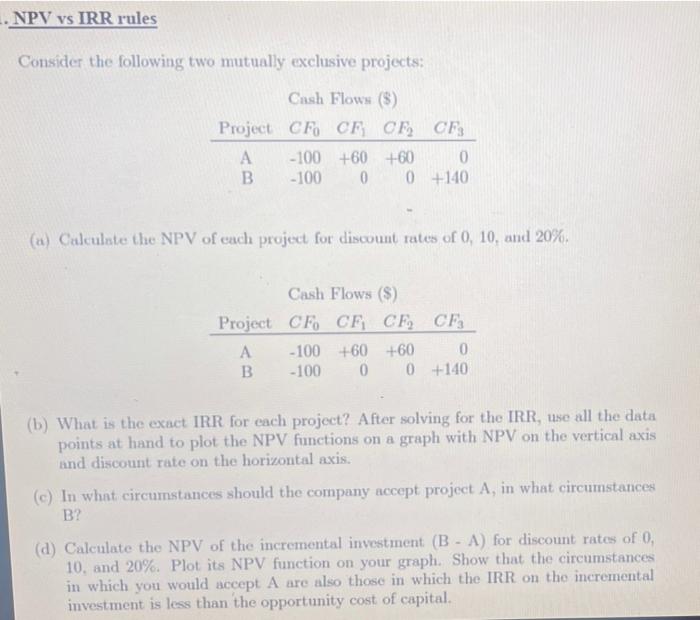
1. NPV vs IRR rules Consider the following two mutually exclusive projects: Cash Flows ($) Project, CFO CF CF, CF -100+60 +60 0 B -100 0 0 +140 (a) Calculate the NPV of each project for discount rates of 0. 10, and 20%. Cash Flows ($) Project CF CF CFCF A ---100 +60 +60 0 B -100 0 0 +140 (b) What is the exact IRR for each project? After solving for the IRR, use all the data points at hand to plot the NPV functions on a graph with NPV on the vertical axis and discount rate on the horizontal axis. (c) In what circunstances should the company accept project A, in what circumstances B? (d) Calculate the NPV of the incremental investment (B - A) for discount rates of 0, 10, and 20%. Plot its NPV function on your graph. Show that the circumstances in which you would accept A are also those in which the IRR on the incremental investment is less than the opportunity cost of capital . NPV vs IRR rules Consider the following two mutually exclusive projects: Cash Flows (8) Project CF CF CF CF A -100 +60 +60 0 B -100 0 0 +140 (a) Calculate the NPV of each project for discount rates of 0, 10, and 20%. Cash Flows (S) Project CF CF CF, CF A -100 +60 +60 0 B -100 0 0 +140 (b) What is the exact IRR for each project? After solving for the IRR, use all the data points at hand to plot the NPV functions on a graph with NPV on the vertical axis and discount rate on the horizontal axis. (c) In what circumstances should the company accept project A, in what circumstances B? (d) Calculate the NPV of the incremental investment (B - A) for discount rates of 0, 10. and 20%. Plot its NPV function on your graph. Show that the circumstances in which you would accept A are also those in which the IRR on the incremental investment is less than the opportunity cost of capital
Step by Step Solution
There are 3 Steps involved in it

Get step-by-step solutions from verified subject matter experts
 Study Help