







Question: a) Consider a little electric dipole (like a polar molecule), with +q located at x=-D, y=0, z=0, and -q located at (+D,0,0). Compute a
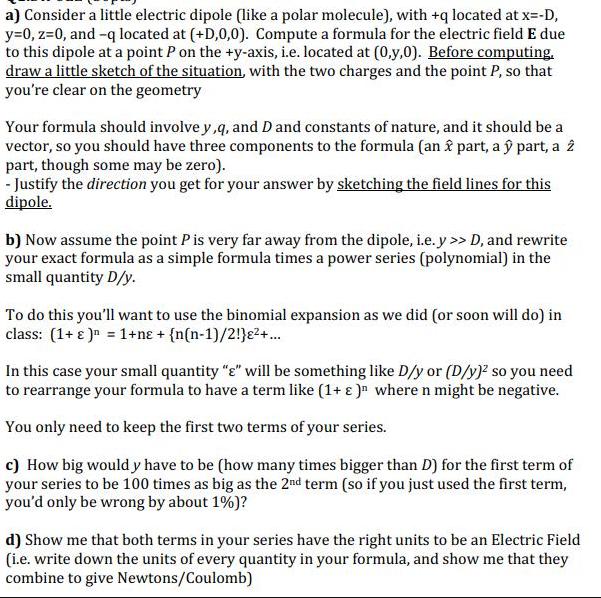
a) Consider a little electric dipole (like a polar molecule), with +q located at x=-D, y=0, z=0, and -q located at (+D,0,0). Compute a formula for the electric field E due to this dipole at a point P on the +y-axis, i.e. located at (0,y,0). Before computing, draw a little sketch of the situation, with the two charges and the point P, so that you're clear on the geometry Your formula should involve y,q, and D and constants of nature, and it should be a vector, so you should have three components to the formula (an & part, a part, a 2 part, though some may be zero). - Justify the direction you get for your answer by sketching the field lines for this dipole. b) Now assume the point P is very far away from the dipole, i.e. y >> D, and rewrite your exact formula as a simple formula times a power series (polynomial) in the small quantity D/y. To do this you'll want to use the binomial expansion as we did (or soon will do) in class: (1+) = 1+ne + {n(n-1)/2!}e+... In this case your small quantity "e" will be something like D/y or (D/y) so you need to rearrange your formula to have a term like (1+) where n might be negative. You only need to keep the first two terms of your series. c) How big would y have to be (how many times bigger than D) for the first term of your series to be 100 times as big as the 2nd term (so if you just used the first term, you'd only be wrong by about 1%)? d) Show me that both terms in your series have the right units to be an Electric Field (i.e. write down the units of every quantity in your formula, and show me that they combine to give Newtons/Coulomb)
Step by Step Solution
There are 3 Steps involved in it
It looks like the images are ... View full answer

Get step-by-step solutions from verified subject matter experts
 Study Help