







Question: NEED DETAILED SOLUTIONS, THX!!! Consider a distribution defined over binary variables: P(a,b,c)P(ab)P(bc)P(c) with P(a=trb=tr)=0.3,P(a=trb=fa)=0.2,P(b=trc=tr)=0.75P(b=trc=fa)=0.1,P(c=tr)=0.4 What is the most likely joint configuration? That is a,b,cargmaxP(a,b,c) ?
NEED DETAILED SOLUTIONS, THX!!!
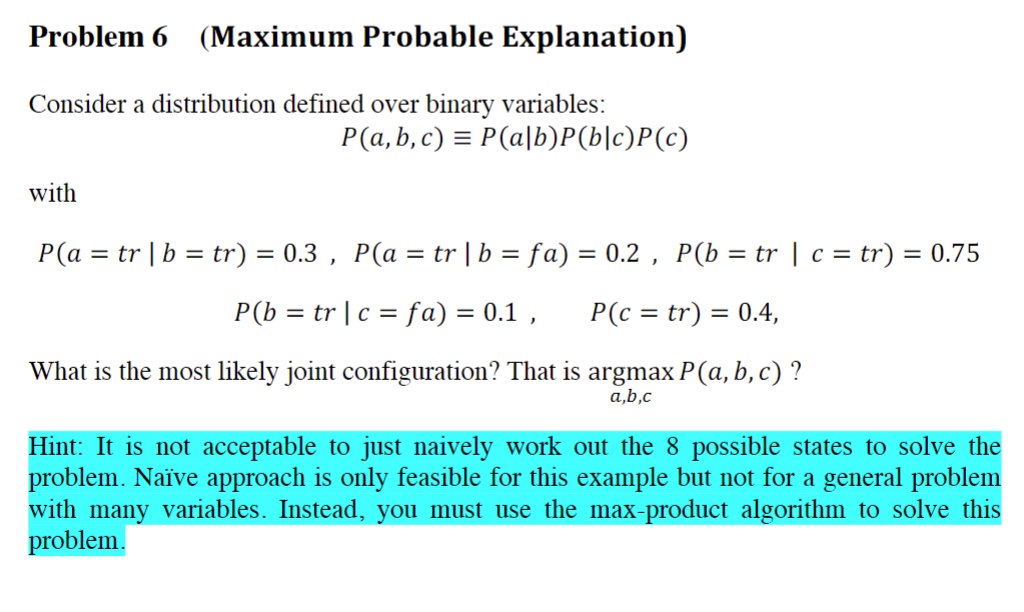
Consider a distribution defined over binary variables: P(a,b,c)P(ab)P(bc)P(c) with P(a=trb=tr)=0.3,P(a=trb=fa)=0.2,P(b=trc=tr)=0.75P(b=trc=fa)=0.1,P(c=tr)=0.4 What is the most likely joint configuration? That is a,b,cargmaxP(a,b,c) ? Hint: It is not acceptable to just naively work out the 8 possible states to solve the problem. Nave approach is only feasible for this example but not for a general problem with many variables. Instead, you must use the max-product algorithm to solve this
Step by Step Solution
There are 3 Steps involved in it
1 Expert Approved Answer
Step: 1 Unlock

Question Has Been Solved by an Expert!
Get step-by-step solutions from verified subject matter experts
Step: 2 Unlock
Step: 3 Unlock
 Study Help